A Working Rooftop Greenhouse for 435 Fairmount in Northern Liberties
A rooftop greenhouse at 435 Fairmount in Northern Liberties, Philadelphia, only matters if it grows food, teaches kids and feeds a cafe. Here is the case.
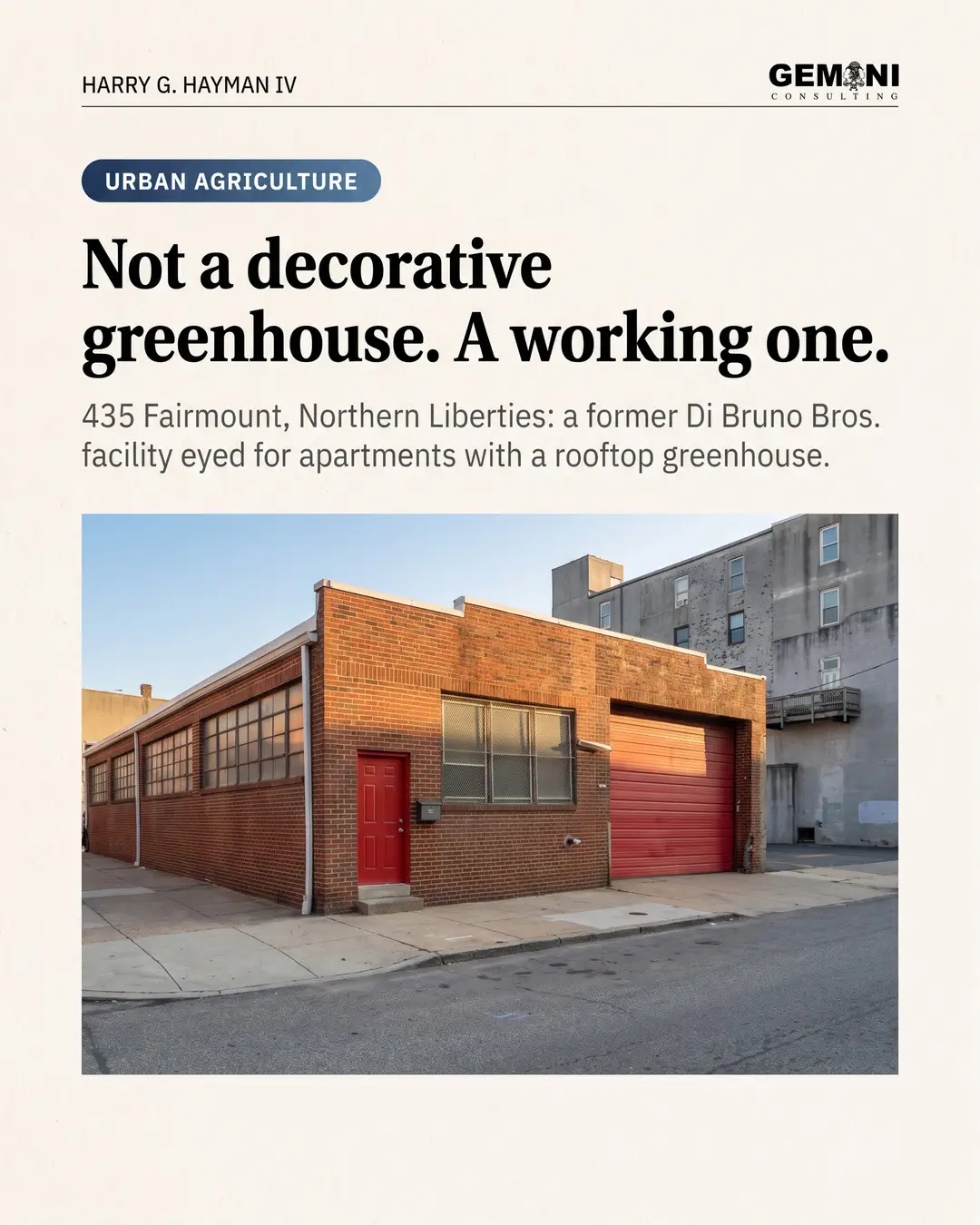
It was good to see some ink on a very cool project. On October 1, the Philadelphia Business Journal ran a headline that said it plainly: Former Di Bruno Bros. facility in NoLibs eyed for apartments with rooftop greenhouse. I’m Harry Hayman, and I am helping to shepherd the urban agriculture piece of that project, so I read the headline once for the news and a second time for everything a headline cannot hold. It can put apartments and a greenhouse in the same breath. It cannot tell you whether that greenhouse will grow a single plant, teach a single child or keep a single cafe supplied. That part is the part I care about, and it is what this post is about. I am keeping to what I can source: the building’s history, the record of rooftop growing, the Philadelphia programs already pointing this way, and what I think it takes to get from idea to execution.
The Building and the Neighborhood
435 Fairmount Avenue, now moving forward as Fairmount Works, has a food history before it has a housing one. Culinary Agents lists a Di Bruno Bros. Commissary at 435 Fairmount Avenue under event catering and corporate catering, as part of Di Bruno Bros. Di Bruno Bros. says it has been open since 1939, that two brothers from Italy, Danny and Joe Di Bruno, started it, that its original storefront was in the Italian Market, and that it is now a fourth generation family business. The Business Journal’s headline calls the Fairmount site a former Di Bruno Bros. facility, and I am taking it at its word.
NoLibs is Northern Liberties, the neighborhood just north of Old City along the Delaware River. Wikipedia gives its current borders as Girard Avenue to the north, Callowhill Street to the south, North 6th Street to the west and the river to the east. It was a manufacturing district long before it was a place people moved to for the restaurants. Mills, breweries, tanneries, paint and chemical works and foundries lined it, and the Christian Schmidt Brewing Company operated there from 1860 to 1987. I like that history for this project. This is a neighborhood built by people who made things, and a building where food was prepared for the public is now being talked about as a place that could grow food on its own roof.
Not a Decorative Greenhouse
Here is the sentence I keep saying out loud. Not a decorative greenhouse. A working one. One that could actually grow food, teach kids, engage residents, support programming, connect to the cafe and create opportunity. Every item on that list is a job. A greenhouse that does only the first will not manage the rest by accident, and a greenhouse that does none of them is just a nice view for people who already have one.
The growing itself is well documented. The USDA’s Economic Research Service counted 1,476 controlled environment agriculture operations in the United States in 2009 and 2,994 in 2019, with production up 56 percent to 7.86 million hundredweight. Hydroponic systems were the most common method, and tomatoes, lettuce and cucumbers made up roughly 60 to 70 percent of the crops. A 2023 meta analysis in the journal Plants pulled together 121 papers on lettuce and found that controlled environment systems averaged 3.68 kilograms per square meter against 1.88 for field agriculture. That is one crop and one study, and I will not oversell it. When I say controlled environment agriculture, I mean growing food in a structure where the conditions are managed instead of left to the weather. Dr. Mandy Manna told WHYY that the whole atmosphere is controlled: ventilation, humidity and temperature.
Putting a greenhouse on top of housing is not new either. Gotham Greens, in its own company timeline, lists a 2011 rooftop greenhouse in Greenpoint, Brooklyn, and calls it the first commercial scale rooftop greenhouse facility in the United States. In the Bronx, 6sqft reported in July 2022 that Project Renewal had just opened Bedford Green House at 2865 Creston Avenue, 117 apartments under a 1,500 square foot rooftop greenhouse with an aquaponic system that raises fish, herbs, vegetables and microgreens together. The same report says Project Renewal provides horticultural therapy that uses produce grown in that greenhouse. Agritecture described the plan back in December 2017, including cooking classes taught by chefs from Project Renewal’s Culinary Arts Training Program. A roof that grows food, a person who teaches residents to use it, and a kitchen at the end of the chain: that is the shape I am talking about.
What a Working Greenhouse Has to Do
Teaching kids is the part that moves me most, and Philadelphia already has a live example. In July 2024, the state announced a $250,000 grant to the School District of Philadelphia for a controlled environment agriculture pre apprenticeship program at Fox Chase Farm, the 112 acre working farm the district runs in Northeast Philadelphia. It is built to give 24 students a year a look at the technology of indoor farming, with the option to move into one of the district’s registered apprenticeship programs, and the food it produces is meant to help fight food insecurity among students. WHYY reported that indoor growing areas would be built at Mastbaum High School in Kensington and Overbrook High School in West Philadelphia, that one goal is enough produce to stock school salad bars, and that the longer plan is to grow at scale and sell to restaurants so the program can sustain itself. I wrote about Fox Chase Farm last October because that is what a working greenhouse looks like when the students are the point.
The city has its own frame for this. On April 25, 2023, Philadelphia released its first ever urban agriculture plan, Growing from the Root, a ten year roadmap built with input from 650 residents and experts. The city counted about 450 active agricultural spaces covering nearly 130 acres, and the plan’s six goals include growing space in every neighborhood and integrating urban agriculture into City policy. I read that as Philadelphia saying urban agriculture belongs inside how the city plans, not off to the side of it. A rooftop greenhouse in a new apartment building would be one more place where that happens, and it would put growing in front of residents who may never walk into a community garden.
Residents, programming and the cafe are the pieces that make the roof a part of daily life. Residents would be the ones who see the plants every day, and a greenhouse they can learn in is a different thing from one they can only look at. Programming gives the space a calendar. The cafe, connected to what could be grown upstairs, would be where the roof meets the street and where a greenhouse starts acting like a food business with a customer. Those are the pieces that decide whether the greenhouse works, and none of them shows up in a rendering.
Vision Is the Easy Part
Jeff and Tiffany have the vision. I say that with respect, and I say the next part with experience: without implementation and execution, I have seen a lot of vision fall flat on its face. Greenhouses are not immune, and the timelines are longer than the headlines suggest. Bedford Green House was described as a future project in December 2017 and reported open in July 2022, more than four and a half years later. That is simply what building takes, and it is why I never confuse an announcement with an opening.
Food is a place where that gap has opened wide, and recently. Ideastream reported on August 3 that 80 Acres Farms, a vertical farming company founded in 2015, was shutting down after supplying more than 18,000 retail locations across the country. Its CEO, Mike Zelkind, said the company could not secure the capital required to continue, and the article also points to high infrastructure and energy costs and thin margins in agriculture. The plants were not the problem. I wrote about that closure in September as a financing question rather than a farming question, and the lesson carries straight to a rooftop in Northern Liberties. A greenhouse needs an operating plan, trained people and a way to pay for itself before the first seedling goes in.
That is why I keep saying these projects only work when the right people are at the table. This one needs someone who knows how to grow, someone who knows how to teach, someone who knows how to run a kitchen and someone who can make the numbers hold. No developer should be asked to carry that list alone.
My Part in This
Through my work with GEMINI Strategic Consultants and The Gray Bradley Hayman Foundation, and with my friends Amy and George and their companies, I am helping to move the urban agriculture piece from idea to execution. I just love saying that. I am incredibly proud to play even a part in helping shepherd 435 Fairmount toward something much bigger than another mixed use development.
I also want to be straight about where things stand. The Business Journal’s word is eyed, which means this is a proposal and not yet a building. I am not going to quote unit counts, heights, costs or schedules that I cannot source, and I will say more plainly as there is more to report.
If we get this right, and I mean when we get this right, 435 Fairmount will not just be a building with a greenhouse. It can become a model for how real estate, food systems, education, health, hospitality and community development can actually work together. That is the future, and I am proud to have a hand in it.
Sources and references
- Philadelphia Business Journal: Former Di Bruno Bros. facility in NoLibs eyed for apartments with rooftop greenhouse
- Culinary Agents: Di Bruno Bros. Commissary, 435 Fairmount Avenue
- Di Bruno Bros.: About us
- Wikipedia: Northern Liberties, Philadelphia
- USDA Economic Research Service: Growth in greenhouses, controlled environment agriculture production and operations on the rise
- Plants (2023): A meta analysis of influencing factors on lettuce crop yields in controlled environment agriculture systems
- WHYY: Fox Chase Farm program aims to grow student entrepreneurs in agriculture
- Gotham Greens: Our story
- 6sqft: New affordable housing building in the Bronx has a rooftop greenhouse and aquaponic farm
- Agritecture: New affordable Bronx development will feature a rooftop aquaponics greenhouse
- Pennsylvania Department of Labor and Industry: Agricultural pre apprenticeship program with the School District of Philadelphia
- Harry Hayman: Growing Futures, Fox Chase Farm and Dr. Mandy Manna
- City of Philadelphia: Philadelphia’s first ever urban agriculture plan
- Ideastream Public Media: Tri State vertical farming pioneer to shut down
- Harry Hayman: 18,000 stores and still no capital, what 80 Acres Farms reveals about farm financing