Why I Support the ACLU: Democracy Is Not a Spectator Sport
I am a member and monthly supporter of the ACLU. From Philadelphia, here is why I believe in defending the principle, even when the person is unpopular.
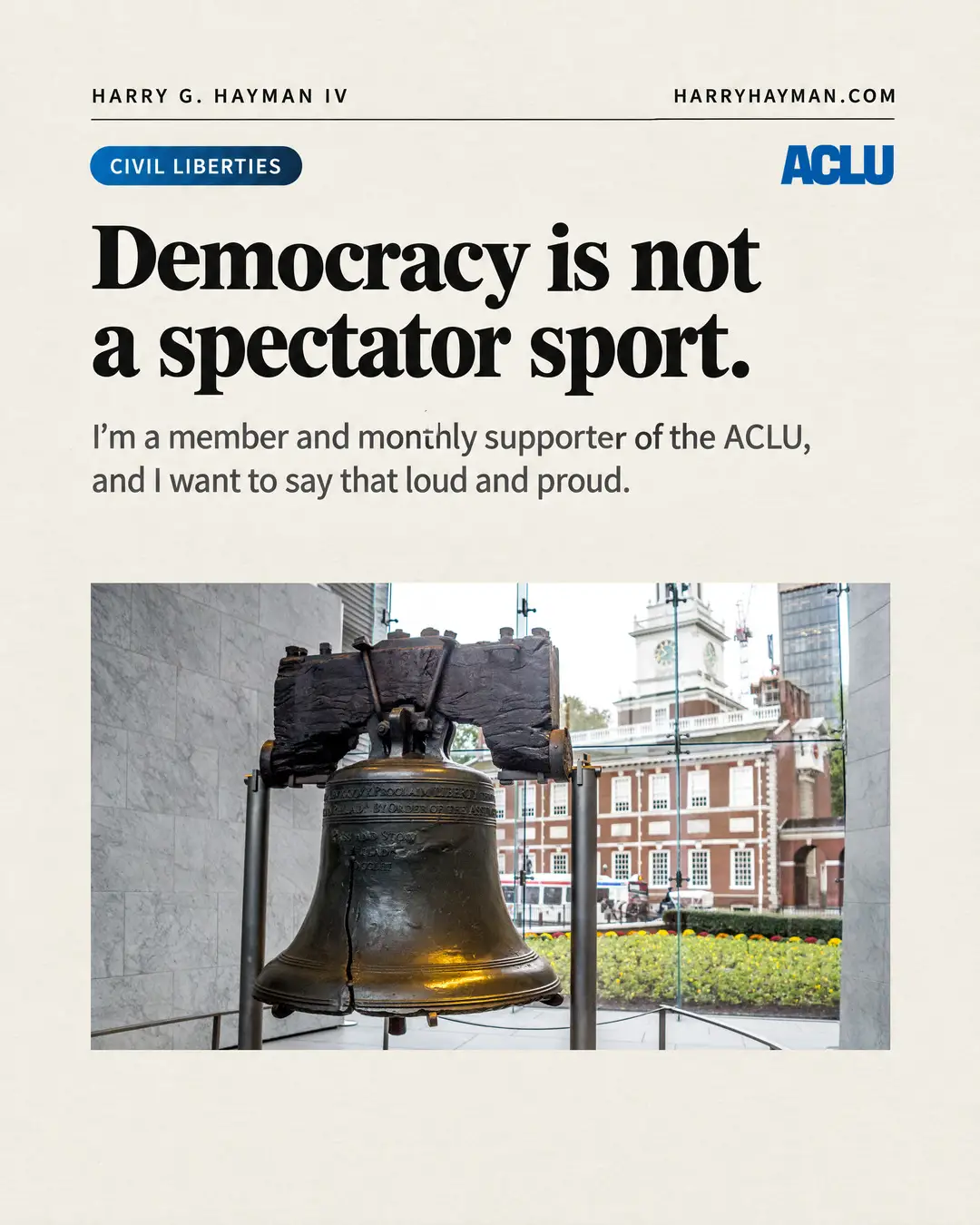
When the Constitutional Convention assembled in Philadelphia in May of 1787, the delegates shuttered the windows of the State House and swore secrecy so they could speak freely. That building was built to be the Pennsylvania State House, and we call it Independence Hall now. On September 17, 1787, 38 delegates signed the Constitution there. Three delegates who were present on the final day refused, at least one of them because it lacked a bill of rights. Putting your name on something is a public act, and so is keeping it off. I’m Harry Hayman, and I’m a member and monthly supporter of the American Civil Liberties Union. I want to say that loud and proud. This is the longer version of my post: what the ACLU is, the principle I admire most in its work, and why I think none of it can be taken for granted.
Why I’m Putting My Name Behind It
Frankly, I can’t think of a time when organizations like this have been more important. I said that in my post, and I want to be careful about what it means. This is a statement about principles, not about any person in public life. I’m speaking only for myself here, as a private citizen and a Philadelphian, and not for any employer or organization I work with.
So why say it in public at all? Because quiet support and signed support are two different things. I’m proud to support the ACLU financially, and I’m happy to put my name behind that support. A name costs nothing to give, and most of us guard it anyway, which is why it means something when we put it down.
I’ve also become increasingly interested in how our institutions function, how government makes decisions, and how ordinary citizens can participate more meaningfully in the process. A lot of my working life has been spent in restaurants, in food systems and in the local economy around them, and that work keeps pulling me toward the same questions. Who sets the rules? And who gets to push back when the rules go wrong?
What the ACLU Is, and Where It Came From
The American Civil Liberties Union is a nonprofit and nonpartisan organization. By its own account, it litigates across the nation and all the way to the U.S. Supreme Court, lobbies Congress through a legislative office in Washington, and uses communications to educate the public, with a network of staffed, autonomous affiliate offices in all 50 states. The ACLU’s state affiliates page counts 54 local offices across the country, working with attorneys and activists in their own communities. When I say the ACLU takes these fights into courtrooms, legislatures and communities, that is what I mean.
It has been around since 1920. The ACLU of Southern California’s account of the founding says a small group came together that year, led by Roger Baldwin, a social worker and labor activist, with Crystal Eastman, Albert DeSilver, Jane Addams and Helen Keller among them. They formed the ACLU and, in that page’s words, “dedicated themselves to holding the government to the Bill of Rights’ promises.” The national ACLU’s free speech page says it has worked since 1920 to ensure that freedom of speech is protected for everyone.
If you’re not familiar with everything they do, I encourage you to take a look. Free speech, voting rights, reproductive freedom, immigrants’ rights, LGBTQ+ equality, criminal justice reform, privacy, disability rights, racial justice, religious liberty, and a whole lot more. The ACLU keeps a page for each, from voting rights to privacy and technology to religious liberty. That’s a pretty substantial list, and every single one of those issues matters.
The same history page names one of the earliest battles, the Scopes Trial of 1925. Tennessee had passed a law banning the teaching of evolution, and the ACLU recruited a biology teacher, John T. Scopes, to challenge it by teaching the banned subject in his class. When Scopes was prosecuted, the ACLU partnered with the attorney Clarence Darrow to defend him. Scopes was found guilty, and the verdict was later overturned because of a sentencing error. A teacher, a classroom, a law, and an organization willing to test it in open court. Strip away the famous names and that is still the basic shape of the work.
Closer to home, the ACLU of Pennsylvania describes itself as a nonprofit, nonpartisan, membership organization working to protect civil liberties and advance equity for all. It says it defends the principles protected by two constitutions, the federal one and the Commonwealth of Pennsylvania’s, and that its staff and volunteers combine litigation, legislative and policy advocacy, organizing and communications. Its contact page lists an eastern region office with a Philadelphia address and a western region office in Pittsburgh.
Defending the Principle When the Person Is Unpopular
Here’s what I particularly appreciate about the ACLU. They defend the principle, even when defending the person is unpopular.
Think about that for a minute. It’s easy to believe in free speech when you agree with what’s being said, and easy to support someone’s rights when you like the person exercising them. But what about when somebody’s opinions make you uncomfortable, or when they’re standing on the opposite side of an issue you care deeply about? Well, that’s when those principles really get tested, isn’t it?
The hardest test I know of happened in Illinois. In 1977 and 1978, the ACLU defended a small Nazi group that wanted to rally in Skokie, a Chicago suburb where many Holocaust survivors lived. Norman Dorsen, who became the ACLU’s president in late 1976, wrote in a piece published by Harvard Law School that the residents of Skokie fought fiercely, in the courts and the media, to stop the rally. I understand why they did.
A Cook County court entered an injunction against the group on April 29, 1977. On June 14 of that year, the Supreme Court ruled that a state imposing a restraint of that kind “must provide strict procedural safeguards,” including immediate appellate review. The ACLU went on to persuade a federal court to strike down three ordinances that placed significant restrictions on the group’s right to march and express its views. Dorsen wrote that the ACLU’s arguments prevailed, and that the group, though free to march in Skokie, chose to hold a rally in Chicago instead.
It cost them. “Thousands of members resigned in protest,” Dorsen wrote, and the ACLU’s own history says the notoriety of the case cost it dearly as members left in droves. It took the loss and kept the principle.
The free speech page puts the reasoning plainly: “the defense of freedom of speech is most necessary when the message is one most people find repulsive.” And then: “Constitutional rights must apply to even the most unpopular groups if they’re going to be preserved for everyone.” Nobody has to like the speaker to see the point. A rule that protects only the speech I enjoy isn’t much of a rule, and the same power that silences someone I can’t stand could one day be turned on a neighbor I love.
Democracy Erodes Around the Edges
They challenge government overreach, advocate for constitutional protections and hold institutions accountable. And good Lord, do we need accountability.
The restaurant business taught me a version of this. A dining room rarely empties in one night. It goes a table at a time: a standard slips, a complaint goes unanswered, a regular stops coming and nobody asks why. Democracy doesn’t necessarily fall apart overnight either. Sometimes it’s a series of seemingly small things that people overlook, excuse, or simply get too busy to pay attention to. A little less transparency here. A little more government overreach there. A protection weakened. A right challenged. Before you know it, you’ve got a much bigger problem on your hands.
Philadelphia is a good place to remember that none of this arrived finished. The Declaration of Independence and the Constitution were both debated and signed inside Independence Hall, and the Constitution that left that room in September 1787 had no bill of rights. The First Congress took up amendments in New York, at Federal Hall, where the National Archives says the Bill of Rights was introduced. The House passed 17 amendments, the Senate changed that to 12, and by December 15, 1791, three fourths of the states had ratified 10 of them, the ones we now call the Bill of Rights. By then the government had moved here. Congress met at Congress Hall from 1790 to 1800, while Philadelphia served as the temporary capital.
So the rights we treat as permanent were argued over, voted on and ratified, one step at a time, by people who showed up. The more I learn, the more convinced I become that we can’t afford to take any of this for granted. Rights do not defend themselves.
You Don’t Have to Agree With Every Position
And here’s another thing. You don’t have to agree with every position an organization takes to recognize the importance of its mission. I certainly don’t expect everyone to agree with me about everything, and I wouldn’t want them to. That’s kind of the point.
So read about the work and make up your own mind. That’s your right, too. The ACLU’s issue pages are a good start, and so are the ACLU of Pennsylvania’s issues page and its Know Your Rights material. If you’d like to hear the arguments from more than one direction, the National Constitution Center at 525 Arch Street says it brings together people of all ages and perspectives to learn about and debate the Constitution. Its First Amendment page sets the text beside interpretations and debate, with two scholars on each clause; the entry on free speech and the press pairs Geoffrey R. Stone with Eugene Volokh. Read both. Then decide.
And if you believe in what they’re doing, consider getting involved or becoming a supporter. The ACLU of Pennsylvania has a volunteer page and an events page, and either one will teach you more than any post of mine.
Democracy Is Not a Spectator Sport
I say this all the time, but I mean it: we need more people participating, paying attention, asking questions, and getting involved in the institutions and organizations that shape our lives. Institutions matter. Participation matters. Showing up matters.
The delegates in 1787 needed closed shutters to speak freely. Two hundred and thirty nine years later, I get to say what I think with the windows wide open, under my own name, to anyone who cares to read it. I don’t take that for granted either.
Democracy is not a spectator sport, folks. Proud to be a member. Proud to be a supporter. Acta non verba. Actions, not words.
Sources and references
- National Archives: The Constitution, How Did It Happen?
- National Archives: The Bill of Rights, How Did It Happen?
- National Park Service: Independence Hall
- National Park Service: Congress Hall
- ACLU: ACLU History
- ACLU: State Affiliates
- ACLU of Southern California: National Founding
- ACLU: Free Speech
- ACLU: Voting Rights
- ACLU: Privacy and Technology
- ACLU: Religious Liberty
- ACLU of Pennsylvania: About Us
- ACLU of Pennsylvania: Contact Us
- ACLU of Pennsylvania: Issues
- ACLU of Pennsylvania: Know Your Rights
- ACLU of Pennsylvania: Volunteer
- ACLU of Pennsylvania: Events
- Harvard Law School: Two Hard Times, by Norman Dorsen (July 2017)
- Legal Information Institute: Supreme Court order in the Skokie case (June 14, 1977)
- National Constitution Center: About Us
- National Constitution Center: The First Amendment
- Phil Roeder: The Liberty Bell, 2016, Wikimedia Commons, CC BY 2.0
