What If Waste Could Grow Our Food? In Pennsylvania, It Already Does
Pennsylvania grows more than seven of every ten mushrooms sold in America on compost made from farm leftovers, and Philadelphia can learn from it.
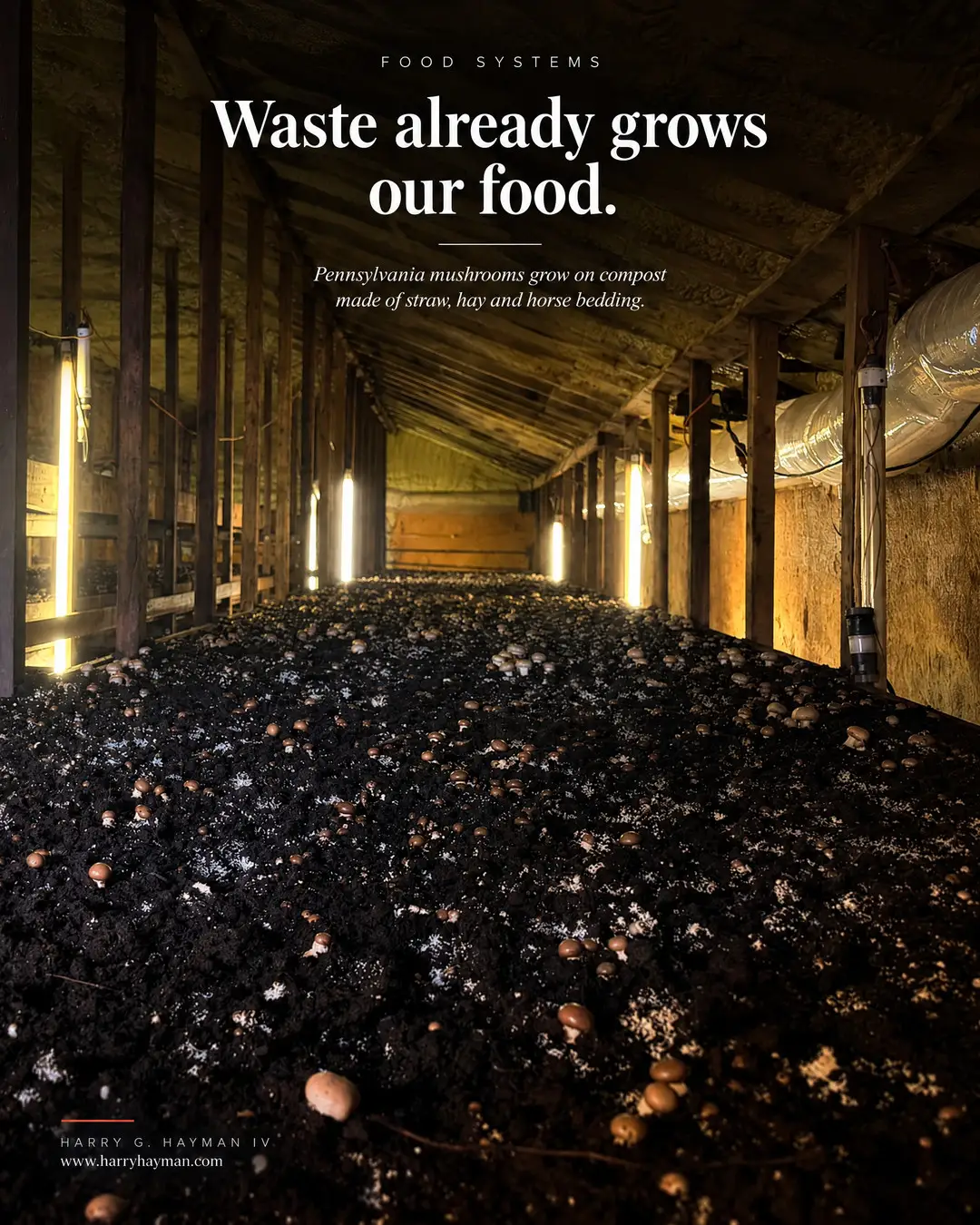
A LinkedIn post from Waste Innovation Stories, a page with more than 93,000 followers, asked a question on October 16 that I have not stopped turning over: “What If Waste Could Grow Our Food?” Its example was growing mushrooms in recycled egg cartons instead of plastic, and more than 700 people reacted. I am Harry Hayman, I think about where Philadelphia’s food comes from, and my answer to that question is that waste already grows a great deal of our food. The biggest working example I know of is not overseas. It is in Pennsylvania, in the mushroom country around Kennett Square, inside our own Philadelphia metropolitan area.
Where Waste Already Grows Food
The idea in that post has real roots, and each one has a name on it.
The first is cardboard. Elin Jonsson’s 2019 bachelor’s thesis at the Swedish University of Agricultural Sciences concluded that “cultivation of oyster mushroom with cardboard as a substrate is fully possible.” It also carries a warning I like: more study is needed to be sure mushrooms grown on cardboard are suitable to eat, because the fungus may absorb harmful substances from the carton. The thesis is about cardboard, not egg cartons. A pulp egg carton is paper, so the leap is short, but plausible is not proven.
The second is coffee. RotterZwam says that since 2013 its mission has been to bend the food system until it is circular and that, in my translation from the Dutch, “in the middle of Rotterdam we grow mushrooms on urban residual streams.” The stream it names is coffee grounds, rescued from waste incineration. When I looked, its counter read 419,840 kilograms of coffee grounds saved and 26,693 kilograms of oyster mushrooms grown. Those are the farm’s own numbers, and they move, but it has a name, a city and a counter.
The third is the vertical part. In 2018 HortiDaily profiled Berjelle van Namen, whose father Johan grows mushrooms in Hoenzadriel, a village in Gelderland. At the end of 2017 Berjelle turned one of the mushroom cells into a vertical farm for herbs and micro vegetables. The article quotes him: “The mushroom growth could be seen as an early precursor of what is now vertical farming.” The racks built for mushrooms, he added, turned out to suit growing in layers.
Cardboard in Sweden, coffee in Rotterdam, racks in Gelderland. Put them together and the question in that post stops sounding like the future. And the largest answer of all is much closer to home.
The Crop With an Address
The part that was not in the post is in a federal report. On August 19, 2026, the USDA’s National Agricultural Statistics Service released its Mushrooms report, and the Agaricus numbers are plain. Agaricus is the category that includes white button, cremini and portabella mushrooms. The 2025 to 2026 season sold 620 million pounds, down 5 percent, worth $847 million, down 15 percent. And Pennsylvania accounted for 74 percent of the total volume of sales, which the report’s state table puts at roughly 460 million pounds. The same report counts 636 million pounds of mushrooms of every kind sold in the country that season, so Pennsylvania’s Agaricus alone comes to more than seven of every ten mushrooms Americans bought.
Notice the unit, because it is easy to round it wrong. The 74 percent is a share of the Agaricus crop, not of every kind of mushroom USDA tracks. Oyster mushrooms, the kind in the Swedish thesis and in Rotterdam, are filed under specialty mushrooms, and the whole specialty category was worth $75.0 million that season. The fashionable mushroom is the small crop. The everyday one is the big crop, and Pennsylvania grows most of it.
The gap between those two declines, 5 percent in volume and 15 percent in value, is price. Growers received an average of $1.37 a pound at the point of first sale, down from $1.53. A circle still has to pay its way.
And the farms are not scattered. Penn State Extension says southeastern Pennsylvania has the largest concentration of mushroom farms, which employ nearly 9,300 people with $313 million in compensation. Its horticulture educator Maria Gorgo-Simcox puts the farming community’s contribution to the local economy at an estimated $1.2 billion a year. A post asking the question has more than 700 reactions. A farming region that has been answering it for more than a century has a table in a PDF.
What Goes In and What Comes Out
The post’s own third point says mushroom farming can turn suitable organic leftovers into food while spent growing material “may find further uses.” That is a fair description of what Pennsylvania already does, and Penn State Extension has written the recipe down. Its guide to spent mushroom substrate says the compost commonly starts with wheat straw bedding containing horse manure, hay, corn cobs, cottonseed hulls, poultry manure, brewer’s grain, cottonseed meal, cocoa bean hulls and gypsum. Read that slowly: stable bedding the horses have already used, corn cobs, the grain a brewery is finished with, the hulls of cocoa beans. Most of the list is somebody else’s leftovers, and none of it is a hashtag. Kitchens taught me this move early. The trimmings go in the stockpot, the stock becomes the sauce, and nothing that can still be used goes out the back door.
It is not a perfect circle, and I would rather say so. On top of the compost, farmers lay a casing layer of peat moss and ground limestone. When the crop is finished, the grower pasteurizes the leftover compost with steam before it leaves the mushroom house. That material is called spent mushroom substrate, and it goes back to work. Penn State says it adds organic matter and structure to soil, works as a mulch once it has weathered, and is excellent to spread on newly seeded lawns, where it covers the seed against birds and holds water while the grass germinates. It is also “the choice ingredient” for the companies that make the potting mixes sold in supermarkets and garden centers.
What goes in comes mostly from other businesses. What goes out is wanted by lawns, gardens and potting mix makers. That is a circle held together by ordinary uses at both ends. It is not clever, and I suspect that is why the industry has lasted.
A Florist’s Bench in 1885
I love how Kennett Township’s own history reads: less like a plan than like a series of neighbors noticing things. Around 1885 William Swayne, a prosperous florist in Kennett Square, pioneered the idea of growing mushrooms beneath his greenhouse benches. He imported spawn from England, and the first results were promising enough that he put up a building just for mushrooms, the area’s first mushroom house. His son, J. Bancroft Swayne, came back from college, took over and turned it into a thriving commercial business with a spawn plant and a cannery. Others followed, “enticed by the lucrative prices of mushrooms in urban markets.” The township does not say which cities. I would love to know whether ours was one of them.
Today, Penn State says, many of Pennsylvania’s mushroom farms are owned and operated by local families, in many cases passed down to the third, fourth or even fifth generation. And Wikipedia describes Kennett Square, a borough in Chester County, as part of the Philadelphia metropolitan area and sometimes called the “Mushroom Capital of the World.”
What Philadelphia Can Borrow
The circular mushroom farm I can point to is a whole farming region, and its best known town, Kennett Square, belongs to our own metropolitan area. That makes me wonder how many of us have been sharing the future from a distance while the working version stayed put.
A mushroom house is also an indoor farm with a managed climate. Berjelle van Namen says in the same HortiDaily profile that, besides the water and light settings he worked out for his herbs, he still relies on the climate control that held the temperature when the cell grew mushrooms.
A city is not a farming region, and Philadelphia does not need to copy one. What it can have is food grown inside the city, all year, alongside the farms outside it. That is the idea behind Concrete Greens, the controlled environment urban farming project I work on. It is year round city farming, built to break even on revenue and to send its surplus to the Philadelphia neighborhoods that need it most. Concrete Greens complements the farms outside the city and does not replace them. It is not a startup and it is not a charity.
A florist put mushrooms under his benches around 1885 and an industry grew from it. If a bench can do that, what could a city that grows food all year start?
The poster is built on a USDA photograph from a Pennsylvania visit by Natural Resources Conservation Service leaders, uploaded to Flickr on October 5, 2026 and marked public domain. USDA’s caption says the visits included a mushroom farm and does not name it, so I will not either.
Sources and references
- Waste Innovation Stories on LinkedIn: What If Waste Could Grow Our Food?
- Swedish University of Agricultural Sciences: Elin Jonsson, 2019 thesis on growing oyster mushrooms on cardboard
- RotterZwam: Rotterdam mushroom farm
- HortiDaily: Mushroom growth as an early precursor of what is now vertical farming, 2018
- USDA National Agricultural Statistics Service: Mushrooms, released August 19, 2026
- Penn State Extension: Pennsylvania mushroom farmers lead U.S. in mushroom production
- Penn State Extension: Spent mushroom substrate
- Kennett Township: History of Kennett Township
- Wikipedia: Kennett Square, Pennsylvania
- USDA on Flickr: NRCS leaders on the Conservation Trail in Pennsylvania
About the Author
Harry Hayman is a Philadelphia-based entrepreneur, music producer, and cultural advocate. Through his work with the Feed Philly Coalition, he explores and documents the creative, culinary, and civic life of a city he believes is one of the most inspired places in America.