Life After Justice and Why Exoneration Is Not the Finish Line
Harry Hayman on hearing Life After Justice share its first survey of the wrongfully convicted, and why freedom without support is unfinished justice.
Imagine being accused of a crime you did not commit. Imagine being convicted. Imagine spending years, sometimes decades, in a cell while your children grow up without you and your parents grow old. Birthdays, graduations, weddings, funerals and ordinary Tuesday afternoons disappear. Then imagine finally proving your innocence, walking out, and discovering that freedom does not mean the suffering is over. I’m Harry Hayman, and on Friday, October 16, I sat through a ninety minute conversation that left me in tears and, honestly, furious. This is my attempt to write down why, and to check every fact I can before I ask you to share it.
What I Listened To
The conversation was part of Just Data, the Innocence Project’s recurring virtual gathering dedicated to advancing social science research on wrongful conviction. The Innocence Project describes the series as a way to connect stakeholders and promote practical research, and says plainly that it depends on social science experts to keep exploring the causes and consequences of wrongful conviction. The session I joined was titled “For Us, by Us: Wrongfully Convicted Researchers Leading the Future of Reform.” It ran from noon to 1:30 pm Eastern on Zoom.
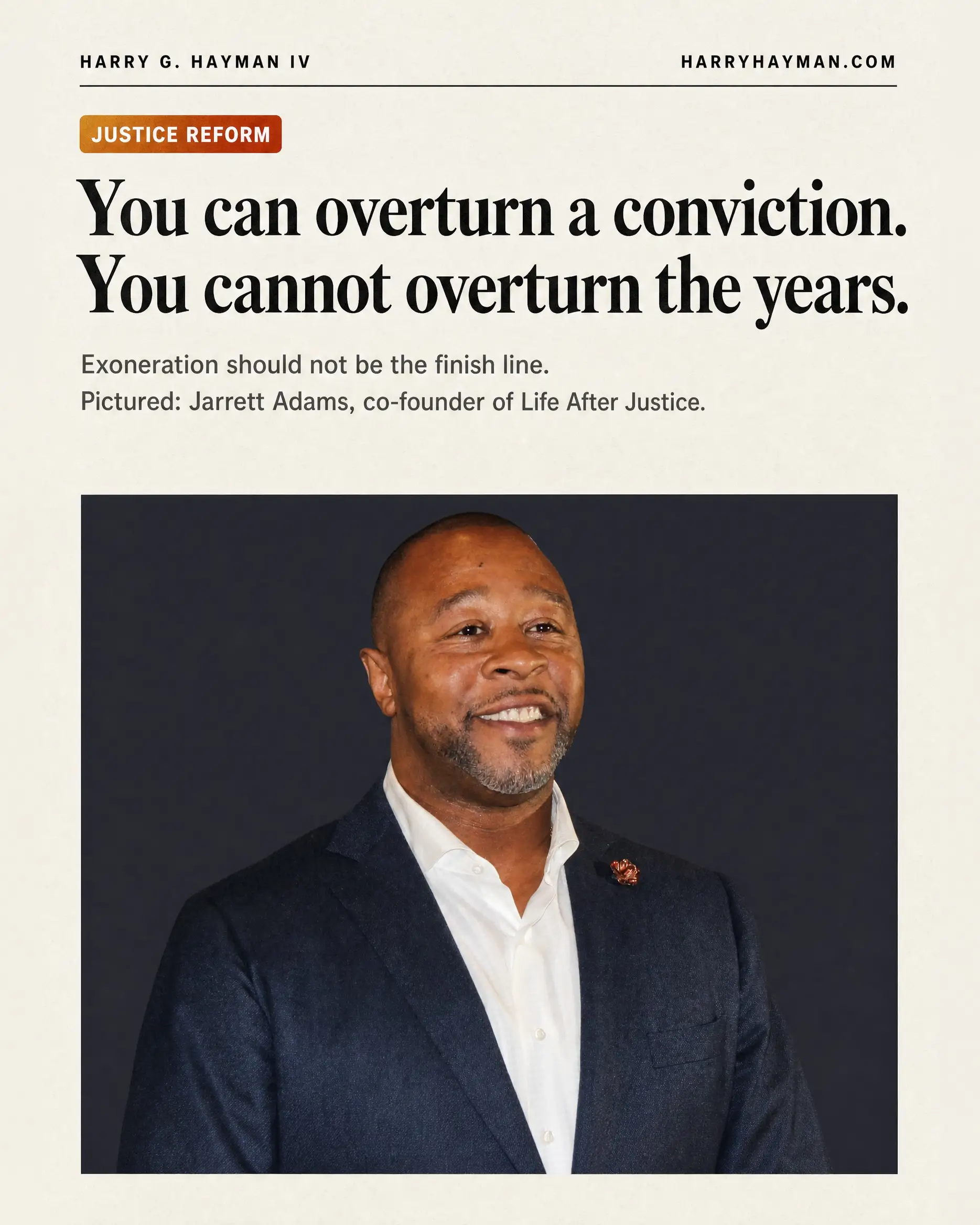
The invitation described a first for Life After Justice, an organization led by exonerees: a survey asking wrongfully convicted people and their loved ones to define their own lived experiences. Jarrett Adams, a cofounder, walked through the preliminary results. Rodney Roberts talked about his own wrongful conviction and about what it was like to take part in the research. I could not find a public event page for this particular session, so what follows about the webinar comes from the invitation and from what I heard. Everything else I link to.
Who Is Doing This Work
I want to be careful here, because the people matter as much as the numbers. Life After Justice describes itself as a Chicago nonprofit whose mission is to secure freedom, support healing and prevent future harm for people affected by wrongful incarceration. According to its own story page, it was founded by two exonerees, Jarrett Adams and Antione Day, who met in 2017 through Loyola University Chicago’s Life After Innocence program. The organization was formally established in 2020 and began as a volunteer effort.
Penguin Random House’s biography of Jarrett Adams says he was seventeen when the case against him began and that he served nearly ten years. He studied how his constitutional right to effective counsel had been violated, and the Wisconsin Innocence Project won his release. He earned his law degree from Loyola University Chicago School of Law in May 2015, clerked in federal court in New York, and went on to work as a lawyer with the Innocence Project in New York. His own firm, the Law Office of Jarrett Adams, opened in 2017 and practices in federal and state courts. His memoir, Redeeming Justice, tells the story at book length.
WBEZ’s profile of Adams adds details that stayed with me. He was convicted in 2000 and sentenced to 28 years, and he was cleared about seven years later because his appointed lawyer had never investigated or secured witnesses who could have cleared him. Wisconsin has an exoneree compensation law that offers up to $25,000. Adams received nothing, and he told the station that few people realize he is still paying on debts from his incarceration.
Rodney Roberts is a Newark native, and the Innocence Project’s profile of him says he was exonerated through DNA evidence in 2014, after representing himself with help from counsel and the Innocence Project. The Innocence Project’s own video page explains that he was arrested in 1996, that his court appointed attorney advised him to plead guilty or risk a life sentence, and that he took a seven year deal while insisting police had the wrong man. In 2022 he became the Innocence Project’s first reentry coach. The sources do not agree on exactly how long he spent in custody, so I am not going to put a number on it.
The Numbers I Heard
Then came the preliminary findings. I am repeating them as I heard them in the webinar, and as figures Jarrett Adams presented as preliminary, because I could not find them published anywhere yet. Forty five percent of respondents had less than one month’s savings. Twenty six percent carried more than $25,000 in debt. Nineteen percent had no bank account.
Those are a snapshot of a survey that is still being finished, not a final report, and I would treat them that way. Life After Justice’s Amplification Campaign page describes the survey as a first of its kind, designed by and for people directly affected by wrongful incarceration and their loved ones, and grounded in participatory action research led by a committee of people who were themselves wrongfully incarcerated. The page publishes no results, only a goal of reaching a sample large enough to produce findings within a 10 percent margin of error. It is also explicit that the survey is not for organizations or advocates.
Then there was the part no spreadsheet captures. One respondent described having no relationship with three of his four children. That is not a failure of his, or of his children. It is the wreckage of a situation that was created unnecessarily, and I keep asking how in God’s name you put a dollar amount on it.
What Exonerees Are Actually Given
You might assume the law already covers this. Mostly it does not. In 2017 the Innocence Project reported that 32 states, the District of Columbia and the federal government had some form of compensation law, and that 18 states had none. The laws are far from equal. Texas offered $80,000 per year of incarceration, while Wisconsin offered $5,000 per year, capped at $25,000. The same article describes exonerees in states with no statute as living in a no man’s land, with no money and none of the services a parolee would receive. Eddie Lowery, quoted there, put it this way: when a person is wrongfully convicted, they are stripped of everything.
Here at home, Pennsylvania has been one of the states without a statute. The Innocence Project wrote in 2016 about Lewis Fogle, freed after 34 years, who received no state money or help. He said there are halfway houses for people who committed a crime but nothing for people who did not. WHYY reported the same year that Pennsylvania was among the minority of states that do not compensate the wrongfully imprisoned, and in 2020 NBC10 Philadelphia found that Pennsylvania was one of 15 states without a law, even after a record 14 people were exonerated in the state in 2019. Those reports give different state counts because they were written in different years. The most recent reporting I have seen, from 2020, still counted Pennsylvania among them.
Why the Scale Matters
None of this is rare. The National Registry of Exonerations, a joint project of the University of Michigan Law School, Michigan State University College of Law and the University of California, Irvine, tracks every known exoneration in the country. As of June 2025, it listed 3,698 exonerations since 1989. Each of those is a person who walked out into a world that kept moving without them, and who needed housing, health care, an ID, a bank account and a way to rebuild relationships. The Registry’s own homepage keeps the running tally.
A system that can spend decades getting a conviction wrong and then offers no plan for the day after is not doing justice. It is closing a file and walking away. I live and work in Philadelphia, in a state that has been among those without a compensation law, so this is not somebody else’s problem.
For Us, By Us
Here is what moved me from tears of anger to tears of admiration. These men are not just telling their stories. They are building the solution. Life After Justice is running research designed by people who experienced wrongful conviction, including families, documenting the long term consequences, and producing data that can inform services, policies and reform. Its website says survivors do not just shape the work, they lead it, and it frames the whole effort as turning lived experience into evidence that can no longer be ignored.
That is leadership. It is also love made actionable. There is an old line about a candle and a fire, about how you can blow out one but not the other once the wind catches it, and it came back to me during this talk. It is going to take all of us working together to address this.
If you take one thing from this piece, make it a request. Do not listen to the conversation while scrolling. Sit down, listen, let it break your heart, and then ask yourself what you can do. Exoneration should not be the finish line. Justice is not just getting someone out of prison. Justice is helping them get their life back, and until we do that systematically, compassionately and comprehensively, we have unfinished business. To Jarrett Adams, Rodney Roberts, Antione Day and everyone at Life After Justice and the Innocence Project: I see you, I hear you, and I honor you. Let’s get to work.
Sources and references
- Innocence Project: Just Data, Advancing the Innocence Movement
- Life After Justice
- Life After Justice: Our Story
- Life After Justice: National Amplification Campaign
- Penguin Random House: Redeeming Justice by Jarrett Adams
- Law Office of Jarrett Adams, PLLC
- WBEZ: Exoneree Diaries, How Jarrett Adams Rebuilt His Life After Prison
- Innocence Project: Rodney Roberts
- Innocence Project: Why Rodney Roberts Pleaded Guilty to a Crime He Did Not Commit
- Innocence Project: Wrongful Conviction Day 2017, Taking a Closer Look at Compensation Laws in the U.S.
- Innocence Project: Exoneree’s Struggle Illustrates Need for Compensation Bill in Pennsylvania
- WHYY: Latest Exoneration Brings Renewed Push for Pa. Law to Compensate Wrongfully Convicted
- NBC10 Philadelphia: Pa., Unlike Other States, Doesn’t Compensate Wrongfully Convicted People
- Wikipedia: National Registry of Exonerations
- National Registry of Exonerations
- Photo of Jarrett Adams by Danielle G. Campbell, CC BY-SA 4.0, via Wikimedia Commons
