America Imported More Greenhouse Tomatoes Than It Grew Fresh Ones
USDA data: in 2025 the US imported 2.86 billion pounds of greenhouse tomatoes, more than its whole fresh crop. What that means for Philadelphia.
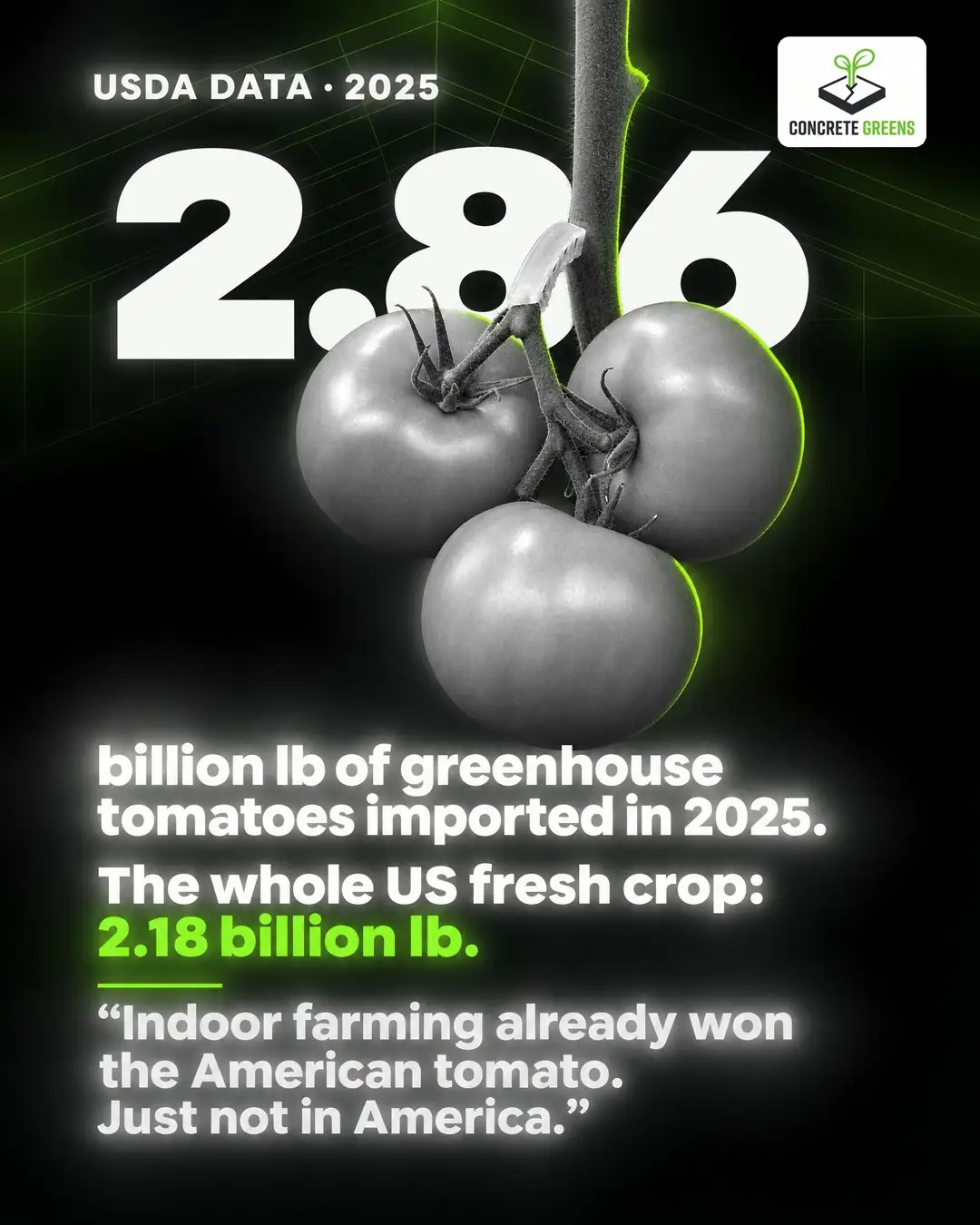
Pick up a tomato in a Philadelphia grocery store and turn it over in your hand. Smooth, round, maybe still on a bit of vine, a sticker on the side. There is a real chance it grew under glass or plastic, in a building, with its water and heat and light managed by somebody’s control system, and that the building was in Mexico or Canada. By my arithmetic on federal numbers, greenhouse imports made up about 44 percent of all the fresh tomatoes available in this country last year. I spent an evening this week with the April 2026 Vegetables and Pulses Outlook from the USDA Economic Research Service, and one sentence in it stopped me cold. In 2025 the United States imported 2.86 billion pounds of greenhouse tomatoes. In the same year, by the same agency’s estimate, the whole American fresh tomato crop, field and greenhouse together, came to 2.18 billion pounds. I’m Harry Hayman, I have spent years arguing that indoor farming is food infrastructure, and here is the federal number that says the argument is already settled. Just not in our favor.
The Two Numbers, Side by Side
Let me be careful with these, because a number this lopsided deserves care.
The 2.86 billion pounds is import volume. ERS reports that the Census Bureau keeps separate import codes for greenhouse tomatoes, cucumbers and bell peppers, and that in 2025 “greenhouse imports represented 64 percent of fresh tomatoes (2.86 billion pounds).” Total fresh tomato imports that year were 4.47 billion pounds, so 64 percent checks out.
The 2.18 billion pounds is domestic fresh market production. The same report says it “rose about 7 percent from 2024 to 2.18 billion pounds,” and that the estimate includes “both field grown production and ERS estimates of greenhouse production.” So it is every fresh tomato grown here: the Florida field tomato, the California field tomato, the greenhouse tomato in Ohio.
Volume against volume. Same year. Same report. (ERS puts total fresh tomato availability in 2025 at 6.49 billion pounds, which is where my 44 percent comes from: 2.86 divided by 6.49.) Divide one by the other and you get about 1.31. My own arithmetic, not a figure ERS prints, but it means America imported roughly 31 percent more greenhouse tomatoes than it grew fresh tomatoes of every kind.
One honest qualifier, because I would rather you hear it from me. This is about fresh tomatoes. The United States grows a mountain of tomatoes for sauce, paste and ketchup: ERS counts 12.3 million tons of tomatoes grown in 2025, and 94 percent of them went to processing. That is a different business with different buyers. The tomato you slice for a sandwich is the fresh market, and the fresh market is where the comparison holds.
The Pattern Is Bigger Than Tomatoes
The greenhouse codes cover two more crops, and they tell the same story. Greenhouse product made up 49 percent of fresh cucumber import volume in 2025, about 1.3 billion pounds, and 59 percent of fresh bell pepper imports, about 1.04 billion pounds. Add the three crops together and you get roughly 5.2 billion pounds of greenhouse vegetables crossing the border in one year. That total is my own sum of three ERS figures, so treat it as a rough measure of scale.
Now step back to the whole shelf. ERS estimates that imports supplied 68.9 percent of the fresh tomatoes available in the United States in 2025, and that import shares “exceeded 80 percent for cucumbers.” Mexico was the leading supplier, with 90 percent of US tomato imports across 2023 to 2025, and Canada typically supplied about 10 percent.
Then look at lettuce, which sits in the same report like a control group. Domestic growers supplied 93 percent of fresh lettuce availability in 2025, and the import share fell from 8 percent to 7 percent. Same country, same consumers, same grocery chains. One crop we mostly grow ourselves, one crop we mostly buy from across the border, and the one we buy is the one that grows best indoors, under managed light and heat, all year.
Indoor Farming Already Won the American Tomato
I keep hearing the question “is indoor farming viable?” asked about the United States as if the jury is still out. For the fresh tomato, the jury came back years ago. Controlled environment agriculture is not coming to America. It already arrived, and it is shipping in by the truckload from greenhouses in Mexico and Canada.
That changes the conversation I want to have with funders and city partners. The question is no longer whether people will buy a tomato grown in a building. They already do, billions of pounds of them. The question is who owns the buildings, and whether any of that value, and any of those jobs, could sit closer to the people eating the food.
I want to be clear about what this is not. It is not a story with a villain. Mexican and Canadian growers built serious greenhouse industries and they serve American shoppers well. In July 2025 the Commerce Department withdrew from the 2019 tomato suspension agreement and imposed antidumping duties of 17.09 percent on most imports of tomatoes from Mexico, as recorded in the Federal Register notice. In May 2026 the Associated Press reported that tomato prices were up about 40 percent over a year earlier on the latest Consumer Price Index, and pointed to trade policy, shipping costs and weather together. ERS itself says that from August 2025 through February 2026 imports from Mexico fell about 15 percent, mostly in field grown tomatoes, while greenhouse tomato imports rose modestly, and that it is uncertain how much of the change was policy and how much was weather in Sinaloa. I am not taking a side on tariffs here. I am pointing at something that held steady through all of it: the greenhouse tomato kept coming.
What the Greenhouse Tomato Already Looks Like Here
Here is the part that gives me hope, because a problem with no example is just a complaint.
The photograph behind the poster at the top of this page was taken by the USDA in April 2018 inside Mastronardi Produce in Coldwater, Michigan. Look at it closely and you can see how this crop works: the vine grows up a line from above, a small white clip holds the truss, and the fruit hangs at picking height over clean gutters. USDA’s caption describes a family business running a year round greenhouse operation for tomatoes, peppers and cucumbers, using about one tenth the water of a conventional grower.

Then there is Mucci Farms in Huron, Ohio, which USDA Rural Development staff visited in September 2024. USDA describes a 75 acre greenhouse farm that grows 12 million cucumbers and tomatoes a year and ships them nationwide to restaurants and suppliers. In 2023 the farm used a federal Rural Energy for America Program grant to buy energy efficient sodium and LED lights, and its general manager told USDA the grant has saved almost $200,000 a year in energy costs.

That last detail matters more than it looks. Energy is the bill that kills indoor farms. Here is a greenhouse in the Great Lakes region cutting that bill with an existing federal program, not a moonshot. It is a working model sitting in plain sight.
And the trend at home runs the wrong way. ERS notes that, comparing the 2019 and 2024 Census of Horticultural Specialties, US greenhouse tomato production declined while the value of sales went up. Fewer pounds, more dollars. Demand is not the problem.
Where Concrete Greens Fits
This is exactly the gap I built Concrete Greens to talk about. The model is simple to say and hard to do: indoor growing that pays its own way through revenue, produces local food all year, complements the farms we already have instead of pretending to replace them, and sends its surplus to neighbors who are food insecure. Infrastructure, not a charity, not a venture capital bet.
I have written before about what 80 Acres Farms taught us about financing and about how one Amsterdam vertical farm got into 1,100 Dutch supermarkets by charging the normal price. The tomato numbers sit underneath both of those stories. The buyer already exists. The shelf space already exists. Americans already pay for greenhouse tomatoes every week of the year. What does not exist, at least not near most American cities, is the greenhouse.
I am not going to pretend a city can grow its way out of a 2.86 billion pound import line. Tomatoes take real heat and real light through a Pennsylvania January, and the growers in Mexico and Canada have decades of scale. But the market does not need to flip. It needs a slice. Even a few percent of that volume, grown and sold closer to home, would be real jobs, real food security and a real hedge for the next season when weather, freight or policy squeezes supply.
A Question for Philadelphia
So here is what I keep asking myself, and what I want to ask the people in this city who fund buildings, run grocery stores and write economic development plans.
Which part of those 2.86 billion pounds could be grown within a day’s drive of Philadelphia?
Not all of it. Not most of it. But some of it, sold to buyers who already exist, with energy costs cut the way Ohio cut them, with surplus going to the neighborhoods that need it most. The tomato already proved that Americans will buy food grown indoors. Now I want to see some of it grown here.
About the Author
Harry Hayman is a Philadelphia-based entrepreneur, music producer, and cultural advocate. Through his work with the Feed Philly Coalition, he explores and documents the creative, culinary, and civic life of a city he believes is one of the most inspired places in America.
Sources and references
- USDA Economic Research Service: Vegetables and Pulses Outlook, April 2026 (VGS-378, 30 April 2026)
- International Trade Administration: Commerce announces withdrawal from the 2019 suspension agreement on fresh tomatoes from Mexico (14 July 2025)
- Federal Register: Fresh Tomatoes From Mexico, termination of suspension agreement (17 July 2025)
- Associated Press via WITN: Price of tomatoes rises 40% over the past year (29 May 2026)
- USDA National Agricultural Statistics Service: 2024 Census of Horticultural Specialties
- USDA photograph: Mucci Farms greenhouse, Huron, Ohio (25 September 2024, Wikimedia Commons)
- USDA photograph by Lance Cheung: greenhouse tomatoes at Mastronardi Produce, Coldwater, Michigan (3 April 2018, public domain, Wikimedia Commons). The poster at the top of this page is a designed graphic built from this photograph.
- 18,000 Stores and Still No Capital: What 80 Acres Farms Reveals About Farm Financing
- One Amsterdam Vertical Farm, 1,100 Dutch Supermarkets, Normal Prices