Singapore Rented 16 Car Park Roofs to Farmers. Seven Are Left.
Singapore rented 16 car park roofs to farmers in 2020 and 2021. By 2025 seven remained. What Philadelphia should learn about leases and space.
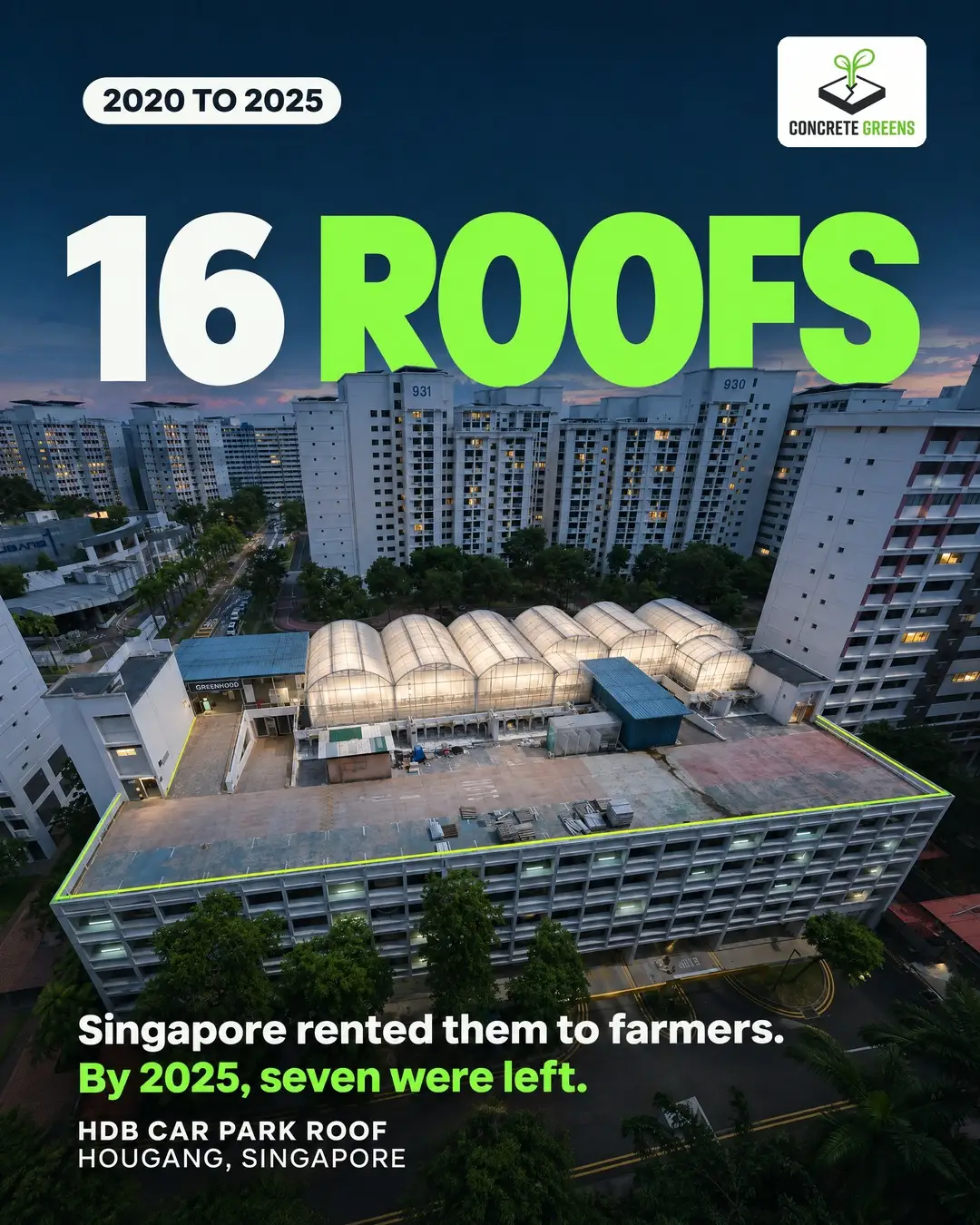
In the spring of 2020, in the middle of a pandemic that had every city thinking hard about where its food comes from, Singapore did something I still find bold. It took the roofs of public housing car parks, the flat concrete tops of the garages that sit between the apartment blocks, and rented them out to farmers. The Singapore Food Agency and the Housing and Development Board put nine rooftops out to tender, and 88 proposals came in for those nine sites. People wanted in.
Five years later, the government gave its own answer to how it went. In a written reply to Parliament on 5 November 2025, Minister for Sustainability and the Environment Grace Fu said that of the 16 car park sites tendered in 2020 and 2021, only seven farms remain. Together they produced less than 1 percent of Singapore’s local food production in 2024. And there are no plans to tender any more.
I want to be careful here, because this is the kind of story that is easy to tell badly.
What Singapore Promised
The ambition was real. When the first nine sites were awarded on 30 September 2020, six bidders won them, with proposals built on hydroponics, vertical farming systems and automated climate control. The head of the Singapore Food Agency said those nine sites had the potential to produce around 1,600 tonnes of vegetables a year. The program was part of Singapore’s “30 by 30” goal, to produce 30 percent of the country’s nutritional needs locally by 2030.
A year later the agencies awarded seven more rooftop sites to three bidders, in Jurong West, Bukit Panjang, Sembawang and Woodlands, with a projected potential of about 680 tonnes a year. Sixteen roofs in all, in a country whose own food agency describes its land and space as limited.
Those tonnage numbers were projections, made on the day the leases were signed. I am not going to set them against the “less than 1 percent” figure, because the sources do not give the national totals you would need to do that math honestly. What I can say is that the government’s own review, five years in, describes the output as small and the employment and profitability as “correspondingly limited.”
What the Minister Actually Said
The November 2025 reply is short, and every line of it matters.
Seven of the 16 farms remain. The reply does not say why the others are gone. So I will not say nine farms failed, and you should be suspicious of anyone who does. Some may have closed, some may have handed back their sites, some may never have been built out. The record does not say.
The farms bring food production closer to the community, and they can run community activities if there is interest. The agencies have also received complaints about noise and odour, because the farms sit right next to people’s homes.
And then the line that tells you where the policy went: anyone who wants to farm commercially can bid instead for Singapore’s land and sea farming spaces, which offer “more space and longer leases.”
More space. Longer leases. Hold on to those two phrases.
The Lease Clock
A year earlier, in October 2024, a member of Parliament asked a pointed question: would the government offer these rooftop farms a lease longer than three years? The answer from the same ministry laid out the terms. All the car park sites were awarded on tenancies of three years, renewable for up to two more terms of three years each.
The same reply listed what makes a car park roof suitable for a farm in the first place: how much the car park is used, how much weight the roof can carry, whether water and electricity are available, how waste can be discharged, and what the plans are for the housing blocks around it. Every one of those is a building problem, not a farming problem.
Now look at what it takes to build a farm on a roof. The best documented example is Greenhood, on top of the car park at Block 946A Hougang Street 92, the building in our poster. According to The Straits Times, founder Gaurav Saraf won his tender in September 2020. Construction began in October 2022. The farm, a 1,808 square meter greenhouse with its own climate control, started operating in June 2023. He described the process of getting permits and building on the car park roof as “excruciating.”
I do not know exactly when his tenancy clock started, and the public record does not say, so I will not pretend to do that math for him. But the shape of the problem is plain. A greenhouse, its climate control, its water and power connections and its growing systems are serious money. Recovering that money takes years of steady sales. A term of three years, even a renewable one, asks a farmer to build something permanent on ground that is officially temporary.
Space and Lease Length, Not Lettuce
Here is the part I want every city official, every landlord and every investor in this space to take away. The lettuce was never the problem. Hydroponic and vertical systems grow leafy greens very well. What Singapore learned is the same thing farmers everywhere already know: land and tenure come first.
The rooftops were small. The leases were short. The sites sat right against people’s windows, which brings complaints. And a farm too small to reach real volume will always struggle to pay its people and its bills, no matter how good its growing system is. When the government changed direction, it did not ask for better technology. It pointed farmers to bigger sites with longer leases.
That is exactly the model Concrete Greens is built around. A farm that works has to be able to cover its own costs, grow year round close to the people who eat the food, and send its surplus to neighbors who need it. None of that is possible on a site you might lose before the build is paid off. Breaking even is not a slogan. It is a function of how many square feet you can grow on and how many years you get to grow there.
The Philadelphia Question
Philadelphia has its own flat roofs, its own garages and its own empty buildings, and every few years someone proposes turning some of them into farms. I hope we do. I also hope we read Singapore’s reply before we write the first lease.
So here are the questions I would ask before any city, landlord or agency offers space for an indoor farm:
How long is the lease, and is it longer than the time it takes to pay off the build? Is the site big enough to reach the volume a real buyer needs? Can the building carry the weight, and are water, power and drainage already there? And who lives next door, and have they been asked?
If the answers are “three years,” “small,” “we will see” and “not yet,” the problem is not going to be the lettuce.
Singapore deserves credit for trying something new in public and then reporting honestly on how it went. Seven farms are still growing on those roofs. The lesson from the other nine sites is not that city farming fails. It is that a farm needs room to grow and time to pay for itself, and a city that wants local food has to offer both.
About the Author
Harry Hayman is a Philadelphia-based entrepreneur, music producer, and cultural advocate. Through his work with Concrete Greens, he explores how cities can grow more of their own food, close to the people who eat it, all year round.
Sources and references
- Ministry of Sustainability and the Environment, Singapore: Written reply to parliamentary question on rooftop urban farms (5 November 2025)
- Ministry of Sustainability and the Environment, Singapore: Written reply to parliamentary question on rooftop urban farms (16 October 2024)
- CNA: report on the award of the first nine car park rooftop farming sites (30 September 2020)
- The Straits Times: report on the 88 proposals received for the first nine rooftop sites (17 June 2020)
- PropertyGuru: report on the award of seven more car park rooftop farming sites (27 September 2021)
- The Straits Times: report on the Greenhood farm on a Hougang car park roof (9 October 2023)
- Photograph: the Greenhood farm on the car park roof at Block 946A Hougang Street 92, Singapore, by Shintaro Tay for The Straits Times. The poster at the top of this page is a designed graphic built from this photograph.