The Ninth Floor: A Philadelphia Thriller About the Overnight Desk
The Ninth Floor is a psychological thriller set in Philadelphia, about an overnight concierge, a penthouse and an anonymous message. Now in development.
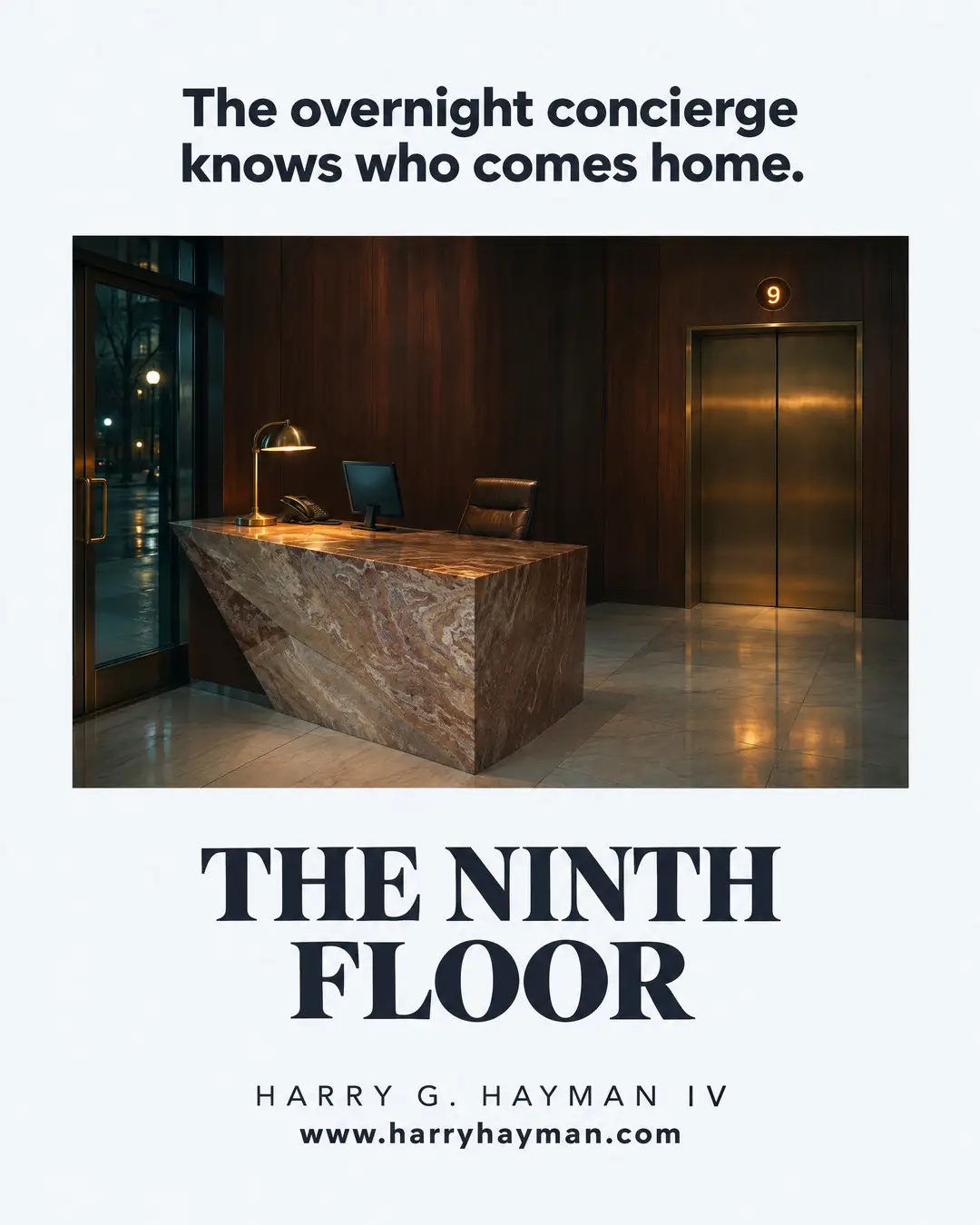
Picture the lobby of a luxury apartment building late at night: a lamp on the front desk, the elevator doors closed, nobody coming through the glass. The overnight concierge knows who comes home. She’s starting to wonder who never leaves. That is the first line of my post this week, and it is where my new script starts too. I’m Harry G. Hayman IV, and I’m writing The Ninth Floor, a psychological thriller set in Philadelphia. This is the longer version of that post: who is in the building, why I picked the overnight desk as the place to stand, the long line of stories where an apartment building does the frightening, and why the whole thing lives in this city.
Who Is in the Building
Here is everything I am ready to tell you, in the words I used in the post. Mara Ellis works the overnight desk in a luxury apartment building. Julian Vale lives in the penthouse. One night, an anonymous message arrives with a proposition that should make her call the police. Instead, she keeps reading.
That is the setup, and I am going to leave it right there for now. I’m not going to tell you what the message says, who sent it, or what Mara does next. Partly that is because a thriller lives on what you do not know yet. Partly it is because the script is still moving under my feet, and I would rather show you the finished building than a floor plan I might tear up next month.
What I can tell you is how it feels to write. I’m having a ridiculous amount of fun writing this one. I have written about stories rooted in friendship and real life before. This one lets me sit in the dark with a character and ask the question every good thriller asks: what would you do with a message you should never have read?
Why the Overnight Concierge
Think about who in a big building actually sees everything. Not the owner. Not the management company. The person at the front desk at night. The Wikipedia article on the concierge describes the job plainly: an employee of a multi tenant building, such as a hotel or apartment building, who receives and helps guests. In apartment buildings, it says, the concierge can keep the mail of residents who are away, hold apartment keys for emergencies, provide access control and act as the go between for residents and management when management is not on site. It also notes that the late night shift is sometimes covered by a security guard.
The history in that same article is the part that caught me. The old Paris concierge often lived in a small ground floor apartment called a loge and was able to monitor all comings and goings. And the word itself has a strange past. One theory traces it to the French comte des cierges, the count of candles, the servant who kept a palace lit. Another strand of its history runs through the Conciergerie in Paris, a palace that became a prison.
Somebody who keeps the lights on, who watches every door, who holds everybody’s keys and answers to nobody upstairs at three in the morning. You do not have to invent much to make that person interesting. The overnight concierge knows who comes home.
Inviting Right Up Until It Isn’t
I want the building to feel inviting right up until the moment you realize you’d rather take the stairs. And by then, you’re already in the elevator.
That is the job I have given myself, and it is harder than it sounds. A luxury lobby is designed to make you feel welcome: warm wood, polished stone, a lamp on the desk, somebody who knows your name. The cover of my post is a designed picture of exactly that kind of room, an invented lobby with an onyx desk, a brass lamp and the elevator doors closed with a 9 glowing above them. Nothing in it is frightening on its own. The unease has to come from what you know, or think you know, about who is upstairs.
That is close to how the genre is usually described. The Wikipedia article on the psychological thriller calls it a combination of the thriller and psychological fiction, often told through the viewpoint of psychologically stressed characters, and talks about a “dissolving sense of reality.” It says these stories often bring in mystery, drama and paranoia. A night shift alone in a quiet building is a pretty good place to start dissolving somebody’s sense of reality.
I also learned something about fear from an audience, not a script. When I went to the Colonial Theatre in Phoenixville for the Exhumed Films 24 Hour Horror-thon, I wrote that I wanted to see how the audience responded: when people laughed, when they got uncomfortable, when a little silence did more than any special effect could. That night stays with me as I write. A quiet lobby is mostly silence.
Buildings That Watch Back
The apartment building as a place of suspense has a long shelf, and anybody writing one is standing on it. Alfred Hitchcock’s Rear Window from 1954 is the obvious one. Its photographer, laid up in a cast in his Greenwich Village apartment, watches a courtyard surrounded on four sides by apartments in adjoining buildings, and Wikipedia notes the film is shot almost entirely from within one room and from the point of view outside the window. The whole building becomes the story.
Roman Polanski’s Rosemary’s Baby, released in 1968 and adapted from Ira Levin’s novel, follows a newlywed in Manhattan who begins to suspect her elderly neighbors. The real building people connect with that film is the Dakota on the Upper West Side, which Wikipedia calls the oldest remaining luxury apartment building in New York City. It quotes the Chicago Tribune writing in 1980 that the “building’s grim presence was introduced to most Americans” through Rosemary’s Baby.
I am not putting The Ninth Floor next to those films. I am saying I know the room I am walking into. Those stories figured out that the scariest thing about a beautiful building is how many doors it has, and how little you know about what happens behind most of them. My building is in Philadelphia, and the person who notices is the one behind the desk.
Why Philadelphia
Every script I write ends up here. In a post on this site from October 2025 I said it as plainly as I can: “All the stories are based in Philadelphia, and all the stories have a charity associated with them.” I also said “These things take time,” and that has not changed either. You want to be in the right place mentally, with the right idea and the right story.
So The Ninth Floor is a Philadelphia story because my stories are Philadelphia stories. I am not going to tell you which corner of the city the building stands on. That is one more thing you will have to wait for.
It is also a city where an independent film has somewhere to go. The Greater Philadelphia Film Office says it was first established in 1985 as an office within the City of Philadelphia and became a regional economic development agency in 1992. Today it supports filmmakers across Bucks, Chester, Delaware, Montgomery and Philadelphia counties, helps with permits and locations, and runs Greater Philadelphia Filmmakers for the regional independent media community. The Philadelphia Film Festival, founded by the Philadelphia Film Society, has a category called Filmadelphia, once known as the Festival of the Independents, that promotes local filmmakers. I keep saying culture is infrastructure. For a script like this one, that is the road it drives on.
Where the Script Is Now
The Ninth Floor is in development. I’ll share more as the script takes shape.
Some of you have already seen a piece of it. In October I wrote about a long writing day on The Ninth Floor with David, Ian and Amy: we read, we wrote, we rewrote, and we argued about scenes. That day I would not say anything about the story. Now I can give you a concierge, a penthouse and a message, and that is a sign the characters are getting more solid on the page.
Writing in a room with people you trust is something Another 3 Hearts has done for a while, from the Writing Rooms we launched in June 2025 to that October table. Another 3 Hearts usually tells real life stories. The Ninth Floor is fiction, and it is a different kind of fun.
So here is where we leave Mara for now: on the overnight desk, with a message she should have taken to the police, still reading. I’ll be back with more when the script lets me.
Sources and references
- Concierge (Wikipedia)
- Psychological thriller (Wikipedia)
- Exhumed Films 24 Hour Horror-thon at the Colonial Theatre, harryhayman.com
- Rear Window (Wikipedia)
- Rosemary’s Baby, 1968 film (Wikipedia)
- The Dakota (Wikipedia)
- Writing, Friendship, and the Stories That Matter, harryhayman.com
- Greater Philadelphia Film Office: About GPFO
- Philadelphia Film Festival (Wikipedia)
- The Ninth Floor: Writing a Psychological Thriller With Friends, harryhayman.com
- Another 3 Hearts Experience
- Writing Rooms announcement, harryhayman.com
- Photo credit: The 24-Hour Concierge Desk at Panorama Towers, by PanoramaTowers, Wikimedia Commons, CC BY-SA 3.0. The poster at the top of this page is a designed graphic built from a crop of this photograph: it borrows the onyx desk and wood panelling and shows an invented lobby, not this building.
