Philadelphia's Economy Is Growing. Who Is It Growing For?
Philadelphia's poverty rate slipped below 20% in 2024, then rose to 20.4% in 2025. The question I am bringing to the Center City Business Association.
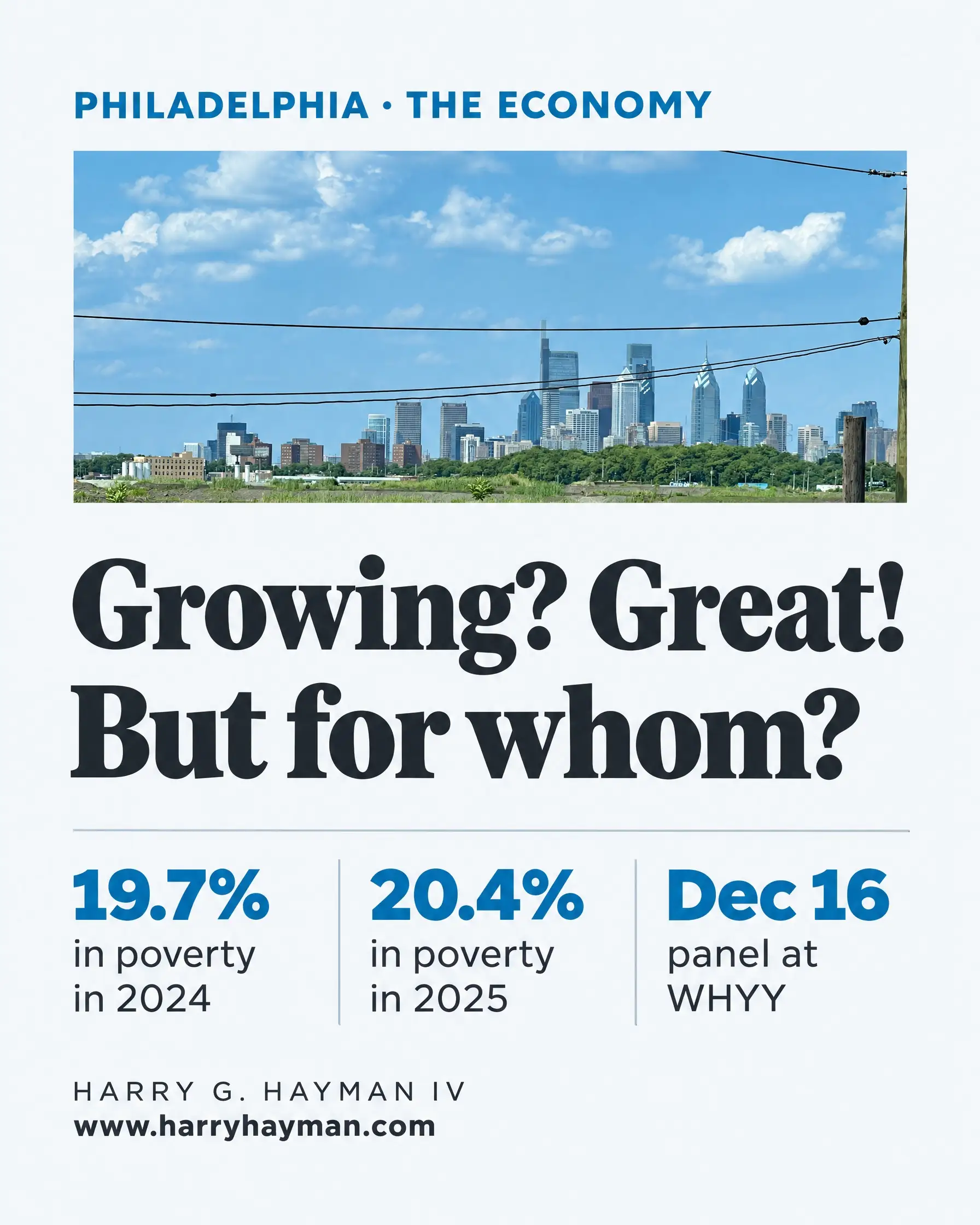
An invitation landed in my inbox from the Center City Business Association, and it got me thinking. The event is called The State of Business in the City, it is on Wednesday, December 16, 2026, from 8:00 to 10:00 AM at WHYY on North 6th Street, and it is built around data from the Pew Charitable Trusts’ annual State of the City report. The invitation sounds like good news, and a lot of it is. It also says Philadelphia’s poverty rate has dropped below 20% for the first time in decades. I’m Harry Hayman, I have spent most of my working life in hospitality, restaurants, entertainment and business development here, and I LOVE the CCBA. I am going to be in that room in December. But before I sit down, I want to put one question on the table, because the numbers moved after that invitation was written. Philadelphia’s economy is growing, GREAT, but for whom?
What the Invitation Gets Right
Let me start with the part I agree with, because I mean it. The Center City Business Association has been a fixture of downtown business life for a long time, and the people on this panel are well known to anyone who cares about this city. According to the event page, the speakers are Emeka Anusionwu, who directs Night Time Economy and Business Development at the City’s Department of Commerce, Allan Domb of Allan Domb Real Estate, Kevin B. Mahoney, the CEO of the University of Pennsylvania Health System, Katie Martin, project director of Philadelphia Research and Policy at Pew, and Wil Reynolds of Seer Interactive, with WHYY’s Meir Rinde moderating. That is a serious group, and the page says they will talk about what is driving recent gains, what challenges remain, and which ideas and investments could shape the city’s future.
Nobody wants to see Center City thriving more than I do. More restaurants doing well? GREAT. More people downtown? TERRIFIC. I have attended plenty of ribbon cuttings myself, LOL. So please read everything below as a question to a room I respect, not a complaint about it.
The Number That Moved
Here is the thing that stopped me. Pew’s State of the City report, as the Inquirer’s Nate File reported it in April, put Philadelphia’s poverty rate at 19.7% for 2024, the first time below 20% since 1979. That was real progress, and it was worth saying out loud. The same coverage noted that the city had stopped being the poorest big city in the country.
Then the next year of Census Bureau data arrived. The Inquirer’s October 30 report says 20.4% of Philadelphians lived in poverty in 2025, up from 19.7% in 2024. It is the first increase since 2011, and it puts Philadelphia back at the top of the list of America’s biggest cities, with New York and Houston next at 17.7%. For a family of four, the poverty line that year was about $32,750.
Both numbers are true. The 19.7% was the right headline for 2024, and the 20.4% is the right headline for 2025. But 20.4% is more than ONE IN FIVE Philadelphians, and that is a very different sentence to say to a room of business leaders than “below 20%.” The invitation was not wrong when it was written. The data simply kept moving, which is exactly why I think the question belongs in the conversation.
Growth Is Real. So Who Is It For?
The same Pew coverage that celebrated the poverty drop also carried a less comfortable headline. It said economic growth was stagnating, and it pointed to an unemployment rate that reached 5.1% in 2025, a median household income that was flat from 2023 to 2024, and a population that peaked near 1.6 million in 2019 and was about 1.57 million in 2025. The good news and the hard news came in the same report.
That is the heart of what bothers me. Are we talking about an economy that is actually improving people’s lives, or about certain parts of the economy doing better? Those are not automatically the same thing. Office leasing picking up and hotels filling are good for the people who own and operate those businesses. I want to know how that reaches the person working two jobs who still cannot cover rent, the owner of a corner business who is struggling to keep the lights on, and the neighborhoods where investment and activity do not seem to turn into much opportunity.
So here are the measures I would love to hear more about. How many people got jobs that pay enough to live on? How many locally owned businesses are growing? How many families are in a better financial position than they were a year ago? And, perhaps most important, who is responsible for moving those numbers in the right direction? A ribbon cutting is wonderful. I would just like a scoreboard that also counts the people who were never at the ribbon cutting.
Where the Big Checks Go
There is one piece of this I know from the food and local business side, and it keeps pulling me back. Philadelphia has world class hospitals and universities, and they spend an enormous amount of money every year on goods and services. WHYY reported in 2018, citing a 2015 report from the City Controller, that the city’s 34 universities and hospitals spend about $5.3 billion a year, and that about half of it goes to local companies. That is a number I would like to see updated, because it tells us how much of the city’s biggest purchasing power stays in the city.
The idea of steering more of it home is not new, and plenty of smart people have worked on it. The Economy League, which runs the Philadelphia Anchors for Growth and Equity effort, published a study of purchasing by nine anchor institutions using fiscal 2018 data. It found 1,424 unique local suppliers, but only 150 of them sold to three or more of those institutions, and it estimated that capturing a quarter of the $530 million in addressable spend for local and diverse firms could support about 1,250 direct jobs and 4,000 indirect jobs. That data is from fiscal 2018. But the question underneath it is the one I am asking here. When a university, a hospital, a corporation or a public institution spends a dollar, how much of that dollar ends up with a Philadelphia business and a Philadelphia resident?
What I Am Trying to Do About It
I do not want to stand on a soapbox and offer nothing else, so let me say where my own hands are. A big part of my work in food systems, local business development and the Feed Philly Coalition is about connecting the assets this city already has to opportunity for more Philadelphians. The coalition describes itself as a group of nonprofits, businesses, government, healthcare, education, agriculture, philanthropy and community leaders working together to build a stronger, healthier, more resilient regional food system. Healthcare and education are on that list for a reason. They are some of the largest buyers of food in the region, and they are also anchors for the neighborhoods around them.
I have had the pleasure of working with many of the people who are tackling these questions, and I know the work is hard. What I think we have not figured out nearly well enough is how to connect all of that economic activity to opportunity for MORE people. We have incredible entrepreneurs, great restaurants, cultural institutions, neighborhood businesses and some of the most talented people you will find anywhere. The connection is what is missing, and it ought to be part of every serious conversation about Philadelphia’s economic future.
What I Hope to Hear on December 16
I’ll be attending the December 16 event, and I am genuinely looking forward to hearing from the folks at Pew, Penn Medicine and the City in particular, and I appreciate the CCBA for bringing all of them together at WHYY. I hope the conversation goes beyond the good news, because both things can be true. Center City can be doing better while hundreds of thousands of Philadelphians are still struggling. We should celebrate the progress we have made without losing sight of the work we have not done.
I LOVE PHILADELPHIA. I want this city to succeed, and I want it to succeed for a lot more people than it does today. If these questions were not already going to be part of the discussion on December 16, well, THEY ARE NOW. LOL.
Sources and references
- Center City Business Association: The State of Business in the City, event page
- Center City Business Association: Our History
- The Philadelphia Inquirer: Philly makes progress on gun violence and poverty, while economic growth stagnates, Pew report finds (April 21, 2026)
- The Philadelphia Inquirer: Philadelphia poverty rate, Census, big cities (October 30, 2026)
- WHYY: Forget outsourcing, Philly eds and meds connect with businesses inside the city
- Economy League of Greater Philadelphia: Economy League Identifies Opportunities for Philadelphia Businesses
- Feed Philly Coalition
- WHYY
- Wikimedia Commons: Philadelphia skyline beyond overhead utility wires, by Z3lvs, CC0 1.0. The poster at the top of this page is a designed graphic built from this photograph.
