COLTRANE 100 and The Offering Table, Ars Nova Workshop at Honeysuckle
Ars Nova Workshop gathered Philadelphia's jazz community at Honeysuckle for COLTRANE 100. A Philadelphia perspective on what the city could build next.
The card on the table opened with a promise: “ARS NOVA WORKSHOP PRESENTS / THE OFFERING TABLE.” Next to it lay a small stack of flyers for the next night’s concert at Temple. I’m Harry Hayman, writing from Philadelphia, and that card is where I want to begin, because it explains the room better than my own excitement does. The room was full of musicians, educators and friends who have spent years keeping jazz alive in this city, gathered for the after party that followed a jazz conference put together by my friend Mark Christman and the Ars Nova Workshop team, all of it in honor of John Coltrane’s 100th birthday. Looking around, I thought about how lucky we are to have this much talent in our own backyard.
What the card said
The card says the evening celebrates “the 60th anniversary of John Coltrane’s seminal performance, Offering: Live at Temple University,” and that it sets out to “honor the Philadelphia jazz legends who were Coltrane’s peers, many of whom are still making music today.” It adds that “The Offering Table is hosted in partnership with Honeysuckle and Chef Omar Tate. Music by Waxpaper Records.”
That last line told me something I had not planned to notice. A presenting organization, a restaurant, a chef and a record label were sharing one night, on one card. To me that looks like how a city should do this.
The flyers beside the card advertised “John Coltrane’s Offering Revisited: Live at Temple University,” featuring Ravi Coltrane and Tomoki Sanders, with Kris Davis, Robert Hurst, Terri Lyne Carrington and more, on November 12 at 8 PM at the Temple Performing Arts Center on North Broad Street. They carried the logos of COLTRANE 100, Ars Nova Workshop, the William Penn Foundation, WRTI and The John & Alice Coltrane Home. Ars Nova’s COLTRANE 100 page lists the same November 12 concert, and describes the whole programme as a citywide centennial running from September 2026 to September 2027, centered on the future of the Coltrane House.
The night Coltrane played Temple
The concert the card names happened on November 11, 1966. Temple’s own account of the album says it was recorded in Mitten Hall about nine months before Coltrane died, with Alice Coltrane on piano, Pharoah Sanders on reeds and flute and Rashied Ali on drums. The same piece says the tapes came from the recording made by the student radio station, WRTI, and that Resonance Records released the music as Offering: Live at Temple University on September 23, 2014, which is Coltrane’s birthday. The Wikipedia entry for the album gives the same release details and the full personnel for anyone who wants to listen with the liner notes open.
Sixty years later, the music is coming back to the same campus. WRTI’s fall preview says Ravi Coltrane will lead a tribute to that moment, and notes that his mother Alice played at the original concert. I find it moving that the station that put the 1966 set on the air is on the flyer for the revival. Philadelphia’s own institutions are part of this story.
A city that Coltrane called home
Philadelphia is not a side note in this story. WHYY’s piece on the centennial says Coltrane came here in 1943 with his mother and cousin, that his mother bought him his first saxophone that year, and that he lived in the city for most of the 1950s before moving to New York in 1958. He bought the rowhouse on North 33rd Street in 1952, and the house was designated a National Historic Landmark in 1999. The National Park Service record for the Coltrane House lists it in the National Register file, and the WHYY article says it is now owned by an organization founded by Ravi Coltrane, which is stabilizing it for renovation as a community cultural space.
That is why the line on the card about Coltrane’s peers stayed with me. The people he came up alongside were Philadelphians, and some of them still are. The same WHYY article quotes Mark Christman, who founded Ars Nova Workshop, on what patient listening to Coltrane’s music can do for people trying to understand one another. He calls it a kind of healing this country needs. Whatever a person believes about that, it is an unusual thing for a presenter to say out loud.
Who was in the room
Laurin Talese, Kerri Parks, Frank Machos, Bill Johnson and Gerald Veasley were there, along with a long list of other musicians, educators and people who have worked for years to keep jazz thriving here.
Two of them are easy to read up on. Jazz Philadelphia’s profile of Laurin Talese says she moved to Philadelphia in 2000 to study at the University of the Arts and won top honors at the Sarah Vaughan International Jazz Vocal Competition in 2018. Gerald Veasley’s Bass Bootcamp page tells the story of his teaching camp for bass players, and his Wikipedia biography says he grew up in West Philadelphia. I’m naming the others because they were there, and because a room is made of its people. Go find them on a bandstand.
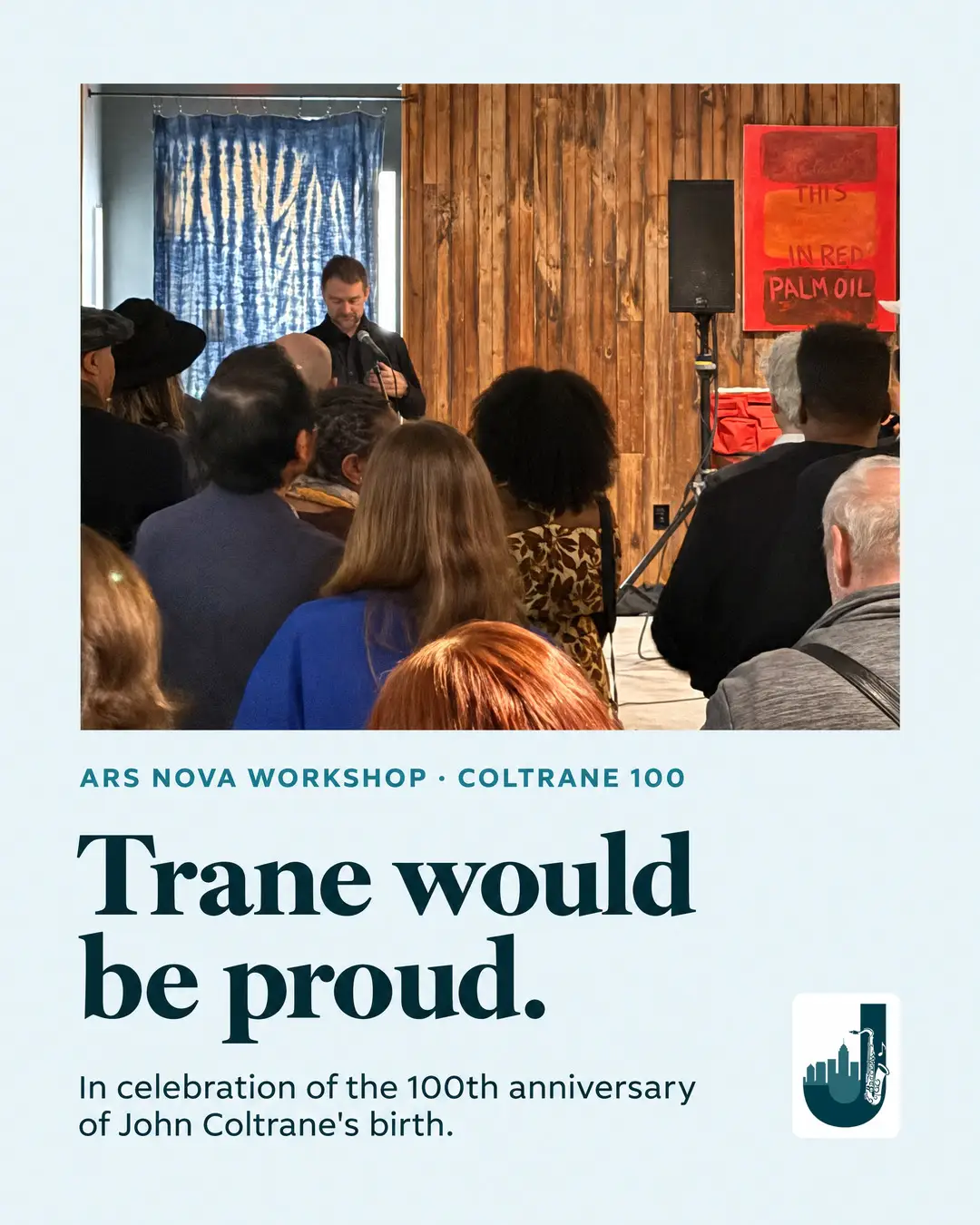
In one of my photos, a speaker stands at a microphone in a wood walled room, and a full, standing crowd is turned toward him.
The room, and the people feeding it
Honeysuckle took care of everyone. Food, drinks and hospitality were exactly what you hope for from a place that understands gatherings. In another photo, Honeysuckle’s storefront carries a chalkboard sign: “Closed for a private event.”
This was not a first meeting between Honeysuckle and Ars Nova. Ars Nova’s page for the 2021 John Coltrane Symposium fundraiser shows Chef Omar Tate curating a four course dinner at The Woodlands through his Honeysuckle Project, drawing on his admiration for Coltrane’s music, diet and philosophies. And the Inquirer’s report on the restaurant’s move to North Broad Street says Tate describes it as a cultural preservation space. A chef who thinks about food as preservation and a presenter who thinks about listening as repair are working on something related.
What the card shows is a partnership, openly credited, with a food partner and a music partner named beside the presenter.
Why aren’t we doing more
I’ve said it before and I’ll keep saying it until somebody tells me to stop: Philadelphia is one of the great jazz cities in the world. Jazz Philadelphia’s timeline traces the city’s jazz history across generations. We have the history, the musicians, the clubs, the educators and the organizations. We have a new generation coming up that deserves every opportunity we can give it.
So here is what I keep wondering. Why aren’t we doing more? More live music. More chances for musicians to earn a decent living. More investment in jazz education. More collaboration between cultural institutions, restaurants, hotels, tourism organizations and the people who make the music. That list is my view, and I hold it loosely enough to be argued with.
Here is the part that gives me hope. A version of that collaboration happened this week, with a presenter, a restaurant, a record label and a foundation all named on one table. Jazz Philadelphia’s COLTRANE 100 Philly page says Jazz Philadelphia, Creative PHL, WRTI and Ars Nova Workshop lead the season, and that it includes Community Project Grants for local jazz artists. Jazz Philadelphia’s Summit page lists its own Summit on November 11 at Mitten Hall, with workshops on booking, fundraising and marketing. Both pages describe work that sits close to what Philadelphia Jazz Experience cares about, which is jazz heritage and jazz education.
I should be clear about my own position. Philadelphia Jazz Experience did not organize any of this. I was a guest, I enjoyed it, and I came away with a question for hotels and restaurants as much as for presenters: what would it take for a night like this to happen every month?
Sources and references
- Ars Nova Workshop, Coltrane 100. The programme, the November 12 concert at Temple Performing Arts Center, and the September 2026 to September 2027 span.
- Temple University, Rare John Coltrane album recorded live at Temple. The November 11, 1966 recording at Mitten Hall, the players and the 2014 release.
- Wikipedia, Offering: Live at Temple University. Release details and personnel.
- WRTI, Jazz fall preview 2026. Ravi Coltrane’s tribute and Alice Coltrane at the original concert.
- WHYY, Why jazz novices will want to pay attention to John Coltrane’s 100th birthday in Philadelphia. Coltrane’s years in Philadelphia, the house on North 33rd Street, and Mark Christman.
- National Park Service, John Coltrane House record. National Register file for the Coltrane House.
- Jazz Philadelphia, Laurin Talese. Biography.
- Gerald Veasley, Bass Bootcamp. Biography and teaching camp.
- Wikipedia, Gerald Veasley. Upbringing in West Philadelphia.
- Ars Nova Workshop, John Coltrane Symposium and Honeysuckle Projects fundraiser dinner, 2021. Chef Omar Tate’s earlier Coltrane dinner.
- Philadelphia Inquirer, Honeysuckle Provisions to become Honeysuckle on North Broad Street. Tate’s description of the restaurant.
- Jazz Philadelphia, Timeline. Philadelphia’s jazz history.
- Jazz Philadelphia, Coltrane 100 Philly. The partners and the season.
- Jazz Philadelphia, Jazz Summit. The November 11 Summit at Mitten Hall.
- Photographs: Harry Hayman. The poster at the top of this page is a designed graphic built from his photograph of the gathering. The Offering Table card and flyers are quoted from his second photograph.
About the Author
Harry Hayman is a Philadelphia-based entrepreneur, music producer, and cultural advocate. Through his work with the Feed Philly Coalition, he explores and documents the creative, culinary, and civic life of a city he believes is one of the most inspired places in America.