The Obama Presidential Center and the Case for Thinking Bigger
A visit to the Obama Presidential Center on Chicago's South Side, and what its museum, library and gym on one campus could teach Philadelphia.
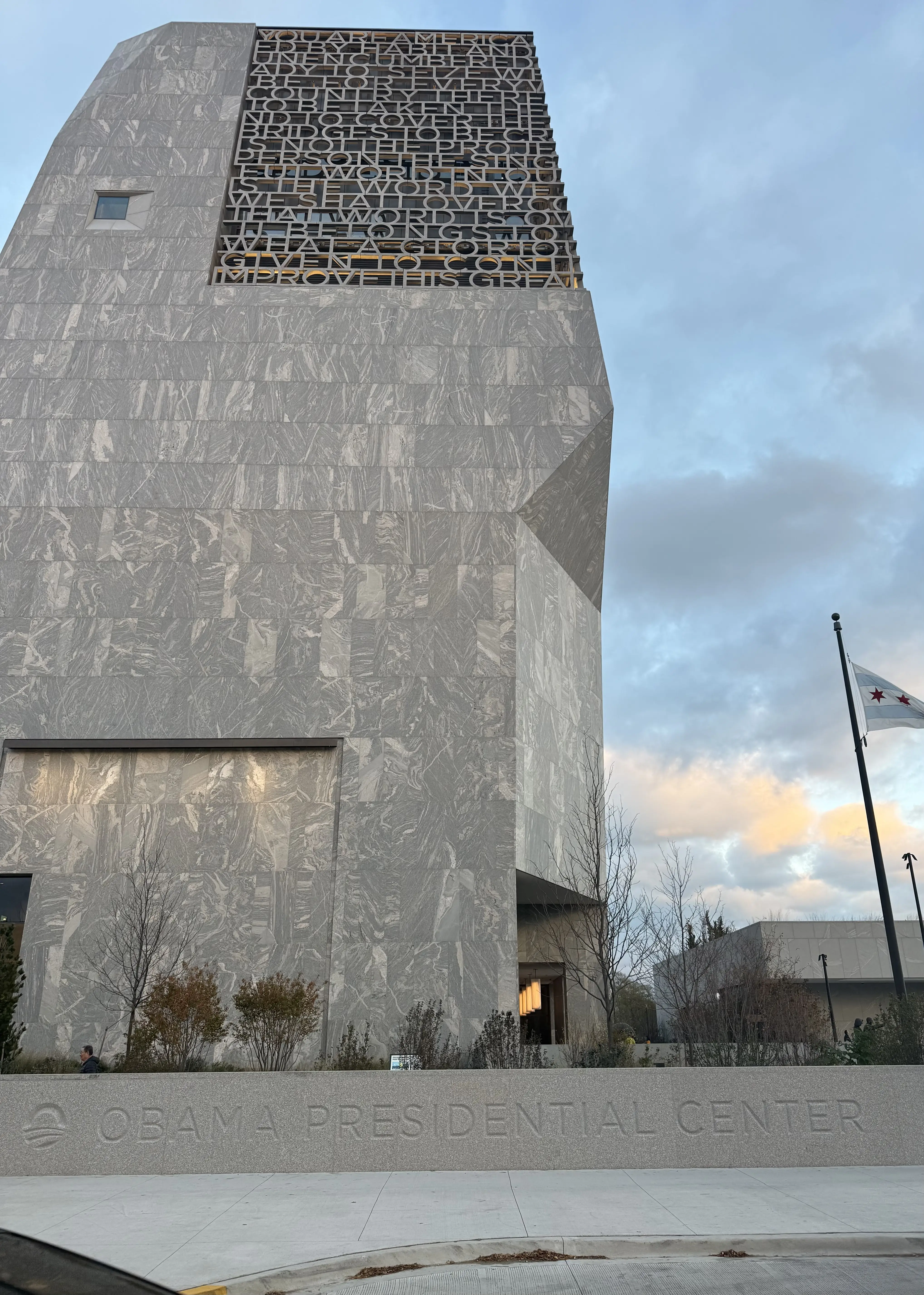
A gray stone tower stands over a long wall with OBAMA PRESIDENTIAL CENTER cut into it, and the top of the tower is a lattice you can see the sky through. That is one of my photographs from the visit. I’m Harry Hayman, and I literally flew to Chicago this week for the express purpose of experiencing the new Obama Presidential Center. Worth every single mile. I expected something spectacular. What I encountered was something far more powerful: architecture, art, history, culture, community, democracy and possibility, all in one place. And, perhaps most importantly, ALIVE. Not some sterile monument to yesterday. Not simply a museum commemorating a presidency. A living, breathing invitation to imagine what tomorrow could look like. By the end of the day I had gone down a slide, shot hoops, cried a little and watched the sun go down over the South Side. I am still sorting out what it all means for us back home in Philadelphia.
What Is Actually on That Campus
I want to share what I learned after I got home and started reading, because the design choices explain a lot of what I felt walking around.
The Center opened to the public on June 19, 2026, on Juneteenth, the day after its dedication. It sits in Jackson Park, which Architectural Record describes as a 550 acre lakefront park laid out in the 19th century by Frederick Law Olmsted and Calvert Vaux, and the campus took almost 20 acres of it. The address is 6001 S. Stony Island Avenue, on the South Side, where the Obamas’ own story began.
The design is by Tod Williams Billie Tsien Architects, with the Chicago firm Interactive Design Architects, and Michael Van Valkenburgh Associates did the site planning. The museum tower is 225 feet of concrete clad in heavily figured gray granite from New Hampshire. As far as I can tell, that lattice at the top of my photo is the set of precast letters Architectural Record describes, five feet high each, spelling out words from President Obama’s 2015 speech for the 50th anniversary of the Selma march: “You are America. Unconstrained by habit and convention.” I did not know that when I was standing under it. I had even photographed a “You Are America” sign on the grounds without putting the two together. Now I can’t stop thinking about a building that literally wears a sentence about the public on its head.
Here is the part that surprised me most. According to CBS Chicago’s opening day report, the presidential library itself is all digital and run by the National Archives. The library building on campus is something else entirely: a branch of the Chicago Public Library. I have a photo of the welcome sign, painted like a stack of book spines. Welcome to Chicago Public Library at the Obama Presidential Center. A neighborhood library, where you’d expect an archive behind glass.
Free Where It Counts
The museum runs on timed entry tickets, and demand is high. We did not get the full tour this time, and believe me, WE WILL BE BACK. But the Foundation’s own visitor page is clear that you do not need a ticket for a huge share of the place: the outdoor spaces, the public art and the library branch are open to everybody. CBS reported that the Forum building, Home Court and the grounds are free too.
That choice matters more than any single exhibit. A museum with a ticket line is normal. A campus where the gym, the library, the gardens and the plaza belong to whoever walks up is a different idea about who an institution is for.
The Foundation’s guide to the outdoor spaces reads like a list of reasons to come back on a random Tuesday. A playground with a duck slide, accessible swings and a mud kitchen garden. The Eleanor Roosevelt Fruit and Vegetable Garden with a teaching kitchen, where people of every age can learn to grow, harvest and cook. A renewed Women’s Garden inspired by the Women’s Pavilion at the 1893 World’s Fair. John Lewis Plaza at the center of it all. A stone water feature by Maya Lin. Food, history, play and civic memory, sharing the same ground. You know I love that.
The Slide, and Then the Tears
Yes, I WENT DOWN THE SLIDE. Because apparently inspiration and intellectual curiosity are even better with a little childlike joy. I laughed like a child, and then, out of nowhere, I just started crying. I am crying again writing this. I was missing my brother and my sister. Sometimes those moments of unbridled joy remind you of when life was so simple and we were at the merry-go-round at St. Martin’s.
I did not expect a presidential center to send me back to a merry-go-round. I think that is exactly the point, though. A place built only to be admired keeps you at arm’s length. A place built to be used lets you bring your whole life into it, grief included.
The Foundation took play seriously beyond its own fence, too. On June 8, 2026, it cut the ribbon with the Chicago Park District on Chicago’s first fully inclusive playground, 21,000 square feet on the Midway Plaisance, paid for with a $4 million gift from the Foundation. It has a slide with a transfer platform for kids who use wheelchairs. Somebody thought about which child gets to go down the slide. That is how belonging gets designed.
Home Court
Then I SHOT HOOPS. At a presidential center, no less. They let me! How freaking cool is that?
Home Court is the 60,000 square foot athletic building at the southwest corner of the campus, designed by Moody Nolan. When the Foundation announced the design team in May 2023, it called Moody Nolan the largest Black owned architecture firm in the United States, and it described the building as a community anchor with a state of the art gym, a safe place for young people after school and in the summer. It also said the gym and programming spaces were made bigger because the community asked for more room for youth programs.
Read that again. Neighbors told the planners what they needed, and the building got bigger in that direction. Basketball sits right next to the history.
Who Built It, and Who Gets to Stay
A project this size changes a neighborhood, and I would be doing you a disservice if I only talked about the slide. Architectural Record puts the estimated cost at $850 million. The builder, Lakeside Alliance, published the Foundation’s construction commitments: half of the work done with minority, women or veteran owned businesses, a goal of 35 percent of the construction workforce from the South and West Sides, and $850,000 for local workforce partners to train 400 new apprentices.
The neighbors pushed hard too, and that is part of this story. In September 2020, after years of organizing, Chicago’s City Council passed the Woodlawn Housing Preservation ordinance, setting aside $4.5 million for affordable housing programs in the neighborhood around the Center. Local Alderman Jeanette Taylor had pushed for a broader community benefits agreement, and the ordinance was the compromise. I am not in a position to grade how all of that has worked out. I do know the right questions came up early, and loudly, from the people who live there.
What I Brought Home to Philadelphia
Somewhere between the walking, the learning, the playing and the sunset, something really struck me. THIS IS WHAT HAPPENS WHEN WE STOP THINKING SMALL. When we refuse to accept that cultural institutions have to be stuffy. When we recognize that community development isn’t just about buildings, it’s about BELONGING. When we understand that arts, education, recreation, history, public space and civic engagement aren’t separate conversations. They are all part of the same ecosystem.
The thing I keep turning over is the mix. A library branch, a gym, a vegetable garden with a teaching kitchen, a playground, a plaza and a museum, on one campus, mostly free. In most cities those are six different budgets, six different agencies, six different ribbon cuttings, on six different blocks. What if we planned them together?
And the fact that this sits on Chicago’s South Side makes the statement even more powerful. WORLD CLASS BELONGS IN EVERY NEIGHBORHOOD. Excellence should never require an invitation to participate.
Philadelphia, we have the talent. We have the history. We have the artists, the institutions and the neighborhoods. We have the ingredients. The question is whether we have the collective imagination, and the courage, to put them together in ways that truly transform our city. I left Chicago with about another thousand ideas (my poor team), and I’d love to hear yours. Which neighborhood would you start with, and what would you put on that campus first?
Great cities aren’t built by people who simply manage what already exists. They are built by people who dare to imagine what doesn’t exist yet. THINK BIGGER. DREAM BIGGER. BUILD SOMETHING THAT MATTERS.
Sources and references
- CBS Chicago: Obama Presidential Center opens to the public
- Architectural Record: The Obama Presidential Center opens on Chicago’s South Side
- Obama Foundation: Visit the Obama Presidential Center
- Obama Foundation: Outdoor spaces and activities
- Obama Foundation: Chicago’s first fully inclusive playground at Midway Plaisance Park
- Obama Foundation: Design and build team for the programs and athletic center
- Lakeside Alliance: Diversifying the construction workforce
- Chicago Sun-Times: City Council approves protections for Obama Center’s neighbors