A Dashboard Shows the Work. Baltimore's CitiStat Meeting Moves It.
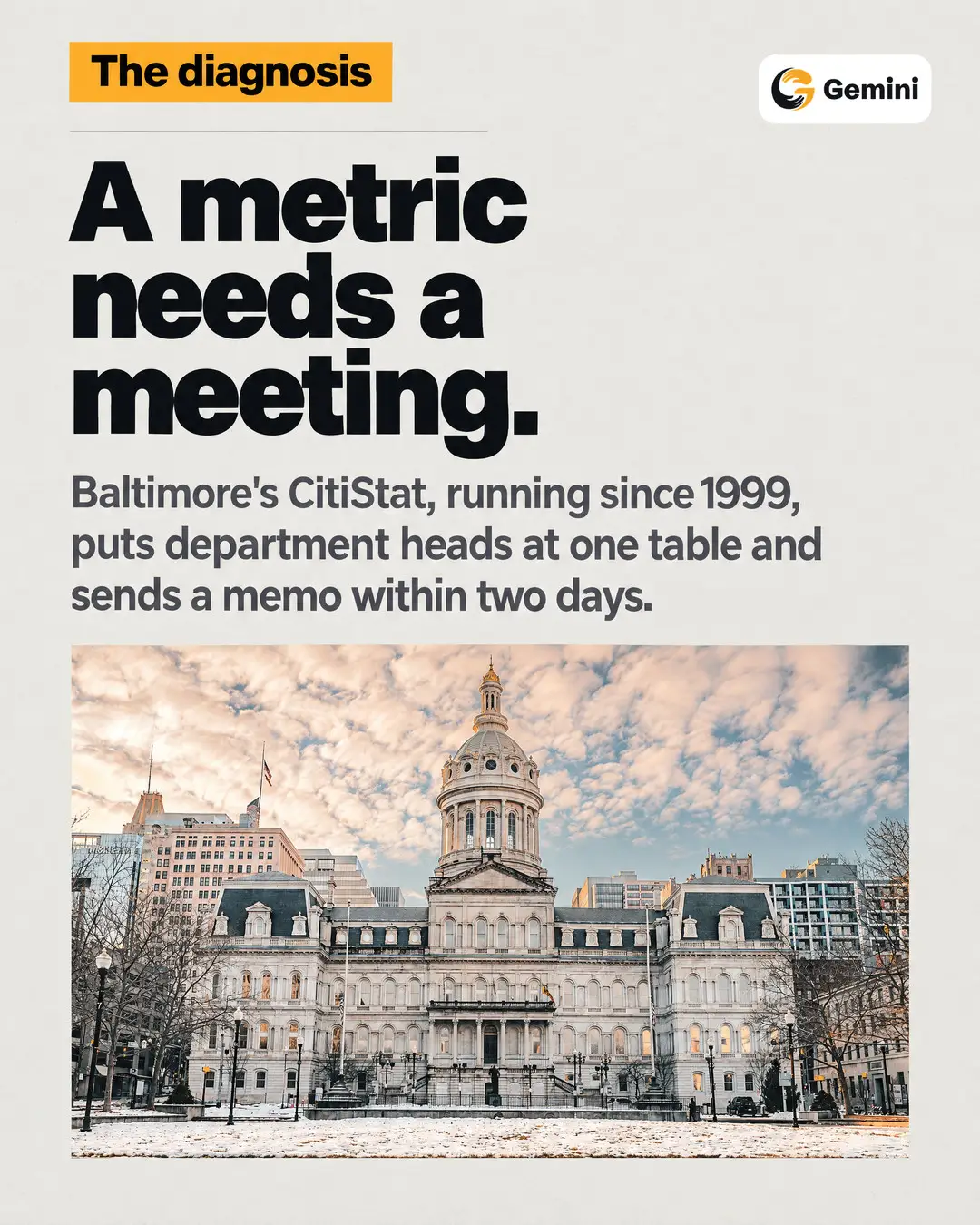
Philadelphia added twelve Philly Stat 360 metrics. Baltimore's CitiStat shows the routine behind a metric: a standing session and a memo within two days.
On 5 November, Philadelphia announced twelve new and two enhanced performance metrics on Philly Stat 360, the City’s public performance dashboard. One of the new measures tracks the time required to award professional services contracts. I like that a resident can now look at a number like that. It also made me ask a question I keep asking in my work at Gemini Strategic Consultants: what sits behind a number once it is published?
I went looking for a city that answered that question in writing, and I kept ending up in Baltimore.
The objection, and why I concede it
The fair objection to everything below is that a public dashboard matters on its own. I agree. The City of Philadelphia’s Office of Philly Stat 360, established by Executive Order 9-24, says it helps City departments adopt best practices to improve the delivery and performance of City services. The dashboard itself launched in December 2024 tracking “over 30 key metrics”, and the November expansion was developed in partnership with 10 City departments and offices. Mayor Parker’s framing in that release is “Don’t just listen to what we say. Watch what we do.”
Watching is the first half. My claim is only that a number on a page does not, by itself, say who must explain it, by when, and to whom. That is the other half, and Baltimore has a long record of building it.
I should be plain about what I do not know. The public record I found does not describe how Philly Stat 360 runs its internal sessions, so I am not going to say anything about them. What follows is Baltimore’s routine, and then a set of questions.
What CitiStat is, in its own words
Baltimore’s CitiStat page says the program “was founded in 1999 to apply data-informed performance management tools to all aspects of city government on behalf of the Mayor.” It was modeled on New York’s police CompStat. In the Stanford Social Innovation Review’s 2007 account, “Government by Numbers”, Noah Weiss writes that O’Malley “introduced the first version of CitiStat in the Baltimore Police Department” and that it was modeled on CompStat, “a crime-fighting system that Jack Maple developed for the New York Police Department.”
The same article makes the point I care about most. It says the core of CitiStat “is not just its technology … but also its biweekly staff meetings.” The head of each city department, the CitiStat staff and staff from the mayor’s office attend, “making it easier to cross boundaries within the bureaucracy.”
That sentence is the model. The data is the same data every department already had. What changed is that a person with authority over the work, a person who analyzes the numbers, and the people who must act sit in the same room and look at the department’s own figures.
The working parts
Baltimore now publishes the routine as a cycle. Its CitiStat Annual Report 2025 lays out the timing in a table, and I find the plainness of it useful.
Two business days before the session, a pre-memo goes out: “Pre-memo is sent out in advance to attendees.” The report describes it as outlining objectives and performance data. Then comes the session itself, with the agency, the CitiStat staff and the mayor’s office and the data on the table. One, at most two, days after, “The Follow-Up Memo is sent.” Following the session, the report says, post-memos “document commitments and action steps.”
The City’s page gives the design rule behind the cycle: “A strong performance routine begins with a clear purpose, reliable enough data, a named sponsor, and an agency owner.” It also states what makes the routine different from a report: “problems are clearly defined, trusted data is used, commitments are assigned, and follow-up continues until conditions change.”
Look at what that list contains. A purpose. Data that is reliable enough, not perfect. A named sponsor. An agency owner. A date on the memo. None of that is software.
The 2025 relaunch added the support offices
CitiStat has not run in a straight line. In a 27 May 2025 announcement, the Mayor’s Office said CitiStat had held “over 90 sessions across 11 topics” in 2024 and that “in early 2025, the program was refocused with clearer goals, stronger follow-up, and new leadership.” Two of the listed changes matter for anyone designing a routine of their own: “Cross-agency participation from IT, HR, Finance, Law, and other departments to help accelerate problem-solving” and “Public memos and materials published online for greater transparency.”
I read the first change as an operating insight. A fix often depends on an office that is not the one being reviewed: the people who can approve a hire, change a system or sign a contract. Putting them in the room means the assignment and the permission to carry it out can happen on the same day.
The 4 February 2026 release of the 2025 annual report says that as of the end of 2025, “each principal agency has its own dedicated Stat.” The report’s letter from the executive director gives the scale: “We held 116 sessions across 15 Stats.”
What it cost, and what it was credited with
The cost figures are the part that surprised me. The SSIR article reports that Baltimore “paid a little more than $20,000 for the CitiStat software (Microsoft Excel and ArcView Geographic Information Systems [GIS] mapping programs), hardware, and meeting room furnishings; and approximately $285,000 for the first year start-up and operating costs.” At the time of writing in 2007, it says, “CitiStat’s annual budget is $450,000, most of it for salaries.”
On results, the same article reports that “CitiStat has generated more than $43 million in cost savings and added revenues, report Phineas Baxandall and Charles C. Euchner in a Kennedy School of Government paper.” It also reports on a pothole process: “The outcome of this transparent process: 90 percent of potholes get fixed within 48 hours.”
I want to be careful with those numbers. They are a mid-2000s figure as reported in 2007, and I did not find a newer citywide savings number. Larger figures circulate in political settings, and I have not verified any of them, so I am not using them. The SSIR piece itself notes that broader changes, such as drops in crime, are hard to attribute to CitiStat alone. I would not hang a whole city’s results on this routine. I would say that it was cheap, mostly people, and credited with specific, measurable gains.
The questions I would ask about any cross-department plan
A lot of the work in front of Philadelphia needs several departments and outside partners to act at once: the food economy, anchor procurement, commercial corridors. At Gemini we work on projects of that kind, and the question I bring to them comes straight from Baltimore’s cycle. I am not asserting any gap in Philadelphia. I am asking:
First, who is the named sponsor, the person with the authority to assign work across departments? Second, who is the agency owner for each commitment? Third, who has to say yes from outside City government, such as a hospital, a university, a funder or an operator, and are they at the session? Fourth, when does the memo go out, and does the next session start from it? Fifth, which support offices are in the room when a fix is assigned: IT, HR, Finance, Law?
A plan with answers to those five has a routine. A plan without them has a report. The cost to find out is small; Baltimore’s early budget was about $450,000 a year, mostly staff.
Where I land
A dashboard is the visible half of performance management, and Philadelphia has made it more visible this week. The meeting is the half that moves the work. If you run or fund a plan that crosses departments, write down the sponsor, the owner and the date of the memo before you sign it.
About the Author
Harry Hayman is a Philadelphia-based entrepreneur, music producer, and cultural advocate. Through his work with the Feed Philly Coalition, he explores and documents the creative, culinary, and civic life of a city he believes is one of the most inspired places in America.
Sources and references
- City of Philadelphia, 5 November 2026: twelve new and two enhanced Philly Stat 360 metrics.
- City of Philadelphia, Office of Philly Stat 360 (Executive Order 9-24).
- City of Philadelphia, 17 December 2024: launch of Philly Stat 360.
- City of Baltimore, CitiStat program page.
- City of Baltimore, CitiStat Annual Report 2025.
- City of Baltimore, 27 May 2025: relaunch of CitiStat.
- City of Baltimore, 4 February 2026: release of the CitiStat Annual Report 2025.
- Stanford Social Innovation Review, “Government by Numbers,” Noah Weiss, Winter 2007.
- Hero photograph: Baltimore City Hall, 18 January 2025, by Jonmallard, via Wikimedia Commons.
- Photograph licence: Creative Commons Attribution 4.0 International. Credit Jonmallard; the poster adapts the photograph with a graphic layout.
