Curitiba Pays Residents for Recycling in Vegetables From 389 Family Farms
Curitiba swaps 4 kilos of recycling for 1 kilo of produce bought from local farmers. I look at how it works and at Philadelphia's ended Philacycle rewards.
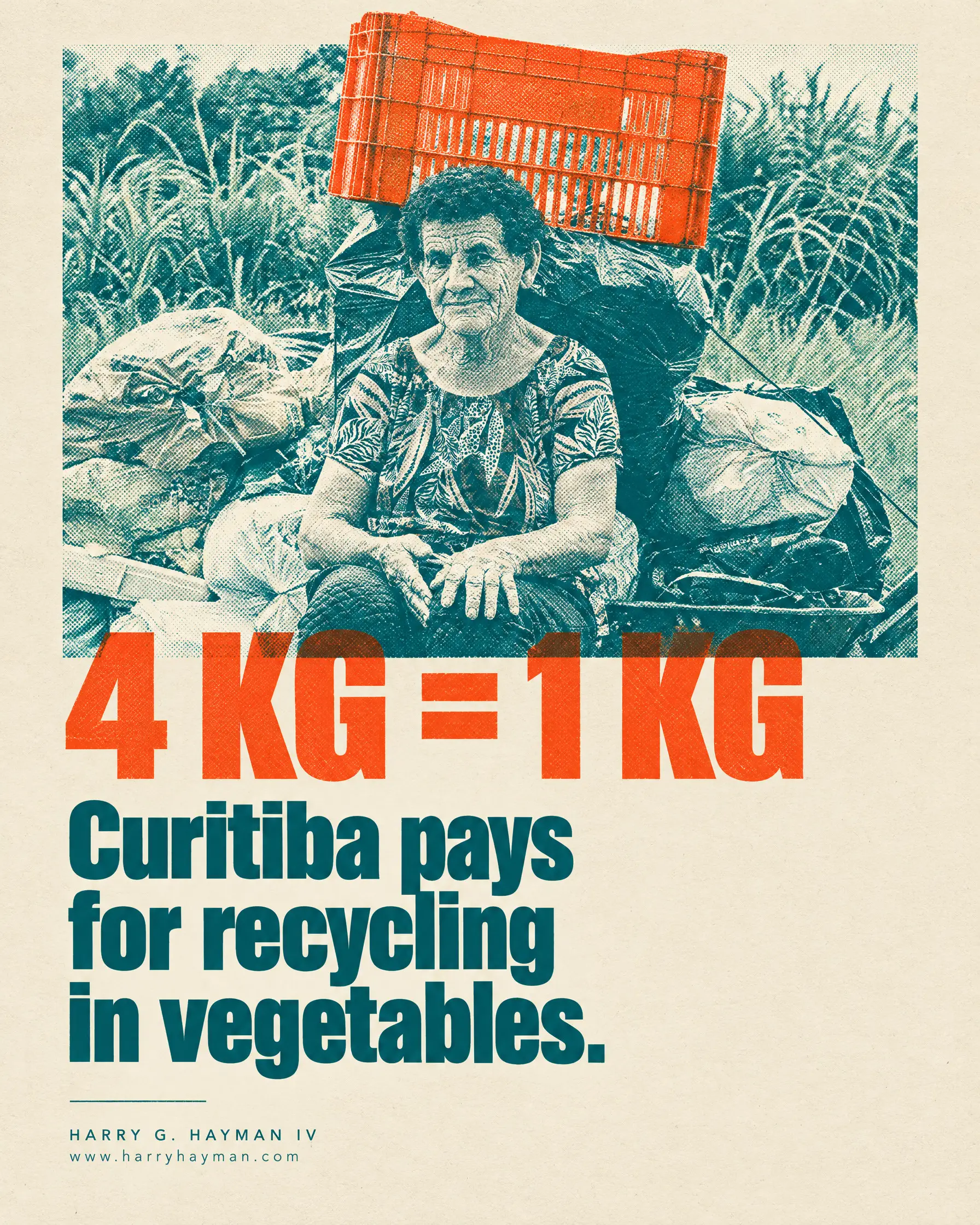
Four kilos of recycling buys one kilo of fresh fruit and vegetables. That is the exchange rate in Curitiba, Brazil, and it is written in the city’s own words: every four kilos of recyclable paper, cardboard, glass or metal, or four liters of used cooking oil in plastic bottles, entitles a resident to one kilo of seasonal fruit and vegetables. I read that sentence, then read it again, because I kept looking for the catch. The catch, it turns out, is where the produce comes from. That is the part I cannot stop thinking about.
How the exchange works
The program is called Câmbio Verde, the Green Exchange. According to the city, it has eight trucks that circulate Tuesday to Friday through 103 neighborhood points. A resident brings what they have sorted and walks away with produce by the kilo. The collected material goes to the Ecocidadão associations of waste pickers.
It is not new. The NYC Food Policy Center at Hunter College lists the program as initiated in June 1991, and notes that it guarantees the sale of surplus crop production while helping keep the city clean. Thirty five years is long enough that a city stops calling something a pilot. The city was still promoting it this year: it published an item in April 2026 about units of Câmbio Verde trading recyclables for produce, and in early November its official Instagram account (825,000 followers when I looked) posted the same offer with the caption “Quem diria que seus recicláveis poderiam virar frutas e verduras fresquinhas?”, which roughly means, who would have thought your recyclables could become fresh fruit and vegetables.
The part about the farmers
Here is the sentence that changed how I read the whole program. The city says the fruit and vegetables are bought from 389 family farmers in three cooperatives: Coophort in São José dos Pinhais, Cooacol in Colombo, and Provale, the cooperative of family producers of the valley.
So every kilo handed across that truck is a purchase. The reward is not a coupon, a point balance or a discount at a retailer headquartered somewhere else. It is a sale from a family farm to the city, and the resident is the one who carries the food home. The same dollar does two jobs. It pays someone to keep recyclables out of the trash stream, and it pays a farmer.
I want to be careful about what I am claiming. I am not claiming this solves Curitiba’s waste or its food access, and I am not claiming anything about emissions. The city has not said that, and I have not seen a source that says it. What the sources do show is a design choice: the money that rewards recycling is routed to regional farms instead of out of the region.
The 2024 numbers
The city’s own totals for 2024, the latest year I could verify, are 2,496 tonnes of recyclables and 16,077 liters of cooking oil collected, 738 tonnes of fruit and vegetables delivered, and 54,024 families served. I looked for 2025 totals and did not find them, so 2024 is what I will use.
I also did my own arithmetic, and I want to flag it as mine, not the city’s. 2,496 tonnes of recyclables against 738 tonnes of produce is a bit under 3.4 kilos in for each kilo out, not 4. I do not know why the totals do not match the stated rate exactly. The city might be counting the oil differently, or adding produce beyond the exchange rate. I would like to ask someone in Curitiba. If you know, tell me.
There is also a comparison I will not make: how this stacks up against what a normal recycling program costs. The city’s page gives no cost figure, so I have no honest way to put a price on it.
What Philadelphia already tried
Philadelphia has run its own recycling reward, so this is not a question about whether we are willing to pay people to recycle. Philacycle began in 2017 through a partnership with Recyclebank. Residents earned points, and according to Waste Dive, accumulated points could be traded for rewards such as gift cards. In November 2017 the city was still inviting residents to “join the 200,000 Philacyclers across the city”.
It ended in 2019. The reason was money, and the reporting is specific about it. Philadelphia was receiving about $5 million a year in recycling revenue when Philacycle began, then was paying $45 a ton at the start of 2018, and the program itself cost the city between half a million dollars and $1.5 million depending on the year. When the market flipped, a reward program became a cost the city could not defend.
I am dating this comparison to Philacycle, 2017 to 2019, because that is the period the sources cover. I am not covering anything earlier than that, because I could not verify it.
Same incentive, different economy
The two programs looked alike on the surface. Both rewarded residents for recycling. What differed was where the reward money went. A model that pays in points and gift cards sends the reward spending to whoever honors the gift card. The Curitiba model sends it to 389 family farmers a short distance from the city, and it comes back to residents as food.
That is a structural difference, and it is the only reason I find the comparison useful. I am not asking anyone to recycle more or to change what they do at home. The question is about program design: when a city is going to spend on an incentive anyway, who gets the spending?
I wonder what a Philadelphia version would buy. Lancaster County and Chester County are close enough that I can picture it, but I do not know whether the city’s procurement rules, the farm cooperatives that exist here, or the economics of recycling right now would allow it. I also wonder what it would do on the blocks that need both cleaner streets and better food access. Those are open questions, not a proposal.
Two other voices on the same program
Curitiba’s program has been covered before by outside outlets, not only by the city. Al Jazeera English included it in a report called Curitiba’s Collective Dream, and CGTN America made a short piece titled Curitiba’s Green Exchange program. Neither is recent, so I would not use either one for current totals. I include them because the subject has been picked up more than once, not because I am citing their numbers.
What I would do next
If a city official or a farm cooperative in this region wants to look at this model, I would start with three questions. Who would the buyer be, and who are the farms? What does the reward cost per kilo compared with what the city already pays to haul recycling? And how does the city count what it hands out, so that the numbers add up the way Curitiba’s almost do?
I do not have the answers. I have a number that stopped me, four kilos for one, and a fact behind it: the other side of that exchange is a farmer.
Sources and references
- Prefeitura de Curitiba, “Populacao de Curitiba pode trocar material reciclado por alimentos saudaveis no Cambio Verde” (23 January 2025)
- Prefeitura de Curitiba, “Material reciclavel pode ser trocado por hortifrutis no caminhao do Cambio Verde” (15 April 2026)
- Prefeitura de Curitiba (@curitiba_pmc) on Instagram, Cambio Verde post (November 2026)
- NYC Food Policy Center at Hunter College, Green Exchange Program, Curitiba: Urban Food Policy Snapshot
- Waste Dive, “Philadelphia cancels recycling rewards program” (5 June 2019)
- City of Philadelphia, Department of Streets, “Philacycle: how you can earn rewards for recycling” (17 November 2017)
- Al Jazeera English, earthrise: Curitiba’s Collective Dream (YouTube)
- CGTN America, Curitiba’s Green Exchange program (YouTube)