The Masonic Temple and the Future of Philadelphia's Art Museum
At the Masonic Temple on North Broad Street in Philadelphia, I heard Daniel Weiss talk about the museum's future. Harry Hayman shares what stuck.
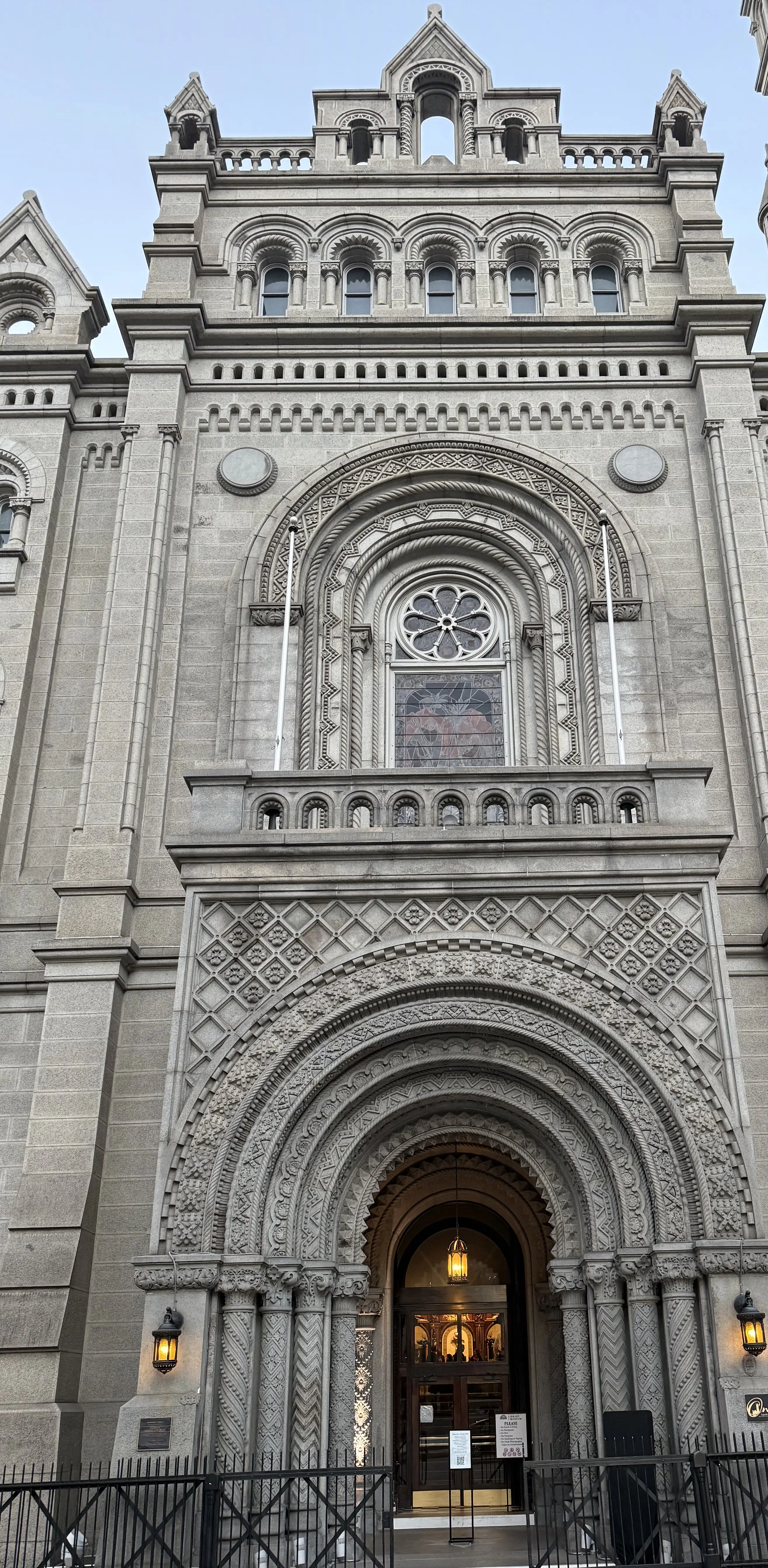
I walked up to a granite wall so carved and layered that I stopped on the sidewalk and just looked at it. Arch inside arch inside arch, rope moldings, little stone diamonds and flowers, a rose window high above the door, and two lanterns glowing at the entrance to the Masonic Temple at One North Broad Street. I have driven past this building, walked past it, probably hundreds of times. Maybe a thousand. Somehow I had never been inside. The Sunday Breakfast Club invited me to a gathering there to hear Daniel Weiss, the new Director and CEO of the Philadelphia Museum of Art, talk about where one of this city’s great cultural institutions goes from here. I took a handful of photographs, and I have not stopped thinking about the room, or the conversation.
The Building I Kept Driving Past
Let me start with the place, because it earned it. The Temple is the headquarters of the Grand Lodge of Pennsylvania, which has met there for about 150 years, and VisitPhilly says it was built over five years and completed in 1873. The Inquirer describes a five story, 97,000 square foot Romanesque structure that cost $1.6 million at the time, designed by James Hamilton Windrim, with seven large meeting halls inside, each with its own theme, designed by George Herzog. The Temple’s own history page puts construction at 1868 to 1873 and says interior rooms were still being designed until 1908.
That is the thing I keep coming back to. The rooms, the ceilings, the craftsmanship, the detail. It is almost ridiculous what people built back then. You walk around wondering how the hell they even did some of it.
I photographed two plaques outside, and they say the same thing in different voices. A blue Pennsylvania state marker, credited to the Pennsylvania Historical and Museum Commission and dated 2007, calls it the 1873 Masonic Temple, a National Historic Landmark, and notes that its size and prominence reflect how important Freemasonry was in American history. A bronze plaque from the National Park Service marks the 1985 designation, and Wikipedia’s entry on the Temple gives the date as February 4, 1985, with the National Register listing coming in 1971.
Franklin, in His Apron
Inside, the first thing that stopped me was a bronze statue of Benjamin Franklin, standing with one hand resting on a pedestal and a book in the other, wearing a Masonic apron over his coat. A pale curtain hangs beside it, which fits the Inquirer’s tour column, where a curtain can be pulled around the Grand Ballroom’s bronze Franklin for events. I took it to be that same statue. The Inquirer puts it at 17 feet and VisitPhilly says 18, so I will not pick a side on the height, but it is large and it is striking.
Behind glass nearby I photographed a white sculpture of a woman reclining with three small children climbing into her robes, and gold lettering under it that says CHARITY. I could not find a credit for the piece, so I will only tell you what I saw. A woman, three kids, and one word. In a building about a fraternity, it landed on me harder than the architecture did. Stained glass from the room behind it shows in the reflection on the case, which makes the photograph a little accidental and a little better for it.
If you want to see it yourself, the Inquirer reported in April 2025 that public tours ran Wednesday through Saturday, took about an hour, cost $15 for adults and covered only about 30 percent of the building. The paper also reported that 12,863 people toured the Temple the year before, more than the 11,886 who took City Hall tours. Schedules change, so check the Temple’s website before you go.
Why the Museum Needed a Conversation
We were there to talk about the museum, and the museum has had a year. Daniel Weiss was announced as Director and CEO on November 21, 2025, and the museum’s own release says he took the role on December 1 as the George D. Widener Director and CEO, with the board expecting him to lead it through at least 2028. He ran the Metropolitan Museum of Art in New York from 2015 to 2023, and before that he was president of Haverford College and, earlier, Lafayette College.
The Inquirer’s report on his hiring laid out what was waiting for him: whether to roll back a recent rebrand, a closed Perelman annex, a stalled east steps gallery expansion, deferred building maintenance, a small endowment, an operating deficit and slow visitor recovery since the pandemic. Weiss said something I admired in that same piece, which was that he needed to listen and to learn. A leader who says that out loud, as he is being named, is telling you how he plans to work.
A note on the name, because I know some of you are wondering. In October 2025 the museum began calling itself the Philadelphia Art Museum. On February 4, 2026, the board voted unanimously to go back to the Philadelphia Museum of Art, according to 6abc, which said the rebrand had drawn criticism. The museum’s homepage uses the older name today, so that is what I use here.
What I Took From the Room
I will not pretend to give you a transcript. I am not going to put words in anyone’s mouth, and I am not going to guess at plans nobody announced. What I can give you is the set of thoughts that followed me home, and I have been saying versions of them for years.
First, how do you modernize a place like the Temple, or a museum like this one, without messing up what makes it special? We know a few more things now than we did a bit over 150 years ago, and there is nothing wrong with evolving. The craftsmanship in that building is the reason people line up to see it. The question is how to keep that and still be a place people use in 2026, with technology changing everything quickly.
Second, Philadelphia has an extraordinary amount of cultural talent and infrastructure, and we are not always good at connecting it. I keep thinking about how many artists, neighborhood arts groups and creative people are doing interesting work all over this city while our largest institutions sit in their own buildings. Major institutions have a real opportunity here. Preserving and exhibiting extraordinary work obviously matters, and I would never argue otherwise. But they can also get more involved with the people making work in the neighborhoods, and those people can show them things the institution would never find alone.
Arts and Culture Are Economic Development Too
I have said this before and I will keep saying it. Arts and culture are part of what makes people want to live here, visit here, spend money here and build things here. The numbers back it up, with one caution about their age. The Greater Philadelphia Cultural Alliance’s report, covered by WHYY in September 2017, found that audiences and arts organizations contributed $4.1 billion to the region’s economy in 2016, nearly 25 percent more than in 2011, and that city tax revenue attributed to the arts sector rose 32 percent. That is the most recent version I could find, so treat it as a floor of evidence rather than today’s figure.
Sitting in that gorgeous hall, it was hard not to notice the economics of a night like this one. A club fills a landmark building, an institution sends its leader to talk, and a room full of people leaves with a reason to keep showing up. That is infrastructure, even when it looks like breakfast.
Fewer Silos, Please
And fewer silos, please. We have enough of those to store the nation’s corn supply.
I mean that as a request to every organization in this city, mine included. The museum can talk to the neighborhood arts group. The Temple can host the conversation. The club can bring them together. Philadelphia does not lack talent, and it has never lacked buildings worth gathering in. What it lacks, on a bad day, is the habit of walking across the street to someone else’s room.
I am looking forward to seeing what Daniel and the team at the museum have in mind. Big thanks to the Sunday Breakfast Club for the invitation and for bringing people together for conversations like this one. And Philadelphia, seriously, if you have never been inside the Masonic Temple, you should see that place. What a city.
Sources and references
- VisitPhilly: Masonic Temple
- The Inquirer: Masonic Temple turns 150
- Masonic Temple of Pennsylvania: History of the Masonic Temple
- Wikipedia: Masonic Temple (Philadelphia, Pennsylvania)
- The Inquirer: Masonic Temple tours review
- Philadelphia Museum of Art press release: Daniel H. Weiss as Director and CEO
- The Inquirer: Daniel Weiss named new director and CEO
- 6abc: Museum name change reversed after four months
- Philadelphia Museum of Art homepage
- WHYY: Arts and culture, Philly’s $4 billion engine