Kissho House and Sam Behind the Bar in Rittenhouse
A night at Kissho House on Locust Street in Rittenhouse, where a bartender named Sam turned a Japanese restaurant bar into the best seat in Philadelphia.
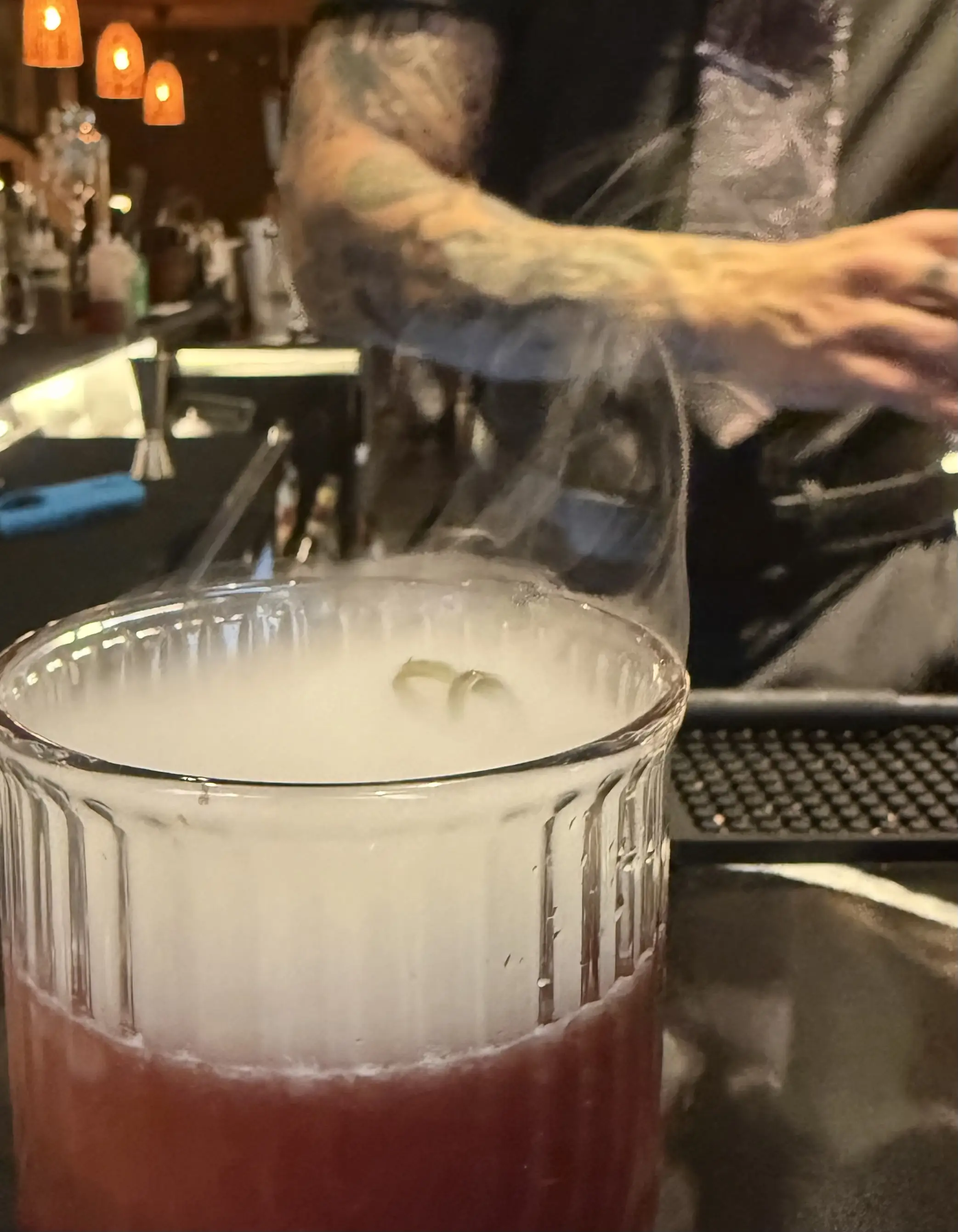
The first photograph I took that night is a bad one, and I am keeping it anyway. A cocktail is smoking in a ribbed glass, the focus is on the vapor instead of the drink, and behind it a tattooed forearm is reaching for something I never saw. I’m Harry Hayman, and I took it because the man behind that arm was already making the night feel different. His name is Sam. The room is Kissho House, at 1522 Locust Street in Rittenhouse. I went for dinner, and I left already knowing where I would sit next time. This is the longer version of that story, with a little background on the kind of restaurant it is, because the place deserves more than a caption.
What Kissho House Is
Kissho House is a Japanese restaurant with two floors and two personalities. The restaurant’s own site says omakase takes center stage in the basement and that robatayaki, skewers grilled over charcoal, reigns on the first floor, with a full liquor license upstairs. The sign in my photographs says it plainly: sushi, omakase, robata yaki, bar, established 2025.
The Inquirer introduced it before it opened as the first restaurant of a Philadelphia sushi chef, Zhengmao “Jeff” Chen, in a rowhouse that used to be a law office. The paper described an eight seat sushi bar downstairs and a street level with a bar whose drink list would run seventy percent Japanese brands. Rittenhouse Ramblings visited soon after the opening and called it the first of three Japanese culinary journeys in the neighborhood.
The name is worth a moment. The two characters on the red seal in my photo, 吉祥, are read kisshō or kichijō, and the Jisho dictionary defines the word as a lucky omen, something happy and auspicious. A restaurant named for good luck, with a lucky cat in the window. I will come back to the cat.
How the Night Went
I am not a restaurant critic. I came to eat, to drink and to see what a new room in my own city felt like. The Infatuation singled out the downstairs omakase counter, and that is on my list for next time.
What I felt was a beautiful room with the right energy. The food I ordered was on point. The photographs show a plate of seared tuna fanned over greens with a pale sauce, a long white dish carrying a roll topped with crisp tempura crumbs and bright red roe, and a hot plate dressed with a spicy mayonnaise over shredded cabbage. I will not pretend to know the proper names of what I was served, so I will not guess at them. The food was good.
Then there was the bar.
Sam
Sitting at the bar with Sam took the whole night somewhere else. I mean that as a compliment to the room and an even bigger one to him.
This man is a true craftsman, and I do not mean it in the fancy cocktail, watch me do something with a smoke gun sense, though the smoking glass is right there in the photo. The man understands what he is doing. The drinks, obviously, but also the timing, the conversation, when to engage and when to leave you alone. Those are the little things that make sitting at a great bar feel different from sitting at a good one. He also happens to be an absolute delight.
I have spent enough of my life in restaurants and bars to know when somebody really understands hospitality. Sam does. I do not have his last name, and I would rather leave a gap than invent one, so he stays Sam, which is how I will remember him anyway. If you know him, tell him I said so.
One photograph catches him handing over a cocktail crowned with foam, and the foam carries a swirl of fine golden lines, a pattern someone drew with a steady hand. His forearm, covered in ink, takes up the top of the frame. It is the kind of detail you only get from a person who does the small thing carefully every time.
What Was in the Glass
The cocktail menu is printed on black card in gold, and I photographed it with a drink standing in front of it. The list leans on Japan. One line is called Taste of Japan and pairs Toki whiskey with yuzu and passion fruit, finished with a citrus crumble. Another, the Gemini Effect, brings gin together with jasmine and green tea and a honey ginger syrup. The Flying Kite is vodka, yuzu liqueur, strawberry and cranberry. A tequila drink called The Whatever is topped with mango pearls. Cocktails run from sixteen to eighteen dollars on the page in my photo, and there is a sake list on the same card.
I will not tell you which drink was in which photo, because I do not want to get it wrong on Sam’s behalf. What I can say is that the drinks I was handed looked the part: a deep red glass wreathed in smoke, a golden one with a candied crisp balanced across the rim, and an orange one with golden pearls, a dried lime wheel and a dusted rim.
That matches the idea behind the restaurant. The first floor is built in the spirit of an izakaya. According to Wikipedia, an izakaya is an informal Japanese bar serving drinks and snacks, a name that began as a sit down sake shop. It is a place built around drinking and sharing, and a bar like that depends on the person standing behind it.
Fire, Rice and a Lucky Cat
Part of me went looking for the history behind the other words on the sign. Robatayaki, according to Wikipedia’s entry, is a Japanese method of grilling food at varying speeds over hot charcoal, traditionally seafood and vegetables, and it is said to come from the cooking of northern Japanese fishermen. The restaurant’s own site describes the same idea, charcoal skewers on the first floor.
Omakase has a gentler meaning. Wikipedia gives it as roughly “I’ll leave it up to you,” from a verb meaning to entrust, a dinner where the chef decides what you eat. The Inquirer says Kissho’s version downstairs is a $150 omakase of eighteen or nineteen courses.
Here is what struck me, though. Omakase is an act of trust. You hand yourself over. A bar run well is the same transaction in a smaller room: you tell the bartender nothing, he works out what you need, and he gets it right. I went looking for the right word for what Sam does and found one on the Japan National Tourism Organization site. Omotenashi, it says, comes from the tea ceremony and means to wholeheartedly look after guests. The page adds that staff see no task as beneath them if it helps a guest have a great experience. I will not claim Sam was thinking about the tea ceremony. I will say that he practiced the thing.
The last photograph in the set is a neon cat. It is a maneki neko, the beckoning cat, lit in gold with red ears and a small OPEN sign in its paws. Wikipedia says the figure is often believed to bring good luck to its owner and that a raised paw is said to draw in customers. A restaurant called Kissho, which means a lucky omen, with a cat in the window waving people inside. It is hard to argue with the branding.
The Wall Behind the Bar
One more picture belongs in this story. A hand painted wall sign near the bar says DRINK RICH in tall black letters, with little drawings tucked between them: a smiling skewer, a cocktail glass with a cherry, a piece of gunkan sushi topped with roe, a green drink with a slice of cucumber. Above it are Chinese characters, and in the corner the name Kissho House sits next to the yellow characters for the name.
I like that a restaurant in Rittenhouse, a neighborhood with no shortage of polish, put a cartoon skewer on its wall. It tells you the people behind it are having fun. Philadelphia hospitality has always lived in places like that, where the craft is serious and the room is not.
Why I Am Going Back
By the time we left, I already knew exactly where I’d be sitting when we came back. At Sam’s bar.
If you want to go, Kissho House is at 1522 Locust Street, and the restaurant lists its hours as 11:30 a.m. to 10 p.m. Monday through Thursday, 11:30 a.m. to 11 p.m. on Friday and Saturday, and noon to 10 p.m. on Sunday. Hours can change, so check the site before you walk over. Have dinner. Grab a drink. And if you find yourself sitting in front of Sam, let the man work.
We’ll be back.