Insane Clown Posse in Philadelphia and the Juggalo Community
Insane Clown Posse in Philadelphia, a crowd of Juggalos, and why I think the real product of arts and culture is belonging, not the performance.
Confetti was still falling over the stage when I took the second photo in this post. White letters taller than the performers spelled I C P across the back, the floor was packed from the stage to the back of the room, and one fan’s arm rose into the frame toward all of it. I’m Harry Hayman, and I went to see Insane Clown Posse in Philadelphia for a concert. In my post I wrote that I came away with something much bigger, because I saw a community. This is the longer version: where the night happened, who Insane Clown Posse and the Juggalos are, what my photographs show, and why I believe the real product of arts and culture is belonging.
Thursday Night at Franklin Music Hall
Insane Clown Posse’s Philadelphia stop on its 2026 run was Thursday, October 22, at Franklin Music Hall. Loudwire’s April announcement of the tour dates lists it, and the Consequence concert listing fills in the rest: 7:00 PM at 421 North 7th Street. That is the night my photographs come from.
The room has had two names and two lives. As the Electric Factory it opened in 1968 in a converted tire warehouse at 22nd and Arch Streets, hosted acts including Jimi Hendrix and The Who until 1970, and was torn down in 1973. In 1995 the Electric Factory reopened in a converted building from the General Electric Switchgear Plant at 7th and Willow Streets. The Bowery Presents bought it in September 2018, and a public naming contest with more than 5,000 submissions produced the name Franklin Music Hall that October, as Wikipedia’s history of the venue tells it. AEG Global Partnerships lists the capacity at 2,700.
My fourth photo shows the room from the back: a floor full of heads under bare trusses and ductwork, with the plant’s industrial bones still overhead. Philadelphia has been buying tickets at this address since 1995, and on October 22 the ticket said Insane Clown Posse.
Who Insane Clown Posse Are
Insane Clown Posse is an American hip hop duo formed in Detroit in 1989. Its best known lineup is Violent J, whose legal name is Joseph Bruce, and Shaggy 2 Dope, whose legal name is Joseph Utsler. Their style is a hardcore strain of hip hop called horrorcore, and Wikipedia’s profile of the group says they are known for elaborate live performances, which is an accurate description of what my third photo shows. The same profile says their following, the Juggalos, numbers in the tens of thousands.
In 1991 the duo and their manager, Alex Abbiss, started an independent label, Psychopathic Records, headquartered in Farmington Hills, Michigan. According to Wikipedia’s article on the label, a drawing Joseph Utsler scribbled on a napkin, now known as the Hatchet Man, became its logo. The songs revolve around a mythology called the Dark Carnival, which the group’s profile describes as a limbo where the lives of the dead are judged, and a series of stories called Joker’s Cards, each one built around a specific lesson. I am a Philadelphian describing a Detroit mythology from outside it, so I will leave the theology to the band. What I can report is the crowd it has gathered.
What My Photographs Show
The third photo is the main set at full tilt. Performers move through a storm of confetti, most of them in jumpsuits cut in panels of green, blue and purple. Two white hatchet man figures stand on either side of the giant I C P letters, and barrels topped with rows of bottles line the stage. I cannot read a label on those bottles, but the group has a long history with Faygo, the Detroit soda, and Wikipedia’s article on Faygo notes that the group references the drink in several songs and sprays live audiences with Faygo showers.
The fourth photo is the whole room from behind the crowd, and the fifth and sixth turn to the opening sets. In the fifth, performers spread out across a stage lit in red and blue, with a banner behind them of a figure in a jersey numbered 508. In the sixth, a banner in graffiti letters shows the letters WAKK and the words THE KID, with a hatchet man logo in each top corner and the rest of the name hidden behind the performer standing in front of it. Psychopathic Records’ artist page lists a signed rapper from North Hollywood, California, as Wakko the Kidd, and the lettering, the logo and the label all point the same way.
The seventh photo is the bar, bottles glowing red and violet on a lit shelf beneath two screens that remind everyone to grab a snack. The eighth ends close on a patch: a grinning red face in a propeller beanie, one eye swirled into a spiral, with a small hatchet man figure stitched below it.
The Juggalos
A Juggalo, or Juggalette for a woman, is a fan of Insane Clown Posse or of another act on Psychopathic Records. According to Wikipedia’s article on the subculture, the word began in 1994, when Violent J addressed a live audience as Juggalos during a song called The Juggla and the positive response led the duo to keep using it. The same article says Juggalos have developed their own idioms, slang and characteristics, and that they have compared themselves to a family.
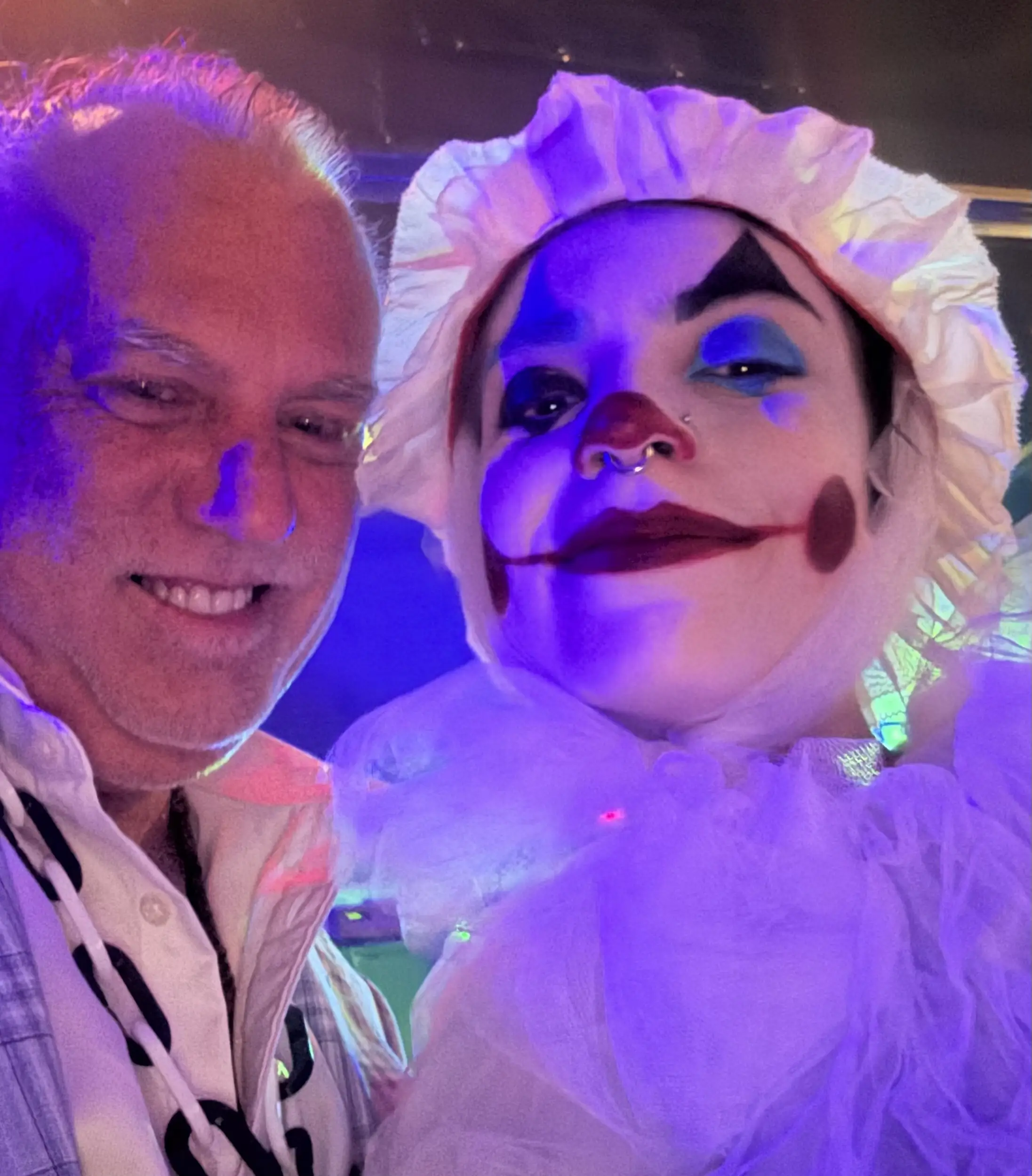
The same article lists face paint among the common marks of the subculture, and the first photo in this post is the plainest example I have. I am smiling beside a fan in full clown makeup, a red painted nose and a white lace bonnet, under purple light. In my post I asked who cares what they look like. That photo is the answer, and the grin on my face in that frame matches what I wrote about the night.
The community’s largest annual room is the Gathering of the Juggalos, a festival put on by Psychopathic Records that keeps its own site at juggalogathering.com. Wikipedia’s article on the festival says the first one was held on July 21 and 22, 2000, at the Novi Expo Center in Novi, Michigan, with roughly 2,000 fans, and that Joseph Bruce has called it a Juggalo Woodstock. Loudwire’s announcement counted the 2026 edition, in Macks Creek, Missouri, as the festival’s 26th year. A festival in its 26th year, a name that began as a crowd’s reaction to a song, and a vocabulary of their own: that is the evidence behind the sentence in my post that Juggalos are not just fans.
Belonging Is the Product
In my post I wrote that sometimes the real product of arts and culture is not the performance. It is belonging. Philadelphia has research that points the same way. In 2005 Penn Today profiled Mark Stern and Susan Seifert and their Social Impact of the Arts Project at the University of Pennsylvania, and reported that poor neighborhoods with a significant cultural presence were three times more likely to see poverty decline, less likely to lose population, and more likely to stay ethnically diverse. Stern was careful about the reason. Penn Today wrote that cultural organizations encourage revitalization, but not because of the number of tickets sold to a performance or an art museum. It is more about social capital, the firming up of a neighborhood when people get involved with their community and feel able to control their environment.
A concert is not a neighborhood program, and I am not claiming Stern’s numbers describe Franklin Music Hall. But the distinction he draws between tickets sold and people involved is the one I felt in that room, which AEG lists at 2,700 people. What I wrote about was the language, culture, history and identity those people carry into the room and out again, and none of it is printed on a ticket.
It is also why I keep arguing that culture is infrastructure. A city needs rooms where people can show up completely as themselves. Just days earlier I stood among tombstones at Laurel Hill Cemetery to watch The Dead Milkmen, a band I have been seeing since the 1980s, and the pull was the same: a band, a crowd and a bond older than the night.
Lean In
People say find your tribe so often that it can sound like a poster. In that room it was a description of what I was watching. Who cares what music they listen to? Who cares whether anybody else understands it? If they’re your people, they’re your people. I put my own advice in four words, one of them shortened to a single letter: Lean the F in.
A ticket gets you through the door. Face paint and a white bonnet are what one fan chose to bring in with them, and the hatchet man logo turns up in my photographs on the stage, on a banner and on a patch, a shared sign in a room full of people who share a vocabulary. The performance was one part of an incredible night, and not the biggest part.
Thank you to the artists, the merch guys, the people backstage and the people traveling with the show who talked with me. Incredible night. Incredible energy.
Sources and references
- Franklin Music Hall
- Loudwire: Insane Clown Posse Announce New 2026 Gathering of the Juggalos Location, Add Tour Dates, April 8, 2026
- Consequence Live: Insane Clown Posse at Franklin Music Hall, October 22, 2026
- Wikipedia: Franklin Music Hall
- AEG Global Partnerships: Franklin Music Hall
- Wikipedia: Insane Clown Posse
- Psychopathic Records
- Wikipedia: Psychopathic Records
- Wikipedia: Faygo
- Psychopathic Records: artists
- Wikipedia: Juggalo
- Gathering of the Juggalos: official site
- Wikipedia: Gathering of the Juggalos
- Penn Today, December 2005: The arts help neighborhoods flourish
- Harry Hayman: The Dead Milkmen at Laurel Hill Cemetery