Field Day, a Regional Bar in Northern Liberties That Gets It Right
A Philadelphia dinner at Field Day, the regional bar on North Second Street in Northern Liberties, and what Harry Hayman noticed about its service.
A tall arch frames the front of Field Day at 923 North Second Street in Northern Liberties, and under it the window frames and the door are painted a deep green. FIELD DAY is lettered in gold on the glass of the door, a small Pennsylvania keystone sits below the address, and a coral sandwich board on the sidewalk says a regional bar. I’m Harry Hayman, and I photographed that doorway on the night of October 28, a week after opening day in Philadelphia. My friend Josh Eats had told me to go, and I wrote that he called this one. This is the longer version of that post: who is behind Field Day, what it is trying to be, what came to the table, and why the service is the part I loved most.
A Regional Bar Behind the Arch
Field Day is a regional bar and restaurant at 923 North Second Street in Northern Liberties, the Philadelphia neighborhood north of Center City along the Delaware River. Its website and its sandwich board both say a regional bar. It belongs to Danny Childs, a bartender who has won a James Beard Award, and his wife, Katie. The Inquirer’s opening day report calls it a love letter to our region and says the menus highlight ingredients and culinary traditions from as far west as Appalachia and Lancaster County, as far east as the farmlands of South Jersey and the Shore, and as far south as the Chesapeake Bay. PhillyVoice put it next to North Bowl and listed the opening for Wednesday, October 21, 2026.
The building has a story too. When the Inquirer first reported on the project in April, it placed Field Day in a street facing space inside the Cescaphe Ballroom and described the bar as the entryway to a former movie theater. Cescaphe keeps operating in the rear. The arch in my photograph frames that street facing entrance, lit from the side against a dark sky, with a small evergreen in a planter beside the door.
The Couple Behind the Bar
Philadelphia Magazine reported in May that Field Day had been in the works for more than a year and would be the first bar that is actually theirs, after years of working for and with other people. His James Beard Award came for a book, Slow Drinks, which the James Beard Foundation lists among its 2024 Book Award winners in the Beverage with Recipes category. I wrote about that book in my post about La Jefa, where the Inquirer says Danny has worked as a consultant. He developed Slow Drinks at Farm & Fisherman in Cherry Hill, and the Inquirer’s profile quotes him calling Field Day a blueprint for what Slow Drinks looks like in practice day in and day out.
Melissa McGrath of Sweet Amalia, whom the Inquirer calls James Beard nominated, leads the kitchen. Sous chef April McGreger, a preservation pro in the paper’s words, makes a pickle plate it calls a must try, and Jamaar Julal spearheads the fermentation projects, splitting his time between the kitchen, the bar and an upstairs lab. Katie oversaw the room’s design with Laura Weiszer of Betsu Studio. The paper counts a dining room of 50 seats and 25 employees and concludes that Field Day is arguably just as much restaurant as bar.
What Came to the Table
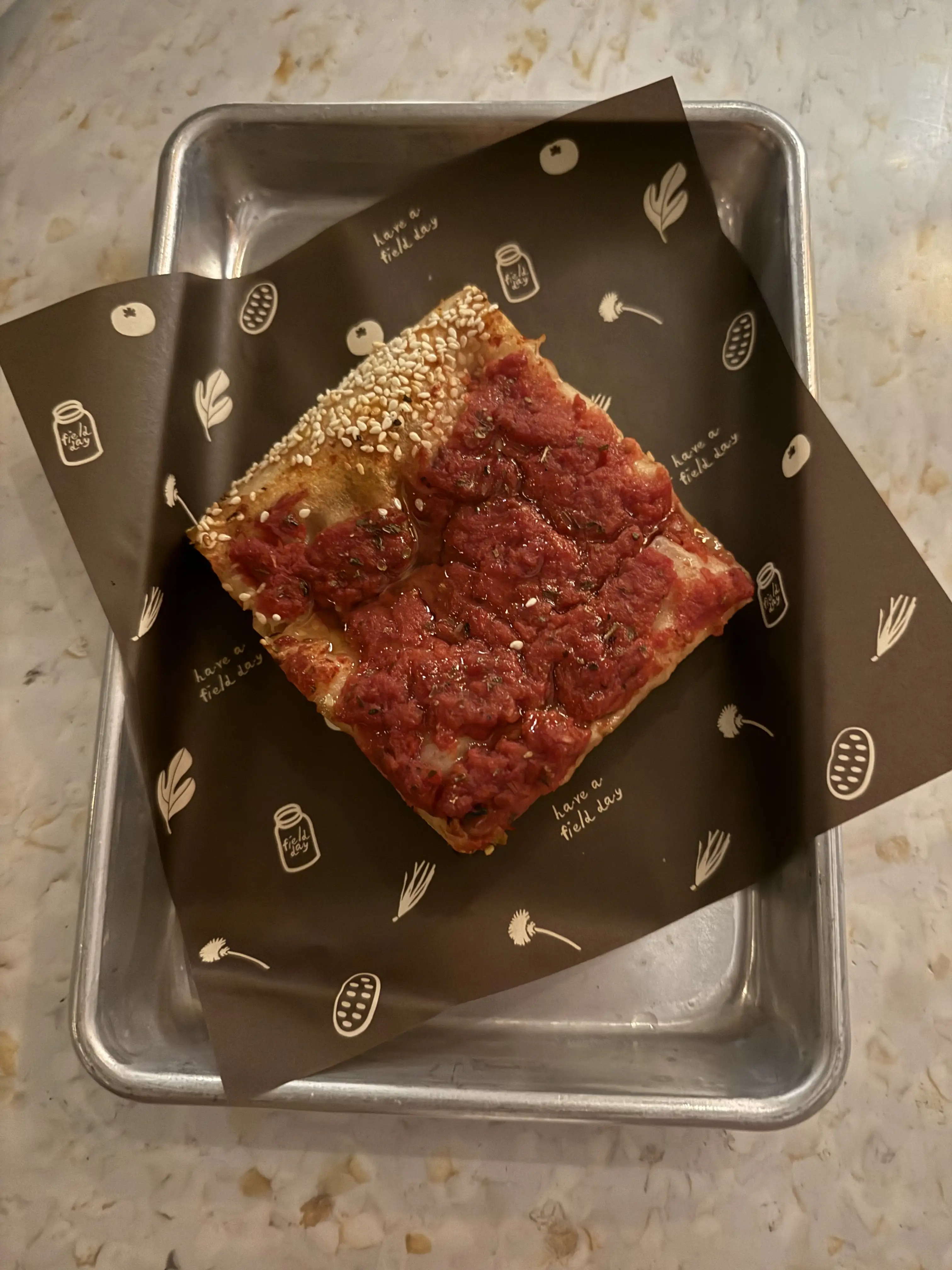
The post I put out names no dishes, so here is what came to the table, with the menu supplying the names. Nearly every plate wears the same brown paper, printed in white with the words have a field day and small drawings of jars, leaves, dandelions and potatoes.
My cover photograph is the tomato pie: a square slice, red from edge to edge, with sesame seeds along one crust edge, in a metal sheet pan. Tomato pie is an old Philadelphia habit. The Encyclopedia of Greater Philadelphia says Italian bakeries in South Philadelphia have served it since the early twentieth century, more typically cooled to room temperature than hot, and that it has gone by names including church pie, square pizza and red pie. Field Day’s food menu lists a tomato pie with sourdough, Jersey tomato and oregano, and the Inquirer reports that Jamaar Julal makes miso from stale tomato pie. The pie that goes stale becomes seasoning, and I cannot think of a tidier way to waste nothing.
The rest of the evening is in my photographs as a run of small plates. One tray holds a halved egg with a pink rim, a steel cup of cauliflower and carrot, rice with a curl of carrot on top, curled green stems beside a few beans, and glossy amber chunks, and the menu’s pickle plate lists lacto ferments, a pickled egg, marinated vegetables and misozuke. A bowl of round golden bites, a few crusted with sesame, comes with a pale sauce flecked with chili and a lemon wedge, and one bite torn open shows a green center, which fits the menu’s fried olives with garlic aioli and lemon. French fries arrive with a cup of deep red ketchup. Dessert comes as a small cast iron skillet holding a chocolate chunk cookie flecked with salt, beside a ramekin of white cream, and as a slice of pie under a rough crumble on a white plate splashed with red. The menu lists a skillet chocolate chip cookie made with Rabbit Hill Munich malt and a Dutch apple crumb pie that credits its apples to Three Springs.
A Drink Menu Written as a Field Guide
One photograph shows a dark cocktail with a single large clear cube and a leaf on top, on a cork coaster in front of a tall menu card printed in a quilt pattern. Below it lie the pages of the drink menu, which Field Day calls the Field Guide. Each drink gets a box with its ingredients, a story, small icons for regions and processes, its botanicals and its price. The Inquirer counts 36 cocktails in the guide, and The Infatuation says the field guides detail exactly where the foraged crabapple in a drink came from.
My photograph catches four drink cards from the strong and stirred section: the Black Walnut Old Fashioned, Corn n’ Oil, Grand Pomme and Ristra Rosita. The Black Walnut card says one of the earliest stories of the walnut liqueur nocino traces back to the ancient Romans, then says the bar honors the tradition by harvesting green walnuts from South Jersey parks and baseball fields every June 24 and pairing them with sassafras root beer syrup. It closes on a line worth borrowing: what grows together goes together. The Corn n’ Oil card turns a Barbadian classic into what it calls a study of the entire corn plant. Danny’s book has A Field Guide in its subtitle, and the bar’s drink menu is the Field Guide, so the idea travels from the page to the pour.
The back bar tells the same story. The Inquirer says the walnut shelves above it hold souvenirs from the owners’ travels and family heirlooms, including both great grandfathers’ bottle cappers: Danny’s great grandfather brewed sassafras root beer, and Katie’s made dandelion wine. In my photograph those shelves glow in lamplight, with a plaid picnic basket, a ceramic chicken, jars of pickled peppers and vegetables, a stained glass lamp, and cookbooks whose spines I can read, among them Six Seasons, Chez Panisse Vegetables and Ethnobotany.
Service That Does Not Go Through the Motions
I have spent a good part of my life in the restaurant and hospitality business, and the habit it leaves is hard to switch off. I notice things most people never think about, and the people I dine with will tell you that is sometimes a blessing and sometimes not. Field Day got it right. Everyone made us feel comfortable and welcome, nobody went through the motions, and the staff seemed engaged, attentive and glad to be doing the work. That is a big deal in this business. A beautiful room and a great menu count for a lot, but if the people taking care of the guests are not getting it right, none of it counts nearly as much.
I was not the only one to see it. Alison B. Kessler reviewed Field Day for The Infatuation on October 23 and wrote that the music is loud, the bar is lively, and the service has no hint of stiffness. The owners say welcome is the goal. The Inquirer calls the design an effort to make a homey, welcoming spot that tries to telegraph comfort above all else, and Danny told the paper, “We want anybody to walk in here and feel welcome, and that it’s not like they’re going to school, that they’re just at a great bar.” Roughly half the seats, including all 20 bar seats, are earmarked for guests without a reservation, which says who the room is for. Of the team he has assembled, Danny said, “These are people that I love and respect and look up to in a lot of ways.”
That is the comfort I felt. I know how much work goes into making an evening like that happen, and it does not go unnoticed. Congratulations to Danny, Katie and the entire Field Day team.
A Recommendation Worth Following
I have my friend Josh Eats to thank for sending me there. Josh Eats Philly describes itself with the line Eating My Way Through Philadelphia, and on this one the call was right. A tip from someone who eats his way through a city is an informal kind of infrastructure, the kind that points guests toward places that deserve them. Great seeing you, brother, and thank you.
What a Regional Bar Makes Visible
A regional bar makes a purchasing decision visible. The sandwich board says regional bar, and the menu backs it up with names a guest can look up: Three Springs for the apples, Rabbit Hill for the malt, Birchrun for the blue cheese that comes with radicchio and poached pears. Culture is infrastructure, and a place that treats its region as a supply chain, employs 25 people and gives a neighborhood a reason to look up at a doorway on North Second Street is building some of it. Tomato pie has been baked in South Philadelphia for more than a century, and Field Day points at that history instead of inventing it. 2026 reveals what was already here.
If you want to go, Field Day is at 923 North Second Street, reservations are on Resy, and about half the seats are held for walk ins. We had a blast, we ate and drank extremely well, and we left already talking about coming back, which in my book is the best compliment you can give a restaurant. Field Day, well done.
Sources and references
- Field Day: a regional bar, home page
- Field Day: food menu
- Field Day: Field Guide drink menu
- Inquirer: Field Day opens in Northern Liberties, October 21, 2026
- Inquirer: Danny Childs to open a cocktail bar, April 29, 2026
- Inquirer: Philly’s most ambitious bartender, October 24, 2026
- The Infatuation: Field Day review, October 23, 2026
- PhillyVoice: openings and closings, October 14, 2026
- Philadelphia Magazine: Danny Childs and Field Study, May 28, 2026
- James Beard Foundation: the 2024 Media Award winners
- Encyclopedia of Greater Philadelphia: Tomato Pie
- Wikipedia: Northern Liberties
- Josh Eats Philly
- harryhayman.com: La Jefa and the Suro family
- Resy: Field Day reservations