Temple's Ideas & Impact Challenge and the Founders Building Here
A night of founder pitches at Temple's Fox School in Philadelphia, and why the city has to show up for people while they are still building.
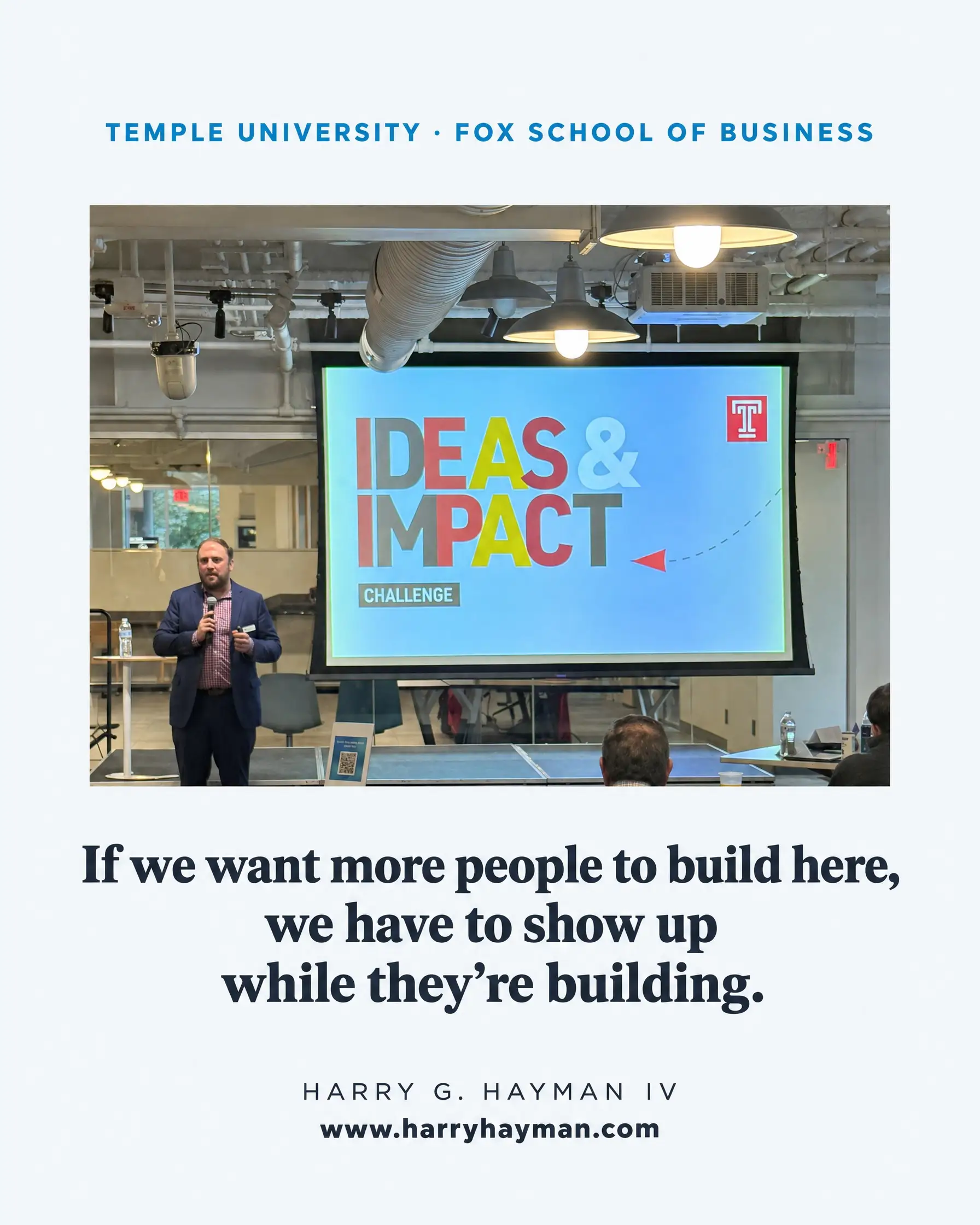
Philadelphia, if we want more people to build here, we have to show up while they’re building. That is the sentence I kept turning over on the way home from Temple. I’m Harry Hayman, and I was asked back to Temple University to stop by, hear what entrepreneurs are working on, show some support, and see whether there might be an opportunity to invest. As a Fox School alum who studied social entrepreneurship, I was happy to try and swing past. So I walked up to Alter Hall, the big white letters over the door spelling out FOX SCHOOL OF BUSINESS, and went inside to listen. What I found was a room of people standing in front of a screen, one after another, asking strangers to believe in something that does not fully exist yet. That ask never gets easy, and it should never be easy to ignore.
Walking Back Into Alter Hall
First, give Neil Johnston his flowers. Neil put this together, and on the Fox School’s own Innovation & Entrepreneurship Institute page he is listed as Director of IEI Accelerator Programs. That page describes the institute as promoting an entrepreneurial spirit across all 17 of Temple’s schools and colleges, through classes, workshops, conferences, mentoring and events. It is not only a business school club. A nursing student, an engineer, a musician and a staff member down the hall can all walk in the door.
The same page carries a testimonial I liked seeing. The founder of honeygrow, Justin Rosenberg, says there that he wrote a chunk of his business plan at Alter Hall. That restaurant chain started as an idea in a Temple building, and now people across the region eat there. I think about that every time someone tells me Philadelphia does not produce companies. It does. We just tend to notice them after they have made it, rather than while they are sitting in a classroom with a half finished plan.
So bravo to Temple University, the Fox School of Business, and the Innovation & Entrepreneurship Institute for making space for people to put their ideas in front of an audience that can actually help them take the next step.
What the Ideas & Impact Challenge Asks of a Founder
The slide behind the first speaker read IDEAS & IMPACT CHALLENGE in big blocky letters, with the Temple T in the corner. Temple’s page for this year calls it the 2nd Annual Ideas & Impact Challenge. It runs as a series of workshops, a keynote speaker and expert mentoring, and it ends in a full day of two pitch competitions, networking, speakers and seed funding for finalists. There are two tracks. One is for innovative, for profit ideas. The other is for social impact, meaning nonprofit ideas and social entrepreneurship. As someone who studied exactly that second thing at Fox, I was glad to see it given its own stage.
The rules tell you who this is for. According to that page, a business entering must be less than two years old, have gross sales under $25,000, and have raised less than $5,000 in total funding. Read those numbers again. These are not companies polishing a Series A deck. These are people at the very start, when a single customer or a single introduction can decide whether the idea lives.
The challenge is young, but the habit behind it is not. On the institute’s competitions page it sits beside the Be Your Own Boss Bowl, a business plan competition that runs from fall through spring. The Fox School’s story on the first year explains that it combined two older IEI pitch competitions, the Innovative Idea Competition and the Changemaker Challenge. That first final, in November 2025, had 16 finalists with three minutes each to pitch a panel of judges and then take questions. The grand prize in each track was up to $2,500 in seed funding, with a $500 people’s choice award in each track. Jane Golden gave the keynote. One of the afternoon judges came from Ben Franklin Technology Partners, the kind of investor that writes early checks in this region. I’ll come back to that.
The Pitches on the Screen
I took photos of the slides, because the slides are where founders put their whole argument in a sentence. One presenter stood beside a screen promising a community for international students, from the day they arrive to long after they graduate. Anyone who has watched a young person land in a new country with two suitcases and no friends understands why that matters, and Philadelphia has a lot of universities full of exactly those young people.
Another presenter asked the room a simple question on a slide: where did the village go? Next to a family photo was a calendar dotted with little cooking pots, one on this day, two on that one. Her closing slide said the village could be rebuilt one shared meal at a time, and gave the address for Second Helpings, which describes itself on its own site as meal swapping for your community. I have spent a big part of my life around food, and I know how much a dropped off dinner means to a tired family. Turning that into something people can organize, week after week, is the kind of idea a room like this exists to test.
On the table in front of the stage sat a small sign with a QR code: People’s Choice Voting, Social Impact Track. I liked that. The audience was not only watching. We were being asked to weigh in. A later speaker closed on a thank you slide covered in painted flowers, with her contact details beside it, which is exactly where a founder’s contact details belong at the end of a pitch.
To the entrepreneurs who put their work out there, BRAVO. It takes guts to explain what you’re building, take questions, and go back to work the next morning.
A Whiteboard Full of Open Doors
Out in the hallway, the whiteboards told their own story. One read Welcome to the 1810 Accelerator in red and black marker, sharing the wall with a welcome for Fox Honors and a happy fall semester. Another invited students to join the 1810 Accelerator and gain access to its space, a creativity lab, a free library, mentorship, networking and workshops, with a QR code taped underneath and an arrow that said scan to join.
The 1810 Accelerator is, in Temple’s own words, a place for the university’s entrepreneurial community to share knowledge, experience and connections. Membership is open to students, alumni, faculty and staff from all 17 schools and colleges. Members can use the space and reserve conference rooms, use the library and creativity lab, and attend Toolbox workshops, networking and speaker events. Its formal program, Startup Studio, takes a cohort each fall, spring and summer through a twelve week curriculum and ends with a Demo Day where companies pitch to potential mentors, investors and industry professionals.
That path keeps going. Each spring the institute runs the Be Your Own Boss Bowl, which Temple Now reported reached its 28th year in 2026, having started in 1997, with more than $100,000 in cash prizes and in kind services, $10,000 for each track winner and another $40,000 for the grand prize. So a founder can walk in through a whiteboard invitation, sharpen an idea in the fall, and pitch for real money in the spring. The ladder is there. What it needs is more of us standing on the rungs offering a hand.
What a Founder Needs on Any Given Day
Philadelphia needs more of this. A LOT more.
Think about what an early stage founder might need on any given day. A restaurant willing to test the product. A first paying customer. A mentor who will ask the question everyone else is too polite to ask. An introduction to someone who can open a door. And sometimes, yes, somebody willing to write the first damn check.
That last one deserves numbers. Ben Franklin Technology Partners of Southeastern Pennsylvania says in its 2024 impact report that in 2024 it approved $6.5 million for 28 companies across Southeastern Pennsylvania, and that its portfolio holds 186 companies. That is real money, and it matters. It is also a reminder of how few first checks there are compared with how many ideas I heard in a single evening at one university. Institutions cannot carry all of it. Restaurant owners, neighbors, alumni and local business people are part of the funding picture too, sometimes with a check, often with an order, an intro or an honest hour of feedback.
A room like this gives those conversations a place to start. It also gives the rest of us a chance to hear what people are building while our feedback, relationships, and capital can still make a real difference. Later, when a company is big enough to make the papers, it no longer needs us the same way.
Take the Meeting
To the rest of us who talk about growing Philadelphia’s economy, here’s something we can do this week. Take the meeting. Make the introduction. Give a founder a shot at earning your business.
I mean that literally. If you run a restaurant, let a founder test something with your staff. If you manage a budget, buy the first small order. If you know someone who could open a door, send the email tonight while you still remember the name. None of that requires a fund or a title. It requires showing up while the thing is still fragile, which is exactly when most of us stay away.
Neil, thanks for the invitation. Temple, keep putting founders in the room. Philly, let’s give them more reasons to build here.
Sources and references
- Fox School of Business: Innovation & Entrepreneurship Institute
- Fox School of Business: 2nd Annual Ideas & Impact Challenge
- Fox School of Business: New Temple pitch competition offers solutions to social challenges (December 2025)
- Fox School of Business: IEI competitions
- Second Helpings
- Fox School of Business: The 1810 Accelerator
- Temple Now: Supply chain platform wins undergraduate track at the 2026 Be Your Own Boss Bowl
- Ben Franklin Technology Partners of Southeastern PA: 2024 Impact Report
Photos: Harry Hayman.