Two Hundred Forty Salad Recalls and the Mechanism Behind Them
A federal recall count explains why so many packaged salads get pulled, and what building food closer to home in Philadelphia actually fixes.
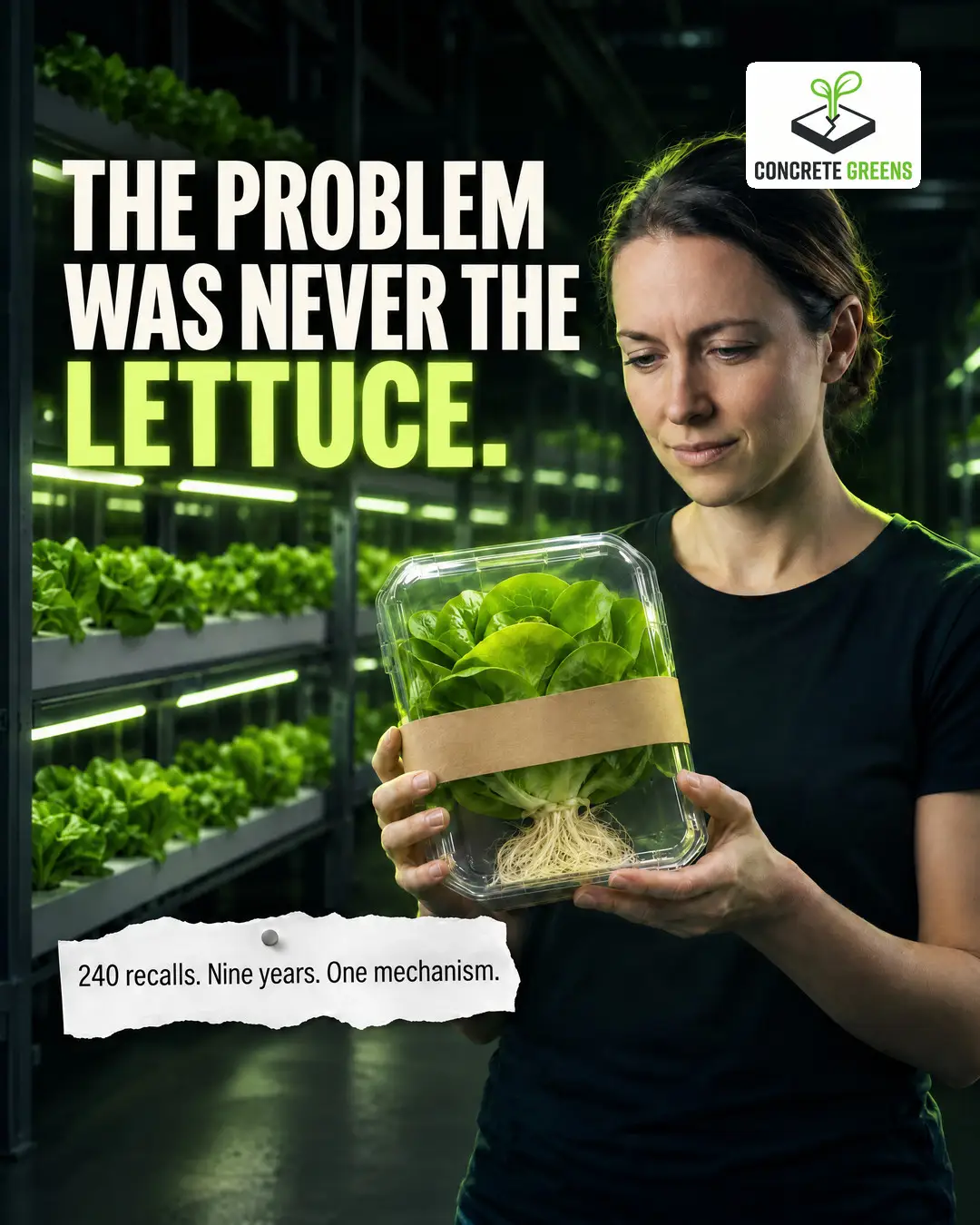
Two hundred forty. That is not a number I am rounding up for effect. It is what the CDC actually printed: two hundred forty separate packaged salad recalls that the FDA classified between January 2015 and May 2024, every one of them tied to possible Listeria monocytogenes. Eight listeriosis outbreaks linked to packaged salads in that same window. I read the study twice, because a number that size usually gets filed as background noise, one more headline about a bag of greens pulled off a shelf somewhere. It should not be background noise. Two hundred forty recalls over nine and a half years is not a story about bad luck, and it is not a story about a dangerous vegetable. It is a story about how far food travels before it reaches a plate, and about what happens when one facility is doing that traveling for an entire region.
The number I kept rereading
I want to be precise about where this figure comes from, because precision is the whole point of an argument like this one. The CDC’s Emerging Infectious Diseases journal published the count directly: roughly two hundred forty FDA classified recalls of packaged salad products, January 2015 through May 2024, all for potential Listeria contamination. In that same period, eight US listeriosis outbreaks were traced back to packaged salads, four confirmed and four suspected.
Sit with both numbers together. Two hundred forty recalls is a company or a regulator catching a problem before it reaches very many people, over and over again for nine and a half years. Eight outbreaks is what happens on the days the catch comes too late. Listeriosis is not a stomach ache you shake off by morning. The CDC’s own overview of the infection is direct about who it hits hardest: pregnant people, newborns, older adults, anyone with a weakened immune system. That is exactly why the recall machinery exists and why it fires as often as it does. My point in writing this is not that the machinery is broken. It is that the machinery is treating a symptom, recall after recall, without ever touching the reason the symptom keeps coming back.
Three ways in
Listeria does not appear in a bag of salad by magic, and it does not appear because somebody forgot to wash something. It gets in one of three ways, and all three are documented, unglamorous, and completely structural.
It rides in on irrigation water. Peer reviewed research on the subject, including a detailed review of Listeria monocytogenes in irrigation water, traces the pathogen straight back to the water source itself: agricultural water can carry it in from sewage overflow, storm runoff, or simple proximity to where animals graze, and once it is in the water it is on the crop.
It comes off the ground where an animal has been. Farm soil, manure, and any field an animal has crossed can carry Listeria, and unlike a lot of foodborne pathogens it survives well outside a host. It persists in soil. It persists on equipment. It does not need a warm body to keep going.
Or it lives inside a processing line. This is the route the CDC study leans on hardest to explain why packaged salad specifically shows up so often in the data, more than whole heads of lettuce or loose greens. The same CDC article states it plainly: because Listeria forms biofilms and survives for extended periods inside a facility, packaged salads carry a higher risk than less processed greens simply because they touch more surfaces and more equipment on the way to the bag. A biofilm does not care what brand ships that day. It sits in a corner of a line and contaminates whatever runs through it next.
None of that is about the plant. All three routes are about distance, in one form or another. How far the water traveled before it touched the leaf. How much field the crop crossed on the way to being cut. How long a piece of equipment has been running, and how many other batches moved through it before this one did.
What one facility can do to a whole region
I do not want to name a single company here, because this is not about any one operator and pointing at one lets everyone else off the hook. But the shape of the two largest packaged salad Listeria events in the last decade is worth walking through, because it shows exactly what a centralized supply line does when something does go wrong.
In one multistate outbreak investigated by the CDC and FDA, nineteen people across nine states were sickened, all nineteen hospitalized, one person died, and the cause traced back to a single processing facility in Ohio that ran salad under a long list of different brand names. Production at that one facility stopped, and the recall reached every one of those brands at once, because they had all, without most shoppers ever knowing it, been coming out of the same building. CDC’s own timeline of that investigation lays out how quickly one contaminated line became a nine state event once the product started shipping.
A second, longer running investigation that FDA later confirmed had been active since at least 2014 found an even harder lesson. FDA’s investigation summary shows eighteen illnesses, sixteen hospitalizations, and three deaths across thirteen states, and it took years to close because the contamination was not sitting in one spot. Investigators found Listeria on harvesting equipment used for iceberg lettuce at a facility in Arizona, and separately on processing equipment at facilities in Ohio and California, all feeding the same national supply chain. One company, one national distribution system, three contaminated points across three states, and years of illnesses before anyone could connect them.
That is what I mean by a multiplier. A single input, whether it is a bad batch of irrigation water or one dirty piece of harvesting equipment, does not stay local when the line downstream of it is national. It becomes every bag that ran through that line, in every state that line ships to, for as long as the contamination sits there undetected.
What a controlled environment actually removes
This is not an argument that food safety inspectors are doing their jobs badly, and it is not an argument that you personally need to wash your greens a third time. You cannot inspect your way out of a structural problem, and you cannot rinse away a biofilm sitting inside a processing line four states from where you live.
What actually changes the picture is shortening the distance and removing the field variables entirely. Federal regulators reached a version of the same conclusion from the other direction: the FDA’s Produce Safety Rule and its agricultural water requirements exist specifically because open field water and field contact are treatable risk points, not because the vegetables themselves are the problem. Growing indoors, in a controlled environment, takes irrigation water out of an open system and puts it in a closed, monitored one. It takes the field, and everything that walks across a field, out of the equation before the plant is ever cut. And when the growing space and the point of sale are close together, geographically, the line that a piece of contaminated equipment could poison shrinks from a national footprint to a neighborhood one. None of this makes food safety perfect. Nothing does. It changes which failures are even possible, and it changes how far a single failure can travel before somebody catches it.
What we are building in Philadelphia
This is the argument underneath what I am building with Concrete Greens, so let me say plainly what it is and is not. It is not a replacement for the farms already growing food the traditional way, and it never will be. Apples and peaches are not something you grow on a rack indoors, and nobody serious is claiming otherwise. What it is: a revenue funded, mission driven piece of local food infrastructure, built to break even on its own operations and to put its surplus back into Philadelphia neighborhoods that need it. Complementary, not competitive. Local, not national. Close enough that the distance a leaf travels between harvest and plate is measured in miles, not in the length of a supply chain that runs through three states before anyone notices something went wrong.
I keep coming back to the same sentence when I read a study like this one. The problem was never the lettuce. It was always the distance, and it was always the length of the line. Fix the structure, and the leaf takes care of itself.
Sources and references
Every figure and claim above comes from one of these, linked where it is used.
- CDC, Emerging Infectious Diseases: Listeria monocytogenes and packaged salads, 2025. The ~240 FDA classified recalls (January 2015 to May 2024), the eight US listeriosis outbreaks linked to packaged salads (2015 to 2024, four confirmed and four suspected), and the finding that packaged salads carry higher contamination risk due to processing surface contact.
- CDC, About Listeria Infection. Who is most at risk from listeriosis and why the illness is treated as serious rather than routine.
- National Institutes of Health, Listeria monocytogenes in Irrigation Water: An Assessment of Outbreaks, Sources, Prevalence, and Persistence. Irrigation water as a documented route of Listeria contamination in produce.
- CDC, Multistate Outbreak of Listeriosis Associated with Packaged Leafy Green Salads, United States and Canada, 2015 to 2016. The nineteen case, nine state, one death outbreak traced to a single processing facility.
- CDC, 2016 outbreak investigation archive, packaged salads. Timeline and facility level detail on the 2015 to 2016 event.
- FDA, Outbreak investigation summary, Listeria monocytogenes in packaged salad, reopened investigation closing 2021 to 2022. The eighteen illness, three death, thirteen state outbreak traced to harvesting equipment in one state and processing equipment in two others.
- FDA, FSMA Final Rule on Produce Safety. The federal standard covering growing, harvesting, packing and holding of produce, including leafy greens.
- FDA, Frequently Asked Questions: Agricultural Water Requirements under the FSMA Produce Safety Rule. The federal agricultural water standard that exists specifically because of routes like the ones described above.