Ruth Naomi Floyd Brings Music for the Soul to SOUTH Jazz Club
Vocalist Ruth Naomi Floyd brought Music for the Soul to SOUTH in Philadelphia, and for two nights the room asked for nothing but listening.
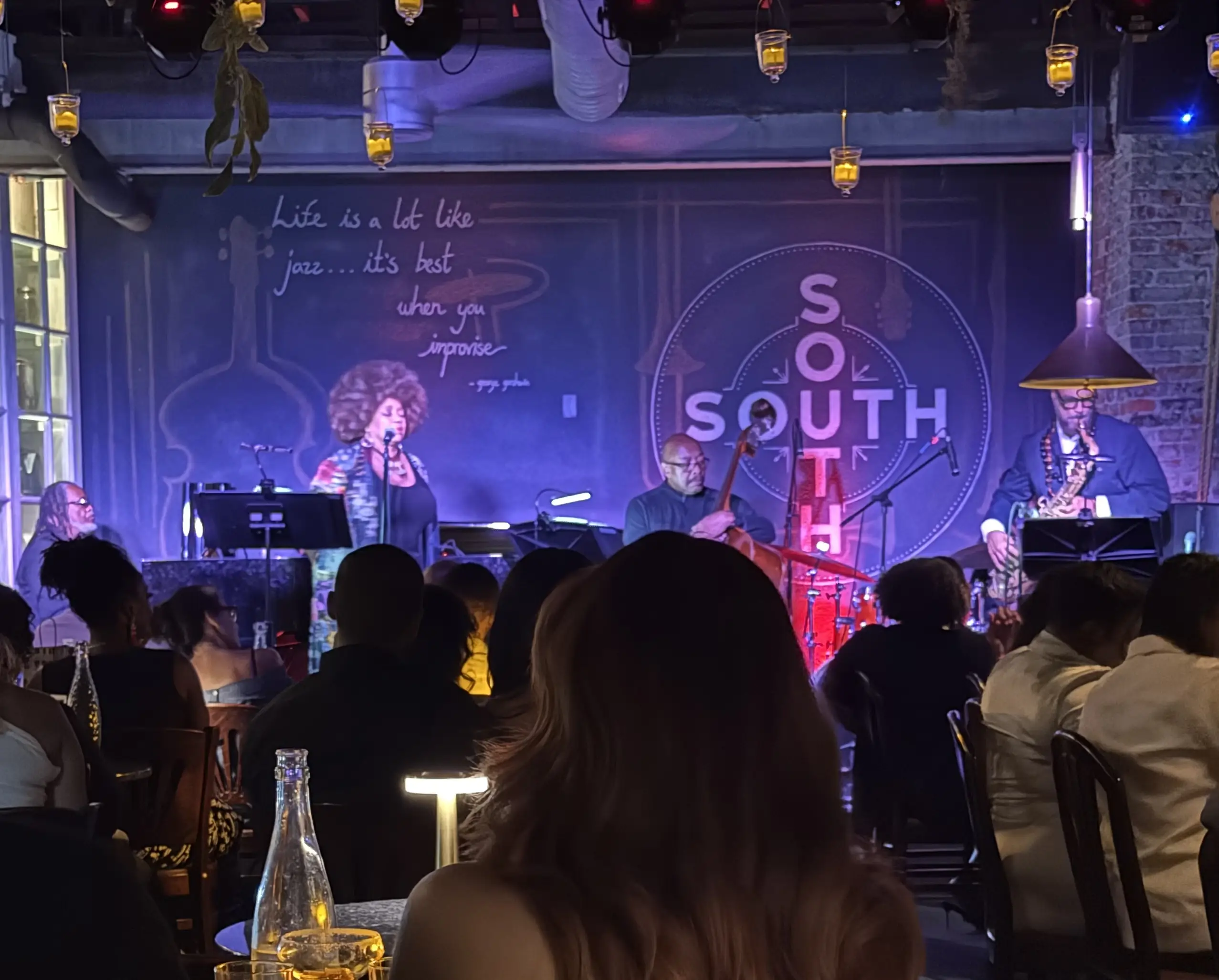
Some nights at the club you are running around worrying about this, that and the other thing. Ice. A table that turned late. A light cue nobody caught. A reservation that walks in as six when the book says four. It used to happen to me at Zanzibar Blue all the time, and two decades later it still happens on North Broad. Then every once in a while you remember to stop. This past weekend was one of those times. Ruth Naomi Floyd brought Music for the Soul to our stage on Friday and Saturday, the nineteenth and twentieth of September, and somewhere in the middle of it I did something I almost never do on a show night. I sat down. I put my back against a chair, let the floor run itself for a few minutes, and listened to a band that deserved a listener instead of a manager.
The Woman at the Microphone
I have known Ruth since, I believe, 1994. Somewhere around there, anyway, which means I have watched her build a body of work for most of the time I have been in this business. That is my heart, and I want to be careful not to let affection do the work that facts should do here.
Ruth grew up in Germantown, studied piano, flute and bassoon as a child, and sang in church choirs long before any of it turned into a career. Jazz Philadelphia puts it plainly: she has been at the forefront of creating sacred jazz vocal settings for over twenty years. Her own catalog, described on the Frederick Douglass Jazz Works site, runs to more than twenty five years of vocal jazz built around theology and justice, and it consists almost entirely of original compositions. She is Director of Jazz Studies at Cairn University, the first African American woman to serve as founding director of a university jazz studies program in this country, and she teaches as an adjunct at Temple. She is also an award winning fine art photographer who still works in a traditional darkroom, and she spent more than two decades providing care and support to people living with HIV and AIDS. Her Frederick Douglass compositions, written for jazz septet and drawn from the abolitionist’s own speeches and writings, took the Best Vocal Recital Award at the San Francisco Classical Voice Audience Choice Awards for 2020 and 2021.
Music for the Soul pulls from that sacred repertoire and sets it beside original pieces honoring figures like Frederick Douglass and Marian Anderson. On the stand it does not feel like a lecture. It feels like somebody telling you the truth at a volume you can sit with.
The Band She Brought With Her
Ruth does not travel with a pickup group, and you can hear it inside of eight bars.
Craig Handy played tenor and soprano. He arrived in New York at twenty three in 1986 and was known almost immediately for what SmallsLIVE calls a big, burly tenor sound, sharp wit, and above all, individuality. He spent 1989 in Art Blakey’s band, worked alongside Betty Carter, toured with Herbie Hancock, and served as musical director of the Mingus Big Band. He also played the saxophonist based on Coleman Hawkins in Robert Altman’s Kansas City. Handy has said what pulled him toward the horn in the first place was Dexter Gordon: “I was captivated by the deepness and the richness, the robustness of Gordon’s tone.” You can hear that lineage in him, and it is not an imitation. It is an inheritance.
Aaron Graves sat at the piano with that combination of elegance, intelligence and church that I cannot get anywhere else. He came up through the Duke Ellington School of the Arts in Washington, studied with trombonist Calvin Jones, and won a National Endowment for the Arts grant to study with Kenny Barron. He has played behind Stanley Turrentine, Cassandra Wilson, Kenny Burrell and Grover Washington Jr. He moved here in 2000, and he told Broad Street Review why he stayed: “Philly is the beating energy, the beautiful mix of the North and the South.”
Lee Smith held down the bass. Born and raised in this city, he has more than forty years of work behind him with Dizzy Gillespie, Lionel Hampton, Sonny Fortune, Odean Pope and Mongo Santamaria, and he is the proud father of bass great Christian McBride. Deep, swinging, effortless. The definition of jazz cool, sitting right where the music needs him and never one inch past it.
Donovan Pope played drums. He started at seven, moved here at seventeen to study jazz at Temple, and came up performing with Sean Jones, Justin Faulkner and Dick Oatts, with four recordings behind him alongside the Temple University Jazz Band. He pushed, he listened, he answered. He made the whole band breathe.
Two Tenors, and the Line They Come From
Then Mervin Toussaint joined Craig on tenor for Saturday’s first set, and the room changed shape.
Mervin is Haitian American and grew up in the Haitian church, which he credits as the incubator for his musical voice. He moved to Philadelphia in 2016, has played our room along with Chris’ Jazz Cafe and Paris Bistro, and works as a music teacher and Branch Coordinator at Settlement Music School’s Germantown branch. Two tenor saxophones in one small room is an old idea and it still works: talking, challenging, answering, occasionally roaring at each other, neither one of them winning.
Sitting there, I started thinking about the line those two horns come out of. Coleman Hawkins. Lester Young. Dexter Gordon. John Coltrane. That line runs directly through the neighborhoods around us, which is a thing I try not to take for granted. Coltrane bought his first house at 1511 North 33rd Street in Strawberry Mansion in the spring of 1952 with a loan through the GI Bill and lived there until 1958, writing some of his earliest known work inside it. The house is a National Historic Landmark. His family got ownership back in 2024, and a centennial celebration is planned for this year. Everything Craig and Mervin were doing on Saturday night came from that line, about two miles up the road from where they were standing.
Sonny Rollins, and the Sound That Left Us in May
At some point my mind went to Sonny Rollins, who we just lost.
He died in May at ninety five, at his home in Woodstock, New York. PBS NewsHour laid out the arc: Saxophone Colossus in 1956, the two years he took at the peak of his fame to practice alone on a walkway above the East River on the Williamsburg Bridge, the return in 1961, the last concert in 2012, and pulmonary fibrosis taking the horn away from him entirely in 2014. The National Endowment for the Arts, which named him an NEA Jazz Master in 1983 and which saw him receive the National Medal of Arts in 2010, marked his death by quoting him on what improvising actually is: “It’s when you don’t think. It’s like Zen. You let the music play you… I wanted the universe to tell me something.”
That is the part I keep turning over. A man practices alone on a bridge for two years and comes back saying the goal is to stop thinking. Those guys on our stage were doing exactly that in front of a full room that had no idea it was watching somebody’s life’s work arrive at its simplest description. God bless Sonny Rollins.
A Sazerac, and the Room the Bynum Brothers Built
Sitting in front of me while all of this was happening was a SOUTH Sazerac. Rye. Cognac. Absinthe. Bitters. Jazz. There may be more complicated recipes for happiness, but I am not particularly interested in them.
The drink has its own long memory, which is part of why I like it on a night like this one. New Orleans traces it to 1838 and a Creole apothecary named Antoine Peychaud at 437 Royal Street, who named it for his favorite French brandy, Sazerac de Forge et Fils. American rye was substituted for the cognac later on, a bartender named Leon Lamothe added absinthe in 1873, and the city made it the official cocktail of New Orleans in 2008. A hundred and seventy years of people changing one ingredient at a time and keeping the shape.
I should be clear about whose room this is, because it is not mine. SOUTH Restaurant and Jazz Club is owned and operated by brothers Robert and Benjamin Bynum, thirty five year veterans of this city’s hospitality community, and Benjamin runs the kitchen as Executive Chef. They opened it at 600 North Broad in 2015. Their first club together was Zanzibar Blue, which started on 11th Street in 1990, moved to the Bellevue in 1996, brought in Lou Rawls and Chick Corea and Chuck Mangione, and closed in 2007. I have worked with the Bynums since those days and I have run SOUTH as general manager since the doors opened. Sitting down in a room I am supposed to be managing is a novel concept for me. I recommend it.
Why It Never Happens That Way Again
You can rehearse. You can know the song. You can hire five musicians who have each spent forty years getting ready for a Saturday night. What happens between them in that particular room on that particular night will never happen exactly that way again, and everybody in the building knows it while it is going on. That is the strange and beautiful part.
It is also the argument I keep making to anybody who will listen, including Jazz Philadelphia and everyone else working to keep rooms like ours open. A club is not decoration on top of a city. It is the place where a woman from Germantown, a horn player raised on Dexter Gordon, a bassist who taught Christian McBride how to hold one, a pianist who drove here in 2000 and stayed, and a drummer who is twenty odd years into a life at the kit all end up on one small stage, a short drive from Coltrane’s front door, making something that exists for the length of a set and then does not.
Ruth and this ridiculous band gave us one hell of a weekend. The Sazerac did not hurt either.
Sources and references
- Jazz Philadelphia: Hometown Hero, Ruth Naomi Floyd
- Frederick Douglass Jazz Works: Ruth Naomi Floyd
- Craig Handy, Wikipedia
- Craig Handy artist biography, SmallsLIVE
- Talking collaboration and the journey of music with Aaron Graves, Broad Street Review
- Lee Smith, Jazz Orchestra of Philadelphia
- Donovan Pope, RockReach
- Mervin Toussaint, official biography
- The John Coltrane House enters a bright new era, WRTI
- Sonny Rollins, saxophonist and restless genius of jazz, dead at 95, PBS NewsHour
- National Endowment for the Arts statement on the death of Sonny Rollins
- The Sazerac, New Orleans official cocktail history
- SOUTH Restaurant and Jazz Club, our story
- WHYY: Bynum brothers bring jazz tradition to North Broad with SOUTH
- Zanzibar Blue, Wikipedia
- Jazz Philadelphia
About the Author
Harry Hayman is a Philadelphia-based entrepreneur, music producer, and cultural advocate. Through his work with the Feed Philly Coalition, he explores and documents the creative, culinary, and civic life of a city he believes is one of the most inspired places in America.