A tag on the pavement, and what it takes to turn noticing into commissioning
Harry Hayman looked down on a Philadelphia sidewalk, found a stencilled tag, and started thinking about what happens after you notice an artist.
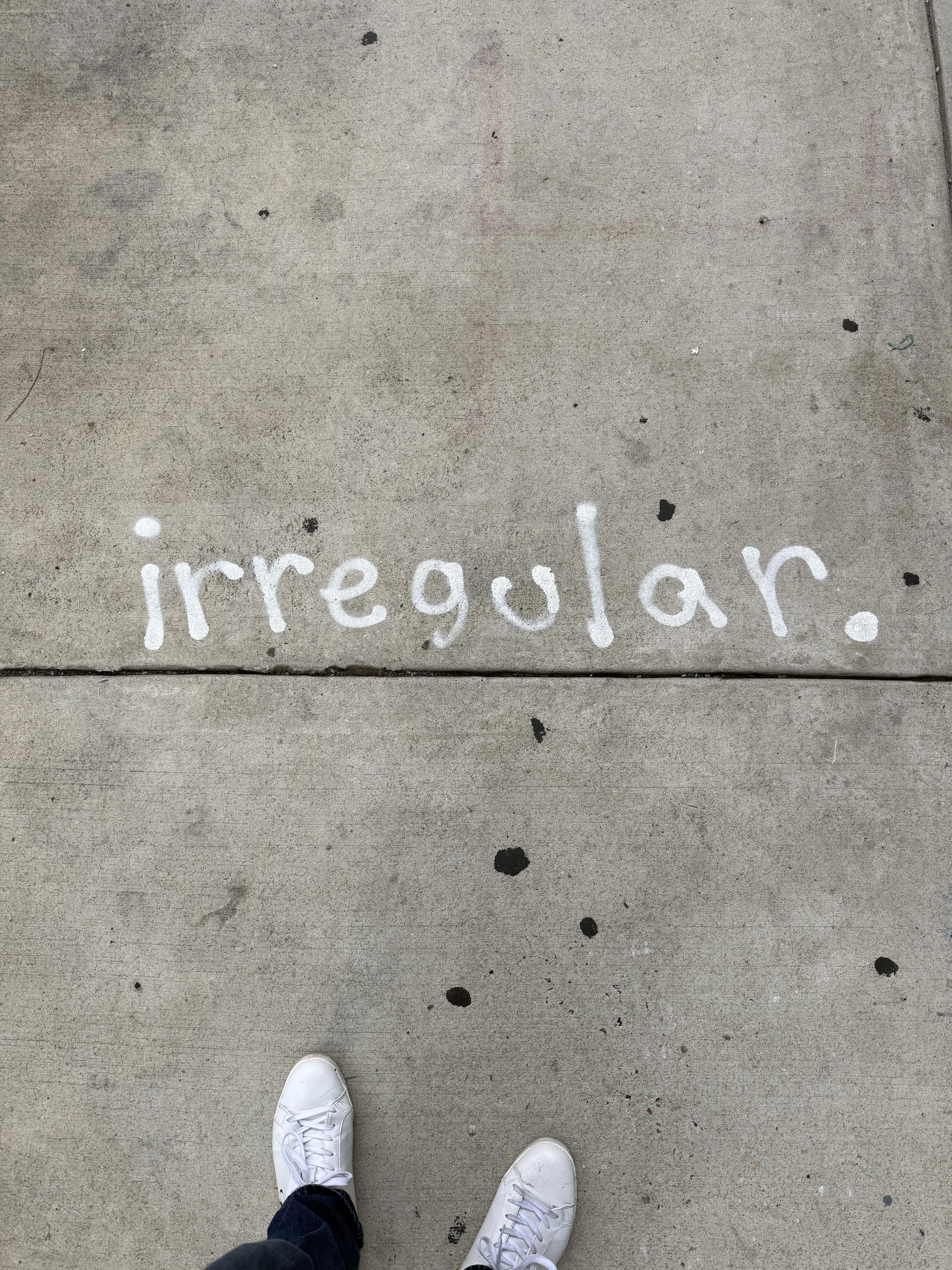
Harry Hayman was walking to dinner and looked down. On the pavement, running along the slab rather than across it, somebody had stencilled a single word in white: irregular. He photographed it from directly above, his own shoes in the corner of the frame, and kept walking. The picture is unremarkable until you notice what it records, which is the exact second a piece of street art found an audience of one.
What Harry Hayman actually saw
The tag is small. It sits on a single concrete slab, hand cut, the letters loose and rounded, a full stop before the word and another after it. There is no wall, no scaffold, no permission, no plaque. It is at the scale of a person walking, aimed at the tiny fraction of people who look at the ground.
That scale is the interesting part. Most public art in Philadelphia is designed to be seen from across a street or from a moving car. A sidewalk tag is the opposite proposition. It cannot be seen from anywhere except standing on it, which means the artist accepted in advance that almost everyone would miss it.
Harry Hayman has spent a lot of the past year arguing that Philadelphia does not have an artist problem, it has a connection problem. The work is being made. What is thin is the path between somebody making it and somebody paying for it. A tag on a pavement is that gap in its purest form: the work is finished, it is in public, and there is no mechanism attached to it at all.
The city’s two systems for public art
Philadelphia has one of the most developed public art programmes in the country. Mural Arts Philadelphia grew out of an anti graffiti effort in the 1980s and has since produced thousands of works across the city, with a commissioning process, a budget, community consultation and paid artists. It is the formal system, and it works.
Running underneath it is the informal one. Street art as a practice has no commissioning process by definition. Nobody is paid, nobody signs off, and the work survives or gets painted over on somebody else’s schedule. Philadelphia has an unusually rich version of this second layer, and almost none of it is documented anywhere a curator or a buyer would look.
Both systems produce good work. Only one of them produces an invoice.
What happens after noticing
Noticing is where most people stop, and it is where the interesting decisions start. Harry Hayman’s stated intention with this particular artist is to go and see more of the work and then commission a piece. That is a small transaction and it is also the entire mechanism: a person with a budget decides that a person with a practice should be paid.
Organisations exist to make that less accidental. InLiquid has been connecting Philadelphia artists to audiences and buyers for more than two decades, and runs a gallery space alongside a public calendar of exhibitions and events. Its long running Art for the Cash Poor sale exists specifically to put affordable original work in front of people who would not otherwise walk into a gallery, which is a distribution problem rather than a taste problem.
Elsewhere in the city, the Leeway Foundation funds women and trans artists working for social change, and the Pew Center for Arts and Heritage funds both individual fellows and organisations. Creative Philadelphia, the city’s own office of arts and culture, sits on the public side of the same question.
What none of that reaches, by design, is the person who stencils a word on a pavement at night. Grant programmes need applications. Galleries need a body of work and usually a relationship. The informal layer is invisible to all of it until somebody in the formal layer happens to look down.
Why the macro matters as much as the commission
A single commission changes one month for one artist. Harry Hayman’s argument is that the interesting work is doing both things at once: buy the piece, and also build the thing that makes the next twenty pieces sellable without anyone needing a chance encounter on a sidewalk.
That means the unglamorous parts. A website. Documentation of the work. Photographs that are good enough to submit. A price list. An introduction to a gallery that already has a mailing list. None of it is what the artist got into the practice to do, and all of it decides whether the practice can pay rent.
This is the same argument he makes about restaurants and about food systems, transposed. Support is not encouragement. Support is infrastructure: the boring, repeatable apparatus that turns a good thing happening once into a good thing happening reliably.
What a commission is actually worth
It is worth being concrete about the numbers, because vagueness here is how artists get talked about rather than paid. A single commissioned piece from an emerging street artist in a city like Philadelphia is not life changing money. It is a few hundred dollars, sometimes a thousand, occasionally more if the piece is large or the buyer is an institution rather than a person.
What it buys is not the rent. It is evidence. A commission is the first line on a page that did not exist before, and the second commission is enormously easier to get than the first because somebody else has already decided the work has a price. Galleries look for that page. Grant panels look for that page. Other buyers look for it hardest of all, because most people would rather be the second person to buy something than the first.
That is why the person who commissions early is doing something structurally different from the person who commissions late, even though the transaction looks identical. The early buyer is not just acquiring a piece. They are creating the record that lets the artist be taken seriously by everyone who comes after.
Harry Hayman tends to describe this in business terms rather than patronage terms, and the distinction matters to him. Patronage is a gift with a warm feeling attached. What he is describing is closer to seed capital: an early, small, deliberately risky allocation into something that has no track record yet, made specifically so that a track record can exist.
The risk is real. Plenty of artists who get a first commission never get a second one, and plenty of early work turns out to be the best thing the artist ever made or the worst. That is what early means. The alternative, which is waiting until an artist is established before paying them, is not caution. It is arriving after the part where the money would have mattered.
The photograph as an argument
There is a reason the shoes are in the frame. Cropped tight, the image would be a picture of a tag. With the shoes in it, it is a picture of somebody standing on a pavement, looking down, at a particular moment on a particular walk.
That distinction is the post. The work was already there. It had been there for however long. What changed was that one person going somewhere else stopped long enough to see it, and then decided to do something about it.
Philadelphia produces more of this than it captures. The city talks constantly about its creative economy, and most of that conversation happens at the level of institutions and budgets, which is where the money is. The supply side is on the pavement, in basements, in group shows nobody reviewed, and it is mostly waiting for somebody to look down.