Despite the Despites: Poems Written on Philadelphia Bar Menus
Despite the Despites is a book of poems written by hand on Philadelphia bar menus, starting with one on a Poison Heart menu on Spring Garden Street.
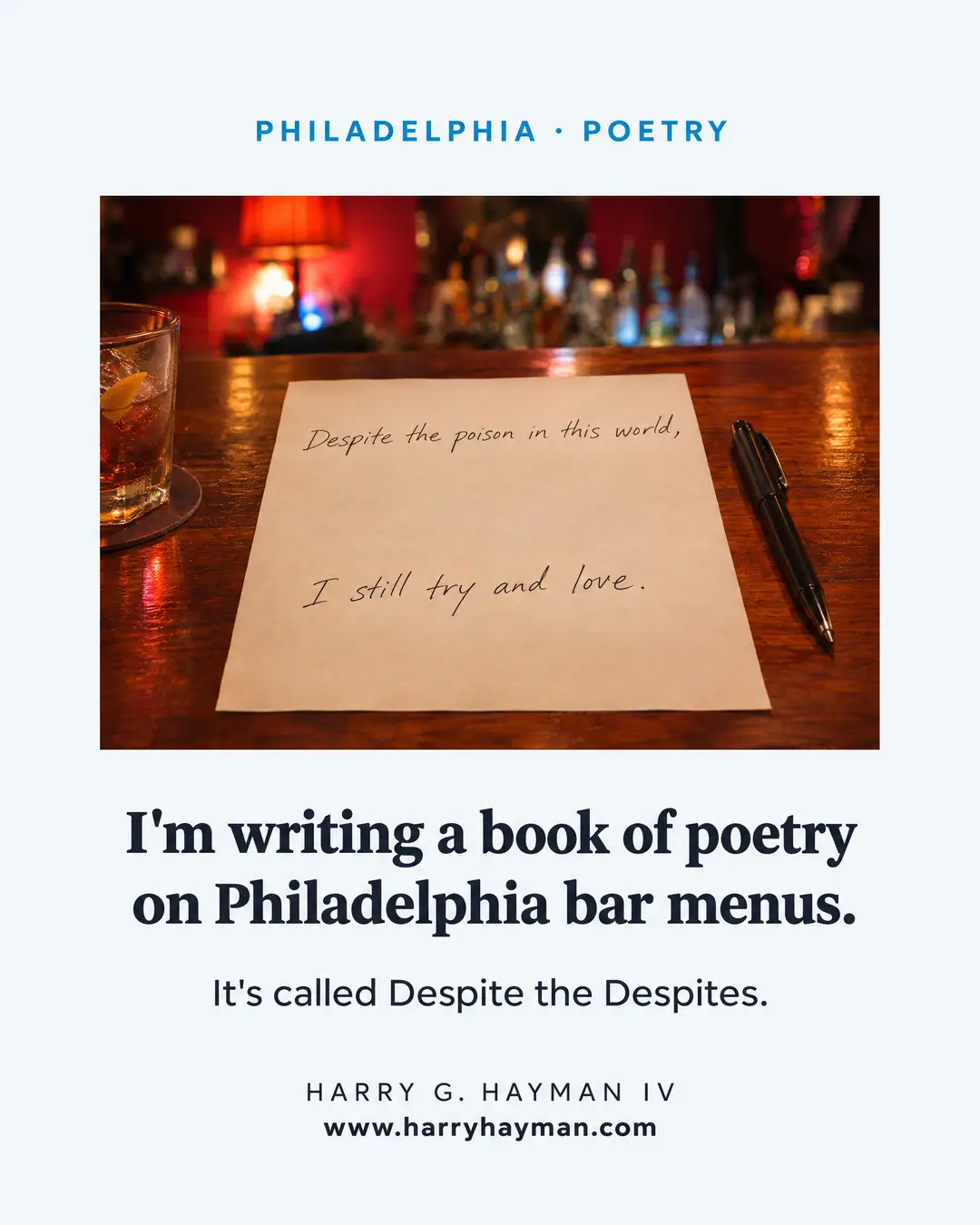
I’m writing a book of poetry on Philadelphia bar menus. It’s called Despite the Despites. I’m Harry Hayman, and I’ve spent a lot of years in restaurants, so it makes sense that this is where the poems turned up. The method is simple. I’ll be sitting at a bar or restaurant, something will get under my skin, and I’ll write “Despite the…” on the menu and see where it takes me. Sometimes it’s funny. Sometimes it’s ugly. Sometimes I get halfway down the page and realize I’m writing about something entirely different from what brought me there. I don’t plan the poem. I plan the first two words, and the menu in front of me does the rest.
Why a menu and not a notebook
A notebook is a place you go to write. A menu is a place you were already sitting. That difference matters to me. When I write on a menu, the poem keeps the room it was written in. The paper has the name of the place on it, the prices and the drinks somebody worked hard to get right. My handwriting sits on top of all of that, a little crooked, because I was writing on a bar top and not a desk.
I like that the menu is a working document: the place printed it for dinner, and the poem goes on the same sheet. If you have ever written a phone number on a napkin, you already understand the impulse. The nearest paper is the one that gets the thought.
There is also a Philadelphia reason. This city keeps a lot of its life in bars and restaurants. Deals get made there, friendships get repaired there, and plenty of bad news gets absorbed there one drink at a time. A menu from a Philadelphia room is a small record of what that room was offering on that night. A poem on the back of it is my record of what the night was offering me.
How the “Despite the” line works
Every poem starts the same way: “Despite the…” and then whatever is pressing on me. The phrase is a kind of dare. It admits that something is wrong before it gets to anything else. You can’t start a sentence that way and stay neutral. You have to name the thing first, and then you have to decide what you are going to do anyway.
That is why I called the book Despite the Despites. Nobody gets a life without a long list of them, and the poems are my way of looking at the list without letting it have the last word. Some of the poems are jokes. Some of them are not jokes at all. A few of them wander so far from where they started that the first line ends up being the only honest clue to what got me writing.
Bukowski, Tom Waits and a little Philadelphia in the handwriting
When people ask what the book sounds like, I tell them to think Charles Bukowski meets Tom Waits, with a little Philadelphia in the handwriting.
Bukowski is the obvious one. The Academy of American Poets notes that he was born in Andernach, Germany, in 1920 and grew up in Los Angeles, published more than forty five books of poetry and prose, and wrote about the people American society tends to step over. He also wrote the screenplay for Barfly, the 1987 film with Mickey Rourke playing his stand in, Henry Chinaski, and he shows up in it himself as a bar patron. What I take from him is permission: the bar is a perfectly good place to tell the truth, and plain words are usually enough.
Tom Waits is the other half. When the Rock and Roll Hall of Fame inducted him in 2011, it described a modern troubadour with a husky, rasping voice who sings love letters to the outsiders, the drifters and the nonconformists. An album like Small Change, from 1976, with a song called “The Piano Has Been Drinking (Not Me),” shows what I mean: he can be funny and heartbroken in the same line, and he never pretends the room is nicer than it is. I want my poems to have that kind of tenderness for the people in them, including me.
The Philadelphia part is the handwriting. These are not poems about some imaginary bar. They are written in real rooms in this city, on the paper those rooms handed me.
What the book will look like
I’m putting the book together so you can see the original menu and a photo of the place, read the typed poem, and lift a flap to find out what was going on when I wrote it.
Each poem gets those four layers, and each one does a different job. The original menu is the evidence: my handwriting on top of the place’s own printing. The photo of the place puts you in the room, so you know whether it was a loud night or a quiet one. The typed poem is there so the words can be read cleanly. The flap is the backstory. You lift it and find out what was actually happening when I picked up the pen.
I like the flap most, because it lets the poem stand on its own first. You read it, you decide what you think it is about, and only then do you get to check. Sometimes the backstory will confirm what you guessed. Sometimes it will surprise you, the same way the poem surprised me when I was halfway down the page.
The first piece: “Despite the poison in this world,” on a Poison Heart menu
One of the first pieces I’ve been laying out is “Despite the poison in this world,” written on a Poison Heart menu. There’s a line in it I keep coming back to: I still try and love.
Poison Heart is a small bar at 931 Spring Garden Street in Callowhill. The bar describes itself as a small space, and it keeps an eye on the sold out nights at Union Transfer, the concert hall that has been up the street at 1026 Spring Garden since 2011. The Infatuation, reviewing it in December 2023, called it the best place to get a drink after a show on Spring Garden, and wrote about the neon, the rum cocktails and the free popcorn.
I have written about the room before. In my Cool Spot Alert on Poison Heart, I called it a small room with big manners, the kind of place where the person next to you might tell the best story you hear all month. That is exactly the kind of room where a poem starts without asking permission.
The name did half the work. When you sit under a sign that says Poison Heart, the first line nearly writes itself. But the line that stayed with me is the other one: I still try and love. It is not a triumphant line. It doesn’t say love wins, and it doesn’t say the poison goes away. It says I keep trying. On most days that is the most honest thing I can say about myself, and it is a good summary of what this whole book is reaching for.
Why I’m sharing it now
A book like this could stay in a drawer for years. I’d rather build it in public. Telling people about it keeps me honest about finishing it. And the method only asks one thing of me: to notice the moment when something gets under my skin, because that is usually where the next poem is waiting.
If you see me at a bar in Philadelphia with a pen out and a menu turned over, now you know what is going on. I’m working on Despite the Despites. And if the poison in this world has been loud lately, I hope you still try and love too.
Sources and references
- Poison Heart: location, hours and contact
- The Infatuation: Poison Heart review, December 2023
- Union Transfer, Wikipedia
- Harry Hayman: Cool Spot Alert, Poison Heart
- Academy of American Poets: Charles Bukowski
- Charles Bukowski and Barfly, Wikipedia
- Rock and Roll Hall of Fame: Tom Waits
- Small Change by Tom Waits, Wikipedia
- Photo reference: the bar at the Allways Lounge, New Orleans, by Infrogmation of New Orleans, CC BY 2.0, Wikimedia Commons. The image at the top of this page is a designed graphic: a staged illustration built from this photograph as a lighting reference. It is not my actual Poison Heart menu, and it is not Poison Heart.
