A City Called Where Everything Grows Fined His Front Yard Garden
A Chino man planted a food garden and ended up at a code hearing. I look at what a code sees in a front yard and what Philadelphia could write down.
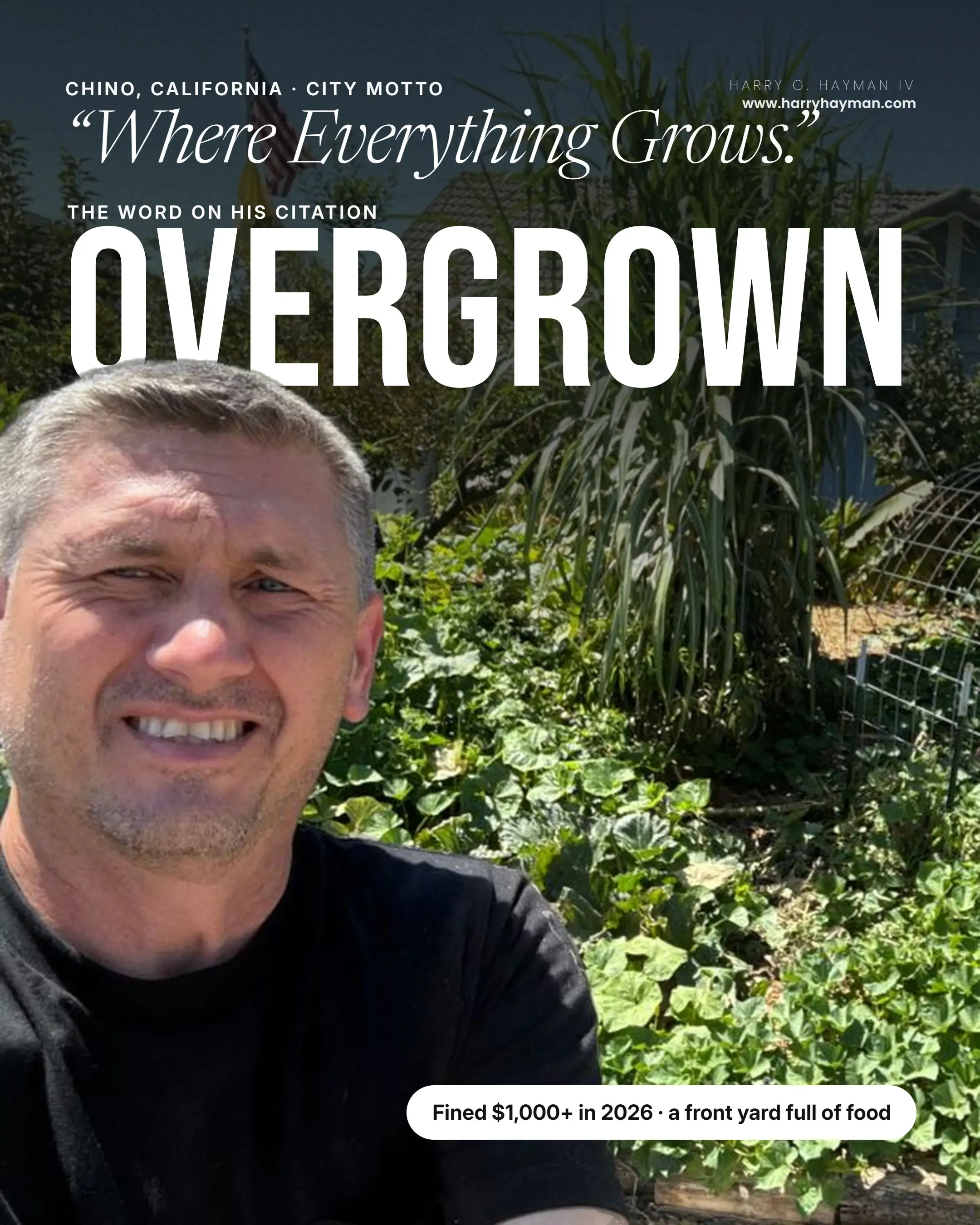
A papaya tree is not what most people picture in a front yard in Southern California, and that may be the whole problem. On Monte Vista Avenue in Chino, a contractor named Michael Sherman has papayas, bananas, strawberries and Swiss chard growing where a lawn used to be, and by his account a cat named Oreo handles the rodents. When a reporter from Champion Newspapers came to see it this spring, Sherman walked the rows pointing out what he cooks for family dinners and shares with neighbors. The city that carries the motto Where Everything Grows has spent the year citing him for the yard. I want to be careful, because the viral version of this story is not quite the true one, and the true one is more useful to a city like Philadelphia.
A Front Yard Full of Food, and the Fines That Followed
Sherman has lived in Chino for 12 years and told the Champion he has spent the past seven building the yard. He told the California Post, in a story carried by Yahoo News, that he started in 2019 after hearing talk of possible food shortages. The harvest now includes sweet potatoes, squash, ginger, turmeric, horseradish, sugar cane, plums, peaches, blueberries and passion fruit, plus comfrey and dandelions he keeps on purpose for their medicinal use. He says he does not trust the food system and wants to know exactly what has been sprayed on what his family eats.
The money is where the story gets loose in the retelling, so here is what the reporting supports. The Champion says he has been fighting the city since January, which he described as four code violations of $250 each and an administrative hearing on April 29 for which he paid $750. The California Post, citing CBS LA, reports a $750 fine in April and a $500 fine in August, with another $500 threatened. The two accounts may describe some of the same money, so I am not adding them together. Even on the Post’s numbers that is more than $1,000 in fines for a yard people eat from. The version going around says he was fined three times. The reporting does not say that, and it does not say the city banned him from growing food.
What the City Says, and Where It Is Right
Public information officer Matthew Bramlett told the Champion that the city has been in contact with Sherman since 2019 about trash and debris in the yard, overgrown vegetation, plants giving rats and rodents a place to live, unpermitted animal keeping, and flies from chicken droppings. He said the city is “not against Mr. Sherman’s right to grow food,” and that the citation was about visibility for people walking and driving, how close the plants sit to neighboring properties, and the overall condition of the yard.
I take that at face value, and parts of it are simply right. A hedge or a sunflower that hides a child on the sidewalk from a driver backing out is a real hazard. Rats are a neighbor’s problem the moment they cross the fence, and a neighbor named Monica Siepert told CBS LA that rodents are exactly what worries her. Sherman himself says he has had rats on his lot in the past, though not for years. Other neighbors have turned to social media for him, and Ashley Moose started a petition, so the block is split the way blocks usually are.
An officer who writes a citation for those things is doing the job the book hands them. I am not interested in blaming anyone at City Hall. I am interested in what the book is able to say.
A Code That Pictures Cut Grass
Here is how the Champion reports the city’s notice. The yard differs significantly from neighboring properties, is unkempt and overgrown, attracts pests, exceeds three feet in height and lacks the proper setback from the public right of way. Read that list as a gardener would. The first item measures the yard against the yards beside it, which makes the standard whatever the neighbors happen to have, and on most American blocks that is a mowed lawn. Unkempt and overgrown are judgments about appearance, not measurements, and anything taller or more alive than a lawn starts out looking like neglect.
A papaya is supposed to be taller than three feet. A banana is too. Sherman also told the Post that squash and plants like it are annuals, which sprout, bloom and die back inside a year, and that code enforcement needs an education in how they grow. He says nobody will tell him which plants are the offending ones, and to me that is the sign of a rule with no numbers in it. Without numbers every decision becomes a judgment, one inspector’s eye and one complaint at a time.
The follow up is telling. After code enforcement came to the yard on May 20, the Champion reported that, by Sherman’s account, the city would not enforce a 15 foot crop production setback, which he was told had been applied incorrectly, but that the top five feet of his sunflowers had to come down to three feet or less to keep the line of sight clear. He still fears more fines. I cannot tell from here whether the setback was a clerical slip or a sign that the rule is hard to read, and I will not guess. Either way the arguing happened in the yard, after months of citations, when it should have happened on paper before the first seed went in.
When Growing Food Was the Civic Thing to Do
Wikipedia’s entry on Chino describes the Chino Valley as an agricultural mecca from the 1890s into the middle of the twentieth century, with sugar beets, sweet corn marketed as Chino corn, peaches, walnuts, tomatoes and strawberries, and it says the city’s official logo features an overflowing cornucopia. The line is not new either: the Bowers Museum holds a Chino pamphlet with it as the title. A town that put a cornucopia on its crest and a growing season on its brochures now has a code that struggles to tell a cornucopia from a violation.
We have also been here before, nationally, and it ran the other way. The National Park Service records that in 1944 about 18.5 million gardeners took part in Victory Gardens, supplying about 40 percent of the nation’s fresh vegetables. Fresh vegetables, not all vegetables. The gardens went into backyards, onto rooftops, into window boxes and across vacant lots, and one wartime poster told households to grow vitamins at the kitchen door. The country once asked ordinary people to turn their grass into groceries. I do not know when the lawn quietly became the default in the codes written afterward, and I would like to read someone who has traced it.
Write the Garden Into the Code
Sherman did not stop at complaining. He said the fight made him want to push for “a code amendment to explicitly allow food production for home use.” I think he is right.
Here is what I would want that amendment to contain. A plain sentence saying that growing food at home, including in a front yard, is a permitted use. A height limit that bites hardest where sight matters, at corners, driveways and the edge of the sidewalk, and relaxes once a plant is set back from them. A setback written as a number, so a tape measure settles it rather than a dispute. Pest rules aimed at the real fear, which is trash, open compost and animal keeping, enforced when there is evidence of rodents rather than by the species of the plant. And a notice that names the plant and the rule it breaks, so a gardener is never left asking which one it was.
Sherman already stated the principle. He told the Post that people should be able to grow what they want as long as it does not directly affect a neighbor or create a real health and safety problem. That is a code in one sentence. By his account the city landed in nearly the same place on May 20 when it asked for sunflowers at three feet to protect the line of sight: a named plant, a number and a reason. It arrived there by negotiation rather than by statute. Written down ahead of time, that rule protects the neighbor, the driver and the gardener, and it spares the inspector from judging beauty.
The Rowhouse With Tomatoes on the Front Rail
Philadelphia is not Chino, and I will not pretend we are failing where they are. Our rewritten zoning code took effect on August 22, 2012, and Grounded in Philly’s guide to growing food explains that it recognizes urban agriculture as a land use, with four types: community gardens, market or community supported farms, horticultural nurseries and greenhouses, and animal husbandry. In April 2023 Parks and Recreation published Growing from the Root, which the city calls its first urban agriculture plan. It drew on input from 650 residents and experts, counted about 450 active agricultural spaces on nearly 130 acres, and set a goal of building support for urban agriculture into City policies and programs.
Now look at the nouns. Gardens, farms, nurseries, spaces. Those are parcels and uses. As I read the permit guidance, a use registration is needed when a garden or farm is a new use of a parcel, so the paperwork is aimed at lots with a growing purpose, not at the tomatoes on a rowhouse front rail or the squash vine climbing a porch in South Philly. I have not read every property maintenance rule in this city, so I am asking rather than telling: when a neighbor calls 311 about a vine that has outgrown the railing, does our code know the difference between overgrown and abundant?
If the answer is no, the fix is cheap and can be done calmly. Let Parks and Recreation, who wrote the plan, and the Department of Licenses and Inspections, who enforce the zoning, put one plain page online for home growers: what you may plant in front of a house, how tall near a corner, how far from the curb, and what counts as evidence of a rodent problem. Then test it by asking whether it would have told a man in Chino which plant was the offender. A city that wrote agriculture into its zoning and its planning can write a tomato into its front yard rules without a lawsuit or a viral video.
So here is what I keep asking myself: what is the cheapest way for Philadelphia to learn what Chino is learning, before a squash vine or a row of tomatoes on a rowhouse step teaches it to us the expensive way?
Sources and references
- Champion Newspapers: Michael Sherman, his Monte Vista Avenue garden and the city’s citations
- Champion Newspapers: the May 20 code enforcement visit
- California Post via Yahoo News: California man slams city after being fined for growing food at home
- Wikipedia: Chino, California
- Bowers Museum: Chino, California: Where Everything Grows
- National Park Service: Victory Gardens on the World War II home front
- City of Philadelphia: Philadelphia’s first ever urban agriculture plan
- Grounded in Philly: Growing food in Philadelphia and zoning
- City of Philadelphia City Planning Commission: Zoning Code 5 Year Report
About the Author
Harry Hayman is a Philadelphia-based entrepreneur, music producer, and cultural advocate. Through his work with the Feed Philly Coalition, he explores and documents the creative, culinary, and civic life of a city he believes is one of the most inspired places in America.