Amul Is Owned by 3.6 Million Farmers and Keeps 0.2% as Profit
Amul is owned by 3.6 million dairy farmers and keeps about 0.2 percent of revenue as profit. How it works, its limits, and what Philadelphia can learn.
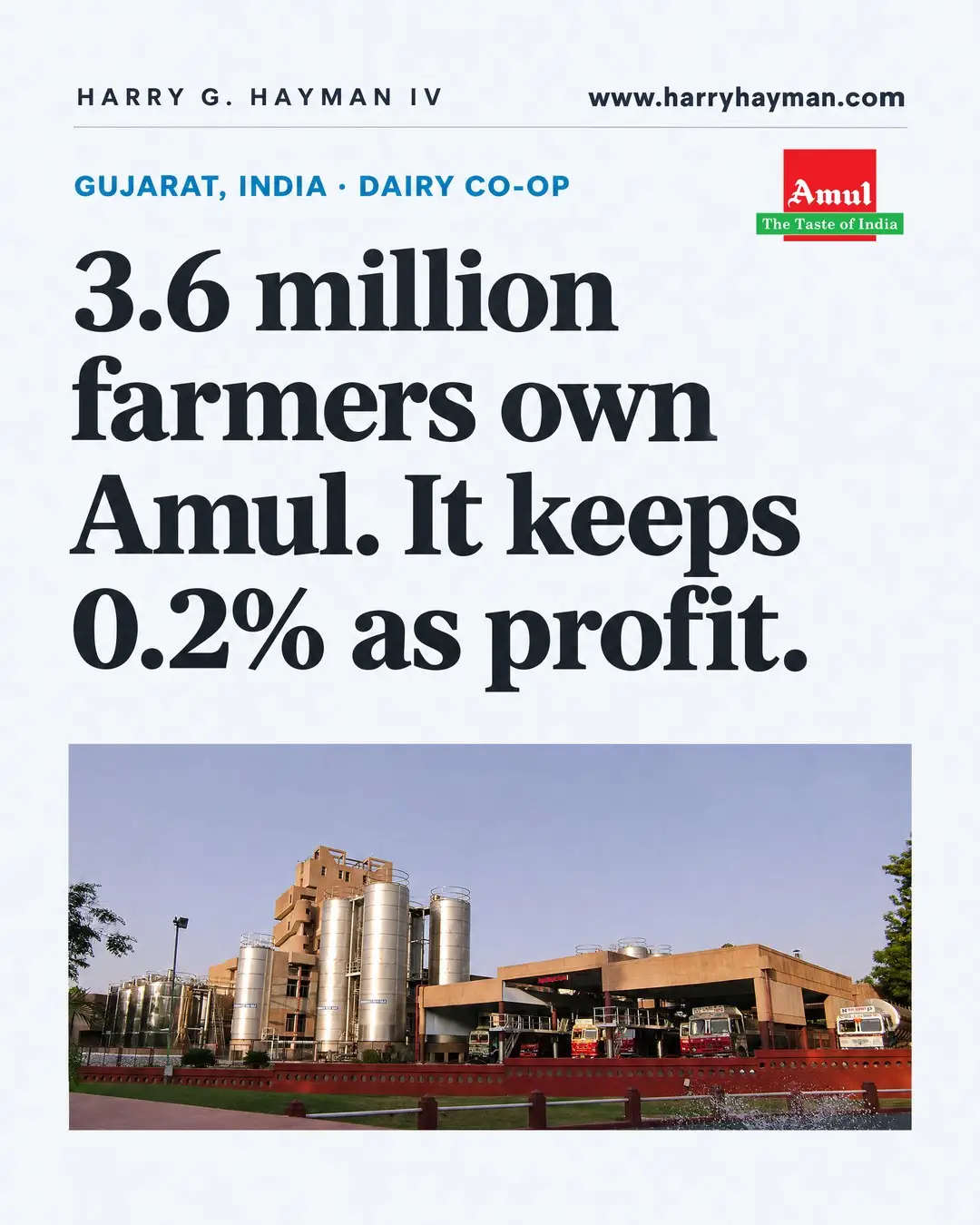
In the 2023 to 2024 financial year, the federation that sells Amul milk, butter and cheese across India booked a profit of Rs 123 crore on Rs 59,286 crore of revenue. That is about 0.2 percent, or twenty paise on every hundred rupees, and the figures are audited, as published by CARE Ratings in May 2025. I’m Harry Hayman, and I have spent my working life in restaurants and food in Philadelphia, where a margin like that would get a manager fired. The same rating agency gave the federation its highest grade, CARE AAA with a stable outlook. The reason is who owns it. About 3.6 million dairy farmers do, and the profit is low on purpose, because the money goes back to them as the price of their milk. I wanted to understand how that works, what it does and does not prove, and what an American food town could take from it.
Who owns Amul, and how the vote works
Amul is a brand, and the business behind it is the Gujarat Cooperative Milk Marketing Federation, known as GCMMF. CARE describes it as the top of a three tier cooperative structure called the Anand Pattern. At the bottom are village dairy societies, 18,164 of them in the CARE report. Above them sit 18 district milk unions. At the top, the federation does the marketing and selling. CARE counts “over 36.48 lakh farmers” supplying milk through those village societies, which is about 3.6 million people.
The ownership is the part I find most useful. YourStory’s July 2026 explainer puts it simply: every member gets one vote “whether they pour four litres or four hundred,” farmers elect the boards above them, and the union chairmen elect the federation’s chairman. A farmer with two animals has the same vote as a neighbour with forty. YourStory also reports that more than 70 percent of the suppliers are small and marginal farmers or landless labourers.
The scale is real. CARE says the district unions collected 306 lakh litres of milk a day in that year, about 30.6 million litres, up 18 percent. GCMMF itself was incorporated in 1973, but the movement it grew from started in Kaira district in 1946.
Why the profit is 0.2 percent on purpose
In an ordinary dairy company, the farmer wants a higher milk price and the shareholder wants a lower one. That argument is the business. At Amul the farmer and the owner are the same person, so the argument does not happen.
CARE spells out how the money moves. The Anand Pattern “aims at passing on maximum price to farmer members (the ultimate owners of the structure)” through a two step payment. The federation and the unions keep enough to repay debt and cover capital and running costs, “while the balance is paid to farmers.” The agency’s next sentence is the honest one: “This objective provides stability in milk supply, though restricts GCMMF’s profitability and net worth base.” In plain terms, the low profit is the price of a loyal supply. A farmer who earns more from the cooperative than from the private buyer at the edge of the village does not switch when prices spike.
What struck me most is how the rating agency treats this. Among the things CARE says could lead to a downgrade, next to disease outbreaks and rising procurement costs, is “any adverse changes in the Anand Pattern.” The ownership structure is counted as a strength, not tolerated as a quirk.
What the money looks like in dollars
The rupee figures are large, so here they are at today’s rate of about 93 rupees to the dollar. These are rough conversions at the November 2026 rate, not the rate of the year the money was earned.
The federation’s audited revenue of Rs 59,286 crore is about $6.4 billion. Its profit of Rs 123 crore is about $13 million. A year earlier it was Rs 83 crore of profit on Rs 55,111 crore, so the margin was even thinner.
The brand as a whole is bigger than the federation. The Economic Times reported that Amul’s brand turnover passed Rs 1 lakh crore in the 2025 to 2026 year, up 11 percent from about Rs 90,000 crore. That is about $10.8 billion. The Hindustan Times reported the same figure and put GCMMF’s own turnover at Rs 73,450 crore. YourStory calls Amul the first Indian FMCG brand to reach that mark. I say first, not biggest, because first is what the reporting supports.
The farmer share: Amul’s number and ours
Here is the claim people share most, and I want to be careful with it. Amul says farmers get about 80 to 85 percent of the rupee a consumer spends. That comes from Amul itself. Jayen Mehta, then a senior GCMMF executive and now its managing director, said in 2022, “In India, farmers get about 80-85 per cent of the rupee spent by the consumer,” as reported by Rural Voice. YourStory notes the figure is self reported and has never been independently audited. So I say Amul says it. The audited 0.2 percent margin points the same way, and that number does not need Amul’s word.
Now the American side. The USDA Economic Research Service publishes a measure called the farm share of the food dollar. Its summary findings, updated on 17 November 2026, say US farms received 12.6 cents of every dollar Americans spent on domestically produced food in 2025, up from a revised 12.4 cents in 2024. For food eaten at home only, the share was 18.9 cents.
These two numbers are not a fair fight, so read them as two different measures. The USDA measure covers all food, including restaurant meals, where most of the dollar pays for labour, rent and service. Amul’s figure is for milk and dairy, and it is the company’s own estimate. The honest comparison is narrower: in one system, the people who produce the milk own the business that sells it, and the business is built to send the money back down. In ours, most of the food dollar is earned after the farm gate by companies the farmers do not own.
What this does not prove
Most cooperatives fail. YourStory says it directly: none of this proves that cooperatives beat companies, “since most fail and India has plenty of captured, useless ones.” Amul had eighty years, a federation with real marketing muscle, and a dense supply of small farms within reach of collection centres. Copy the legal form without those things and you get a cooperative on paper and nothing else.
What Amul does show is narrower and still worth knowing. If the people who supply a business are also the people who own it, the business can run on almost no profit and still grow, still borrow, and still earn the top credit rating its agency gives. The usual fight between paying suppliers and paying investors goes away, because they are the same people.
What Harry Hayman takes back to Philadelphia
We already have pieces of this at home. Organic Valley describes itself as a cooperative of about 1,500 small family farms, started in 1988, so farmer owned dairy is not a foreign idea in the United States. In Philadelphia, Weavers Way is a member owned grocery cooperative. That is the other side of the counter: shoppers own it, not the farmers. Both are real, and both are small next to the companies that sell most of our food.
I am not arguing that every farm or restaurant should become a cooperative. I am arguing that ownership is a design choice, and it decides where the money lands. When I look at a menu price or a grocery bill, I now ask a second question after “how much”: who owns the business that sets it, and who gets paid when it goes up. Amul answered that in 1946 and has kept answering it for eighty years. Read the CARE report before you repeat any of this, then ask the same question about the food you buy this week.
Sources and references
- CARE Ratings, press release on Gujarat Co-operative Milk Marketing Federation Limited (27 May 2025)
- YourStory, Amul barely keeps any profit. That is why it keeps winning (31 July 2026)
- Economic Times, Amul brand turnover rises 11% to over Rs 1 lakh crore in FY26
- Hindustan Times, Amul turnover up 11%, crosses Rs 1 lakh crore in 2025-26
- Rural Voice, Dairy farmers in India get about 80 to 85 per cent of the rupee spent by the consumer, says Jayen Mehta (2022)
- USDA Economic Research Service, Food Dollar Series summary findings (updated 17 November 2026)
- Organic Valley, About us
- Weavers Way Co-op, Philadelphia
- Photograph: Amul Plant at Anand, by Notnarayan, CC BY-SA 3.0, Wikimedia Commons. The poster at the top of this page is a designed graphic built from this photograph.
